
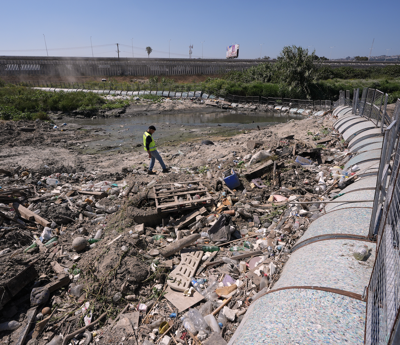


Oscar Romo walks among debris that has been captured by a trash boom installed in the Tijuana River at the border near where the river enters the United States from Tijuana, Mexico, April 8, 2026, in San Diego, Calif. (AP Photo/Gregory Bull, File)
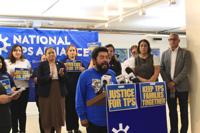
Elected officials and environmental organizations from the United States and Mexico recently came together for a press conference in San Diego to advocate for a conversation regarding the Tijuana River’s ongoing pollution crisis while calling on leaders to include environmental solutions in the discussion surrounding the United States-Mexico-Canada Agreement (USMCA), which replaced the 1994 North American Free Trade Agreement (NAFTA) during Trump's first presidential term.
According to Charles Rilli, the deputy chapter director of the San Diego chapter of the Sierra Club — the main organization pushing for environmental protections — the current trade agreement does have standards for certain penalties for U.S. companies to uphold labor laws, but does not offer the same standard to be applied to environmental regulations, he said in an interview with CALÓ News.
“By looking at the types of issues that really trigger either [both] governments to respond to something, we find that this free trade creates a real path to having forcible environmental standards that would create real accountability for both governments,” Rilli said.
The Tijuana River spans about 120 miles, flowing north through the cities of Tijuana and Tecate in Baja California, Mexico, and eventually crossing the international border into Southern California, where pollutants from factories and communities run off into the Pacific Ocean, impacting San Diego’s South County. These pollutants have led to the closure of local beaches and negative impacts to air quality.
During the press conference, Assemblymember David Alvarez of California’s 80th District said there is clearly an economic benefit from a free trade agreement, but it must not overshadow the environment and communities. The assemblymember said he would soon introduce a resolution that addresses environmental concerns.
“We're here to say, just like our resolution that I'm presenting to the legislature in August, that we must have enforceable, measurable commitments to end transboundary pollution in the Tijuana River Valley and the watershed and real investments in infrastructure as part of any renegotiated USMCA,” Alvarez said.
"As President Trump has indicated that no immediate extension of USMCA should be assumed, negotiators now have a historic opportunity to ensure that any future agreement aligns economic prosperity with environmental responsibility,” a letter signed by organizers to U.S. Trade Representative Ambassador Jamieson Greer states.
According to a White House press release, the United States did not agree to renew the USMCA in its current form because the deal is not sufficiently beneficial for the United States.
On July 20, the Trump administration implemented a 50% tariff on certain goods from Canada. Those tariffs are anticipated to begin on August 19.
Greer is set to travel to Mexico this week to continue bilateral discussions related to the USMCA joint review, where he will touch on steel, aluminum and derivative products, automobiles, economic security, labor, agriculture and electronic payment services.
The trade agreement between the countries conducts about $1.6 trillion in annual goods trade under the agreement, which has also shielded both Canada and Mexico from many of Trump's global tariffs, according to Reuters.




(0) comments
Welcome to the discussion.
Log In
Keep it Clean. Please avoid obscene, vulgar, lewd, racist or sexually-oriented language.
PLEASE TURN OFF YOUR CAPS LOCK.
Don't Threaten. Threats of harming another person will not be tolerated.
Be Truthful. Don't knowingly lie about anyone or anything.
Be Nice. No racism, sexism or any sort of -ism that is degrading to another person.
Be Proactive. Use the 'Report' link on each comment to let us know of abusive posts.
Share with Us. We'd love to hear eyewitness accounts, the history behind an article.