





Under U.S. immigration law, minors entering the country alone are granted certain protections, but legal representation is not one of them. Photo by Larm Rmah
Funding for Public Counsel, an L.A. law firm that represents approximately 200 children who have come without parents to the U.S., is at stake, thanks to the Trump administration.
On Tuesday, the U.S. Department of the Interior issued a stop-work order to the Acacia Center for Justice, which has a network of 85 organizations nationwide, including Public Counsel.
“ The administration's [decision] demonstrates complete disregard for the well-being of vulnerable children who have survived violence, abuse and trafficking,” said Joel Frost-Tift, senior supervising attorney for the Public Counsel’s Immigrants’ Rights Project’s Unaccompanied Children (UC) team. “Immigrants are five times more likely to succeed in their cases if an attorney represents them.”
The stop-work order has halted Acacia’s entire operation, leaving 26,000 minors without any legal aid. Federal funds support Acacia’s work annually, with approximately $200 million as part of a five-year contract. But now, the funding is at risk.
Frost-Tift told CALÓ News that the approximately 15-person UC team serves children who are or were under the custody of the Office of Refugee Resettlement.
He added that many of these minors had been subjected to further violence while traveling to the U.S. border and while being held by U.S. immigration officials.
Gina Amato Lough, directing attorney of Public Counsel’s Immigrants’ Rights Project, called for the immediate restoration of legal services for unaccompanied immigrant children. “This stop-work order directly jeopardizes our work, as we receive over $1 million annually from Acacia to represent more than 200 vulnerable children each year—some so young they can barely recite their ABCs,” she said. “Now, these children, along with thousands more across the country, face the unimaginable prospect of navigating immigration court alone.”

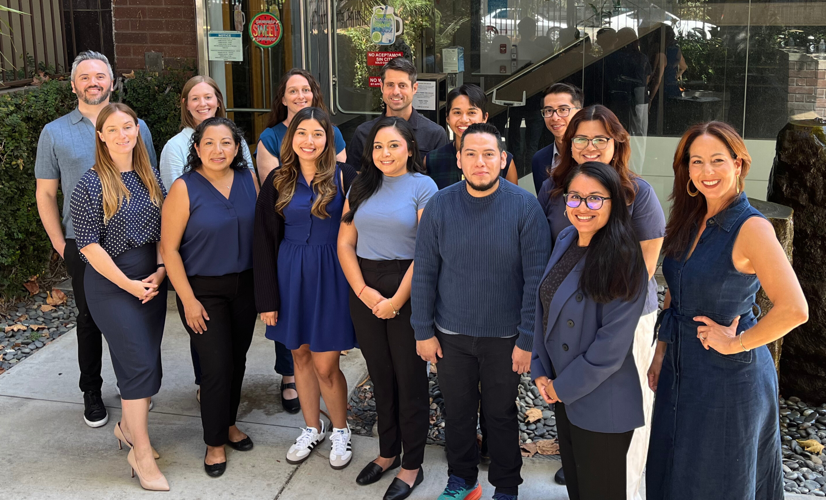
Some of Public Counsel's attorneys. Photo courtesy of Public Counsel.
In the latest string of actions against the undocumented community residing in the United States, the Donald Trump administration issued a stop-work order for programs providing legal aid and immigration representation to unaccompanied migrant children.
As initially reported by the Associated Press, the Interior Department did not explain the stop-work order, outside of telling the Acacia Center for Justice that the halt came from “causes outside of [their] control” and asked that they should not interpret the order as a judgment of poor performance.
In 2018, producer and director Linda Freedman's documentary, "UNACCOMPANIED: Alone in America,"was released. The film documents the real-life obstacles young, unaccompanied children face when they appear alone, without a lawyer, in immigration proceedings. The video features three different underage kids, who are seemingly nervous and all who say they do not know why they are in court and do not know what a lawyer or attorney is.
Frost-Tift has also seen these obstacles play out in real time throughout his time as an attorney. “I've been in court before. I've seen judges hold up the book [on] immigration law, which has over a thousand pages, and then tell young children that unless they plan on reading all that, they should find an attorney to represent them,” he said.
Under U.S. immigration law, minors entering the country alone are granted certain protections, but legal representation is not one of them; therefore, government-provided attorneys are not needed in immigration courts.
According to the National Conference of State Legislatures, in 2019, more than 72,000 unaccompanied undocumented children traveled to the U.S. without a parent or legal guardian and most of them went through the legal process of deportation without a lawyer.
At this point, nonprofit organizations and the federal, state and local governments step in to try to provide these kids with pro bono legal assistance; however, according to the National Conference of State Legislatures, between 75 and 90 percent of kids going through deportation proceedings do so without an attorney.
A big part of legal representation is also helping children with language barriers. Frost-Tift said Trump’s order to halt these services will also negatively impact language equity efforts and prevent children, many of whom do not speak English, from communicating or understanding any legal proceedings. “Immigration law is already complicated and hard to follow; it’s even more complicated when you do not understand the words you’re reading,” he said. “These interpreter services are really crucial for us to be able to communicate with some of those clients who are children.”
Public Counsel’s UC team represents children in immigration court, juvenile court and before the USCIS Asylum Office. They also assist children with filling out and submitting different types of applications and immigration petitions, such as asylum applications. Non-legal needs, including education and health care, are also some of the services the organization looks to help provide for the hundreds of children they represent every year. “ But we're no longer receiving any more funds for any of these cases,” Frost-Tift said.
Frost-Tift said that this decision will be incredibly shattering to children exiting the custody of the Office of Refugee Resettlement (ORR) state-licensed facilities in the next few weeks or months. “Without this funding so many children are going to be forced to navigate the court system on their own and it's going to be devastating,” he said.
Frost-Tift also said images of children seen in front of a judge, alone, representing themselves, could soon be a common reality if the administration's decision is not challenged, something he foresees happening.
”In court, children are asked to have a sponsor that they speak to when they're released from the Office of Refugee Resettlement, and typically the judges will expect the sponsors to come to court with the children,” he said. “But in some cases, the sponsor may not be able to come to court; it might be difficult to get out of work or they may be scared about their own immigration situation. Sometimes children have had difficulty finding an adequate sponsor that can really take care of them, so yes, sometimes children will appear on their own.”
Mary Meg McCarthy, executive director of the National Immigrant Justice Center, called on members of Congress to vocally oppose what she referred to as an “egregious abuse of power by the executive branch."
"The Trump administration continues to choose politics over the rule of law and cruelty over humane treatment of children,” McCarthy said. “This denial of congressionally-appropriated funding violates federal law. Without funding for immigration lawyers, children who arrive in the United States alone will not have access to due process to navigate this country’s punitive and complex immigration system.”








(0) comments
Welcome to the discussion.
Log In
Keep it Clean. Please avoid obscene, vulgar, lewd, racist or sexually-oriented language.
PLEASE TURN OFF YOUR CAPS LOCK.
Don't Threaten. Threats of harming another person will not be tolerated.
Be Truthful. Don't knowingly lie about anyone or anything.
Be Nice. No racism, sexism or any sort of -ism that is degrading to another person.
Be Proactive. Use the 'Report' link on each comment to let us know of abusive posts.
Share with Us. We'd love to hear eyewitness accounts, the history behind an article.