
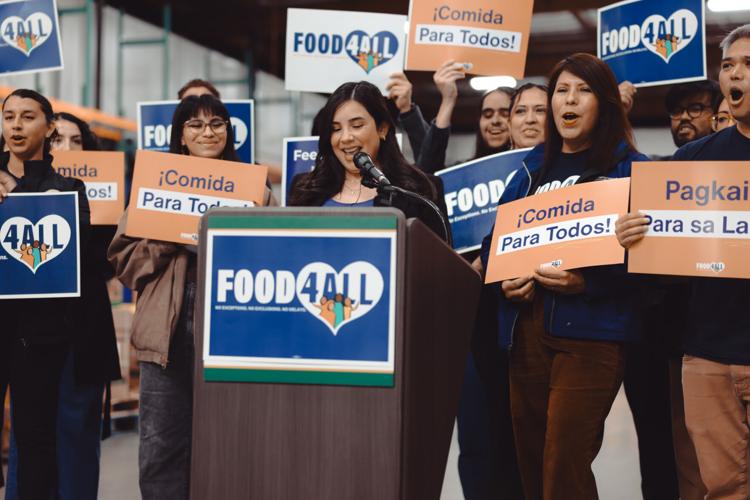


Asm. Celeste Rodriguez, AD 43.
On Thursday, January 29, the Food4All Coalition and State Assemblymember Celeste Rodriguez (D-43) held a press conference to urge Governor Gavin Newsom and the Legislature to adopt a state budget that provides food assistance to all Californians, regardless of immigration status.
Food4All is a diverse coalition of more than 100 anti-hunger, anti-poverty, immigrant rights and grassroots organizations that are working together to bring an equitable food safety net that does not discriminate based on immigration status.
While the Governor’s proposed 2026–2027 budget advances the California Food Assistance Program (CFAP) for income-eligible undocumented individuals ages 55 and older, it leaves younger adults behind and falls short of fully mitigating the damage caused by new Supplemental Nutrition Assistance Program (SNAP) restrictions in the federal budget bill, H.R. 1.
“I am grateful for the continued commitment to expand the California Food Assistance Program. However, the proposed budget does not go far enough. These new and devastating federal restrictions on SNAP will force families to go hungry and let me be clear, we will not accept that,” said Rodriguez. “California cannot and will not stand by while federal decisions pull the rug out from under families who are already struggling.”
Since the Trump administration took office, immigrant communities have been under constant attack. On July 4, 2025, President Trump signed H.R. 1, the One Big Beautiful Bill Act of 2025 (OBBB). The law contained several provisions that affected SNAP, which included changes to its eligibility, benefits and program administration.
The impacts of H.R. 1 will worsen longstanding inequities in access to food assistance for immigrant families in California. Despite being the state’s most effective anti-poverty program, CalFresh remains inaccessible due to the immigration status for nearly 700,000 Californians of all ages.
Speakers at the press conference called for state action to end unjust exclusions and ensure a food safety net for all Californians, regardless of where they were born. “Hunger does not discriminate, and we must do what is right. In these trying times, Los Angeles County
has already stepped up to protect Angelenos from gaps in federal funding that have threatened the safety net our immigrant and working families depend on. This is another opportunity for bold action, strengthened by local and state partners that will uphold our values as Californians,” said Hilda L. Solis, Los Angeles County Board Chair and first district supervisor.
In L.A. County, about 15% of households relied on SNAP benefits in 2023. Imperial County in southeastern California had the highest percentage of households on SNAP benefits with 28%. At 17% , both Los Angeles and San Bernardino counties had higher percentages of households receiving SNAP benefits in 2023 than the national average.
“California has the power to ensure immigrant families don’t go hungry. We must hold Governor Newson and all California legislators accountable so that families can keep food on the table by moving quickly to restore access through CFAP,” said Khiabeth Sanchez, Health Justice Manager at Organizing Rooted in Abolition, Liberation, and Empowerment (ÓRALE).
SNAP often goes to people with the greatest need. According to the United States Department of Agriculture (USDA) report for 2023, SNAP benefits go to households that include a minor child (39%), older adults (42%), or someone with a disability (19%). Nearly 16% percent of SNAP participants identify as Hispanic.

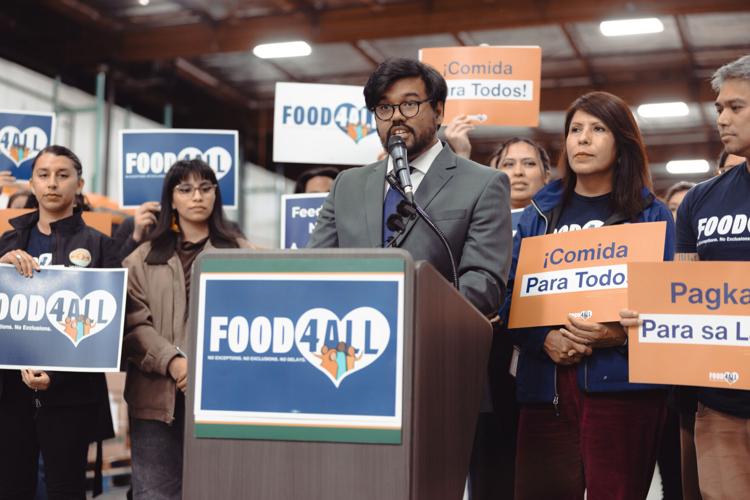
Benyamin Chao, Supervising Public Benefits Policy Manager.
In communities across California, shifting political dynamics and immigration enforcement are reshaping daily life for many Latino families. The Parent Institute for Quality Education’s (PIQE) latest research included focus groups with caregivers from three regions across California, the Bay Area, Central Valley and Los Angeles, documenting how federal immigration enforcement efforts have negatively impacted their lives and the lives of their children. Participants described prolonged periods of self-isolation, avoiding everyday activities such as grocery shopping and recreation, including taking their children to the park. In some cases, caregivers reported keeping their children home from school due to fears of racial targeting and family separation.
Benyamin Chao, supervising health and public benefits policy manager at California Immigrant Policy Center, said at the press conference that people need to start questioning how ICE gets the funding and resources to fuel their operations. “One of those ways is by cutting off federal funding that helps feed California and explicitly restricts access to food for humanitarian immigrants,” he said. “It’s up to each of our elected leaders to stand up for immigrants right now, instead of standing by while the president weaponizes hunger for political gain.”








(0) comments
Welcome to the discussion.
Log In
Keep it Clean. Please avoid obscene, vulgar, lewd, racist or sexually-oriented language.
PLEASE TURN OFF YOUR CAPS LOCK.
Don't Threaten. Threats of harming another person will not be tolerated.
Be Truthful. Don't knowingly lie about anyone or anything.
Be Nice. No racism, sexism or any sort of -ism that is degrading to another person.
Be Proactive. Use the 'Report' link on each comment to let us know of abusive posts.
Share with Us. We'd love to hear eyewitness accounts, the history behind an article.