
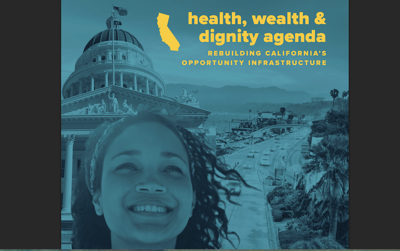

The Health, Wealth & Dignity Agenda was recently released hoping to create a better future for vulnerable communities. (Screenshot)
As California gets ready to elect a new governor, so are organizations that are presenting a new agenda that looks for the best interests of vulnerable communities who are often excluded from political discourse.
Recently, a group of Latino leaders unveiled a comprehensive, coordinated policy agenda to advance a more just, inclusive and prosperous California. The 47-page agenda titled “Health, Wealth & Dignity Agenda; Rebuilding California’s Opportunity Infrastructure” provides a roadmap for elected officials to address the issues facing Latinos across the state. The agenda focuses on three pillars: health, wealth and dignity.
Healthcare is a main concern
Numerous reports indicate that healthcare is a human right and access to healthcare is foundational to creating health and economic stability. However, research also shows that only individuals who can access reliable healthcare are more likely to receive preventive care, manage chronic conditions and maintain consistent participation in the workforce.
Under the current administration, health care is suffering a setback. Just in L.A. County alone, since H.R.1, the so-called “One Big Beautiful Bill,” was passed in 2025, more than 200,000 people have lost their Medi-Cal coverage. One in five of them is a child.
About 3.3 million individuals, or 8.25% of the state’s population, live in mixed-status households with undocumented family members. More than half of the state’s children identify as Latino and have at least one immigrant parent who was born outside of the U.S.
“Immigration status affects access to coverage, economic stability, mental health, family unity, and trust in public systems,” states the agenda.
Dr. Seciah Aquino, executive director of the Latino Coalition for a Healthy California (LCHA), said that centering health is a moral imperative and the foundation of California’s continued economic strength.
“As the fourth largest economy in the world, built in large part by Latino communities who represent 40% of the population and contribute over $1 trillion to our GDP, we must ask ourselves: what more is possible if we fully invest in their health?”he said.
He added that codifying equitable policies like access to health coverage, regardless of immigration status, ensures that care is not subject to political cycles, but a permanent commitment to all communities.
One of the recommendations is a forward-looking health policy agenda that includes an immigration-informed lens across healthcare delivery, coverage expansion and community engagement, ensuring that all Californians, regardless of status, can access the care and services necessary to thrive and begin to rebuild trust between residents and systems of government and care.
Another one is to reinvest in the healthcare infrastructure, including workforce, hospitals, clinics, doctors’ offices, mobile health and telehealth.
“Health systems must meet people where they are—linguistically, culturally and geographically—while closing the coverage and trust gaps that continue to leave many families behind,” states the agenda.
Supporting the agenda at the local level
The Southeast L.A. area (SELA) has seen firsthand how health goes hand in hand with wealth and dignity.
Wilma Franco, executive director of the SELA Collaborative, said this area has been the epicenter of several challenges and crises like COVID-19, lack of resources, immigration raids and other attacks on the communities.
“I think we collectively are feeling the sense that we need to begin to demand more for our communities,” she said. “But as we think about the gubernatorial race, and the shift in power that you know we're all kind of working towards, making sure that the governorial race emphasizes the need and the importance of health, dignity and wellness of the Latino community.”
Wealth and dignity
The participating organizations hope California has an opportunity in wealth by rebuilding infrastructure through sustained investments in workforce development, housing access, and family support systems. It also calls for realigning economic development strategies to create debt-free pathways to high-wage careers and build intergenerational prosperity for every Californian from birth to maturity.
However, for low to middle-income communities, this is not even a question when their priority is just to make it through the end of the month.
“This agenda is about changing that. It’s about making sure people have a real shot at stability, at owning something for themselves, and at retiring with dignity,” said Helen Iris Torres, CEO of Hispanas Organized for Political Equality (HOPE.) “That means opening pathways to good jobs, making higher education work for today’s workforce and ensuring our communities aren’t left out of where the economy is going – especially as technology and AI reshape the future.”
The Dignity pillar establishes dignity as a governing standard, recognizing that California’s long-term stability and prosperity depend on whether all residents can live with safety, security and full participation in civic and economic life, states the agenda.
There are also several programs proposed, including the Golden State Residency Program, expanding access to the ballot through the High Opportunity Voter Accessibility Act, protecting Californians with prior contact with the criminal legal system from discrimination as they rebuild their lives and strengthening the state’s civic and cultural infrastructure through sustained, dedicated funding.
Angelica Salas, executive director of CHIRLA, said the 2026 Agenda provides the next governor with “a bold blueprint to make that promise real in law and in practice, while also providing a roadmap for leaders across the country to protect and advance a collective dignity.”
The coalition has shared the agenda with the candidates for governor.
“We don't want to wait until somebody is in office for us to begin these conversations. These conversations should be had now and should be informing our community, and how we select the next governor,” said Franco.






(0) comments
Welcome to the discussion.
Log In
Keep it Clean. Please avoid obscene, vulgar, lewd, racist or sexually-oriented language.
PLEASE TURN OFF YOUR CAPS LOCK.
Don't Threaten. Threats of harming another person will not be tolerated.
Be Truthful. Don't knowingly lie about anyone or anything.
Be Nice. No racism, sexism or any sort of -ism that is degrading to another person.
Be Proactive. Use the 'Report' link on each comment to let us know of abusive posts.
Share with Us. We'd love to hear eyewitness accounts, the history behind an article.