
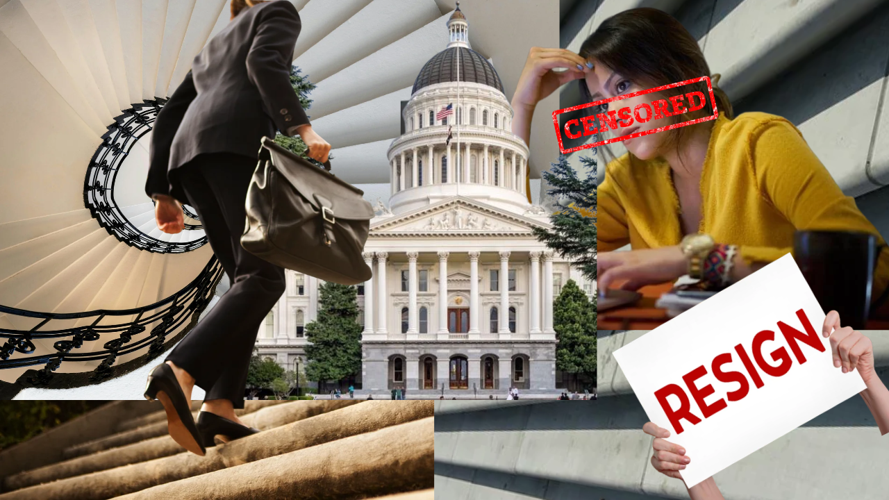


Social media has contributed to the rise in harassment female politicians face. (Canva)
When politicians face scrutiny, experts have observed that men and women are often treated differently in the court of public opinion.
If women are associated with some kind of public relations crisis, even if it's a crisis with a man at the center, they will almost definitely be held to a higher standard than the man, according to Caroline Heldman, a political scientist and department chair of the Gender, Women and Sexuality Studies department at Occidental College in Los Angeles.
Heldman describes it as “weaponized morality.” Cultural norms hold women to a higher standard because the public often perceives women as more “moral” than men. So when a woman and a man are involved in similar scandals, the public shames the woman more than the man.
In the case of California Sen. Sasha Renée Pérez (D-Alhambra), when a Los Angeles-based news outlet reported that a journalist had been fired in part due to his relationship with her, the journalist received support from the community, while the senator received sexist and misogynistic messages. Other news outlets described their brief relationship, which lasted two months from January to March 2026 according to both parties, as “a fling” and “an affair.”
While the public largely sided with Torres, pledging to follow his work and unsubscribe from his former newsroom, Pérez met a very different response.
“Elected officials should expect scrutiny of our decisions and votes, but no one should have to endure aggressive sexual comments, racism and intimidation,” Pérez said in a statement shared exclusively with CALÓ News.
In the article published on Oct. 23, unnamed sources claimed that Sen. Pérez used her relationship with L.A. journalist Memo Torres to edit and guide his political coverage. Both parties have acknowledged their brief relationship, but denied the senator had any hand in Torres’ work.
CALÓ News received access to a message from June indicating an internal review into Torres’ work found no issues.
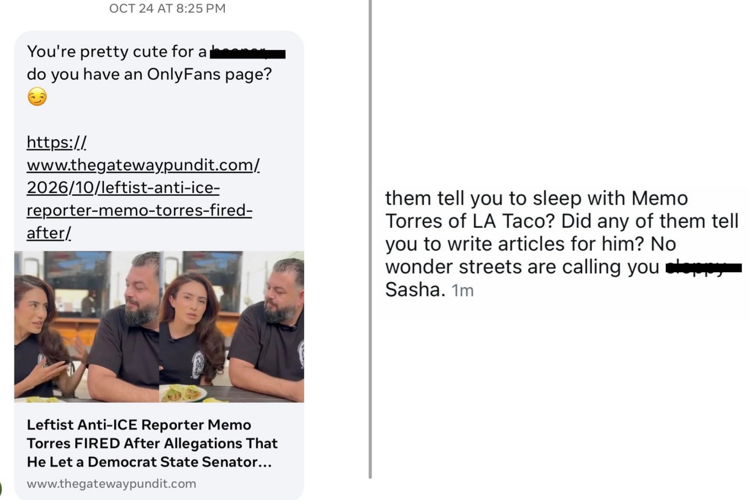
Shortly after the article came out, the senator shared in an Instagram story that she had been receiving “a dramatic increase in sexually explicit comments, messages and emails as a result of sexist and false narratives.”
One of the messages Pérez received referred to her with a sexist nickname and her first name, Sasha, while another message asked the senator if she is on OnlyFans, a platform individuals use to sell explicit photos.
Another individual evoked the name of the late civil rights icon Dolores Huerta, who, just months before she passed away, revealed she was raped and had a child by Cesar Chavez, whom Huerta built the farmworker movement with. Huerta said she chose not to come out with her story earlier, out of fear her experience would discredit the important work of the movement.
“You are just as sloppy as [Huerta],” the comment reads. “You do not represent Latinas… resign.”
“Women in politics are all too familiar with this behavior and how false, sexist accusations attempt to diminish the value of our work,” Pérez said in her statement to CALÓ News. “Accountability matters and so does our right to serve with dignity.”

Sen. Sasha Renée Pérez has received an increased amount of sexually harassing and racist messages in the past month. (Handout)
The role media plays
Traditional media have played a heavy role in the shaming of female politicians who are seen as stepping out of line — but the rise of social media has only made the repercussions higher.
For decades, research has shown that media coverage of female politicians is rooted in sexism, focusing on female politicians’ appearance, their competence and legitimacy, though more recent studies suggest the media is starting to work on eliminating clear gender bias.
“We know that more broadly women in politics face a double standard when it comes to media coverage that then translates into, you know, a significant bias amongst the general public,” said Heldman, who specializes in media, gender and race in American culture.
Society has come to almost expect male leaders to cross an ethical line, making the public reaction less negative when that line is crossed, according to Amanda Clayton, an associate professor of political science at UC Berkeley. When a woman crosses that same line, however, it’s seen as a “violation of expectations,” Clayton said.
Former L.A. Mayor Antonio Villaraigosa was caught having an affair with a Telemundo news anchor and was reelected for another term, while the anchor was suspended, reassigned to another beat and later resigned. In 2007, then-Mayor of San Francisco Gavin Newsom publicly apologized for having an affair with an employee — he was reelected later that same year and his political career has since skyrocketed.
Torres claims the L.A. Material article was an attempt to “tarnish [his] reputation and [Pérez’s] at her expense.”
“This was not an affair or anything malicious,” Torres said in a statement shared with CALÓ News. “And while I appreciate the continued flow of support from the community, I don’t appreciate the sexualization of Sasha by comments and other publications. She… should be treated with the same respect that everyone has treated me.”
In his statement, Torres apologized to Pérez for getting “dragged into this” and called on the news outlets that reported her name to apologize to the senator for the harassment she has received since.
“L.A. Material stands by its reporting,” the outlet said in a statement to CALÓ News.
“In keeping with best journalistic practices, we went to Senator Pérez for comment, which she provided in a statement on the record, and which we included in the piece,” the statement said. “To withhold the name of a public official involved in a newsworthy matter, particularly one who had commented on the record, would be at odds with established norms of journalism and our responsibility to the public.”
As representation grows, so does harassment
Female representation in politics has been steadily growing over the last decade. Ten years ago, only 30 women served in the California State Legislature. For the first time ever, the next legislative session will see gender parity in both the State Assembly and Senate.
As more women have been running for and being elected to office, the amount of targeted harassment they receive seems to have risen as well.
“That's the whole point of misogyny in politics — to try to police the space and keep women out of it, you know, punishing an individual woman, but also making it a chilly space for women to not want to enter,” Clayton said.
California Women’s List, a political action committee dedicated to getting women elected, released a report in 2023 detailing the experiences of over 100 politicians on the campaign trail between 2016-2022. The politicians who identified as female overwhelmingly had more difficult experiences.
Two-thirds of the women reported they experienced targeted sexual harassment during their campaigns, compared to 36% of the male politicians. The prevalence of sexual harassment was even higher for women of color and LGBTQ+ women.
“The advent of social media has made the political environment for women candidates and politicians far more hostile than it was in the past, and it was already pretty hostile,” Heldman said.
Social media’s wider reach gives way to far more direct sexism and targeted harassment, despite platforms’ assurances that they root out that content.
While Meta, for example, has rules against identity-based bias and slurs on its platforms, a 2024 Center for Countering Digital Hate study found that 93% of the time when sexist comments toward female politicians were reported, Instagram kept the comments up.
“To run and to serve as a woman politician today means you know the default is that you're gonna face a steady stream of sexist and gender slurs and attacks online,” Heldman said, adding that this culture has a “chilling effect” on young women who may be deterred from running for office as a direct result of the harassment they see other women receive.
The female respondents in the California Women’s List survey also reported more impacts on their mental health —including excessive anxiety and worry, sleep disturbance and frequent fatigue – compared to their male counterparts.
Where do we go from here?
“If half the population is essentially chilled and discouraged from participating in politics, in our democracy, in the most meaningful way, because of the culmination of all of these millions of online comments in the environment that has normalized, I think we need to see it as a systemic problem, and we need to address it as such,” Heldman said.
The public, media publications and political institutions all have a role to play in addressing targeted harassment in politics, she said.
Social media algorithms are designed to amplify comments and posts that have lots of back-and-forth, so replying and arguing under sexist comments can do more harm than good. Instead, Heldman advises individuals to simply report comments and users who are harassing someone.
Heldman also urges the public to hold publications accountable when stories about women appear to be framed through a misogynistic lens.
For the social media companies, Heldman argues they need “a new business model” that doesn’t monetize arguments. They also need to “enforce the rules that they already have in place against identity-based bias and we know for a fact that they're not doing that,” she said.
Finally, in order to address an issue that affects half of the population, elected officials need to be doing more, Heldman said.
“Political leaders need to be holding these social media companies accountable for the ways in which they are damaging our democracy,” Heldman said. “And one really prominent way is their normalization of sexist attacks against women political leaders.”
Denise Florez contributed to this story.








(0) comments
Welcome to the discussion.
Log In
Keep it Clean. Please avoid obscene, vulgar, lewd, racist or sexually-oriented language.
PLEASE TURN OFF YOUR CAPS LOCK.
Don't Threaten. Threats of harming another person will not be tolerated.
Be Truthful. Don't knowingly lie about anyone or anything.
Be Nice. No racism, sexism or any sort of -ism that is degrading to another person.
Be Proactive. Use the 'Report' link on each comment to let us know of abusive posts.
Share with Us. We'd love to hear eyewitness accounts, the history behind an article.