
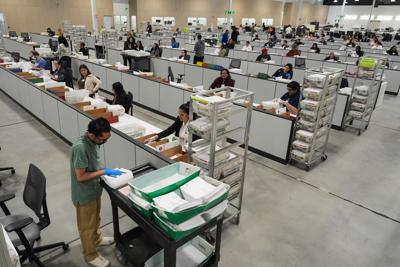

Ballots are inspected the day after California's primary election at the Los Angeles County Ballot Processing Center Wednesday, June 3, 2026, in City of Industry, Calif. (AP Photo/Jae C. Hong)
A federal appeals court dismissed the Trump administration's effort to block around 20,000 California ballots from alleged noncitizens.
The Ninth Circuit Court of Appeals ruled 2-1 on Monday that the Department of Justice (DOJ) improperly went around a lower-court judge that had not yet ruled on the case. In its appeal, the DOJ claimed a decision was needed immediately, as L.A. County has already processed over 331,000 ballots.
“The United States’s claimed emergency, at least in part, is a self-constructed one,” the majority wrote in an unsigned opinion.
Federal Judges Mark Bennett, a Trump appointee, and Gabriel Sanchez, appointed by Biden, ruled that the federal government failed to allow the lower court adequate time to rule on its request to separate and block the 20,000 ballots.
The judges added that “at least part of the delay here is attributable to the United States’s own delay in filing suit.”
Judge Patrick Bumatay, another Trump appointee, dissented, writing “the federal government has a sovereign interest in safeguarding federal elections.”
Bennett wrote in a concurring opinion that “disturbing the established rules could have unintended consequences,” like disenfranchising voters and upending election procedures just one week before Election Day.
California Attorney General Rob Bonta, who at a press conference last week told reporters he believed the Justice Department's case was “weak,” said in a statement that the decision “serves as an important step in our efforts to protect Californians’ right to vote and our state’s authority to run fair and secure elections.”
Gov. Gavin Newsom called the appeals court ruling a “positive development and a welcome speed bump to Trump’s disgusting attacks on the Constitution and our country’s democracy,” and called on Californians to continue voting early.
How we got here
The saga began on July 16, when Department of Homeland Security (DHS) Secretary Markwayne Mullin sent California Secretary of State Shirley Weber a letter claiming his department believed there were over 190,000 registered voters in California who “may be” non-citizens.
Weber’s office requested more information about how DHS had come up with this number. According to Weber, DHS officials refused multiple times to provide any information, and the issue went silent.
On Oct. 13, the DOJ sent California and L.A. County election officials a letter stating that they believed there were 20,000 possible non-citizens registered to vote in the state. The Justice Department gave the state 48 hours to review the list and demanded these ballots be separated and not counted until their citizenship is confirmed.
Weber refused, writing in response that she would not disenfranchise voters based on the Trump administration’s “unsupported and likely inaccurate ‘belief’.”
Two days later, the DOJ filed a lawsuit in the Central District of California, seeking emergency relief and later a temporary restraining order, claiming the state demonstrated “a total lack of commitment to work with the federal government to protect the integrity of our elections.”
Judge David O. Carter, a Clinton appointee, scheduled a hearing for Oct. 27.
On Oct. 21, after finding out L.A. County had already received and processed over 331,000 ballots, the DOJ asked Carter to rule on the case by noon the next day.
When Carter didn’t, the DOJ took the extraordinary step of going straight to a federal appeals court and asking them to step in.
The court dismissed the appeal, writing the DOJ had not given Carter enough time to reach a decision.
Carter is set to hear oral arguments in the case Tuesday afternoon. He is expected to rule on the case following arguments.
Who are these alleged “non-citizens?”
Monica Flores, the assistant registrar-recorder for the Candidate and Voter Services Bureau of the L.A. County Registrar-Recorder/County Clerk, wrote in a sworn statement that the majority of the 20,000 targeted voters are not associated with L.A. County addresses.
Flores reported practical concerns over the feasibility of meeting the DOJ’s demands, as well as concerns that even if the county could meet those demands, it would be violating California election laws.
Despite this, Registrar staff did review a sample of 200 names on the DOJ’s list that had L.A. County addresses.
This review shows the government’s October list is “unreliable,” according to Flores.
Of the 200 names, 112 are not actively registered to vote and thus did not receive a mail-in ballot. Nearly 39% of the individuals reported being born in the United States, and 71% have no voting history.













(0) comments
Welcome to the discussion.
Log In
Keep it Clean. Please avoid obscene, vulgar, lewd, racist or sexually-oriented language.
PLEASE TURN OFF YOUR CAPS LOCK.
Don't Threaten. Threats of harming another person will not be tolerated.
Be Truthful. Don't knowingly lie about anyone or anything.
Be Nice. No racism, sexism or any sort of -ism that is degrading to another person.
Be Proactive. Use the 'Report' link on each comment to let us know of abusive posts.
Share with Us. We'd love to hear eyewitness accounts, the history behind an article.