
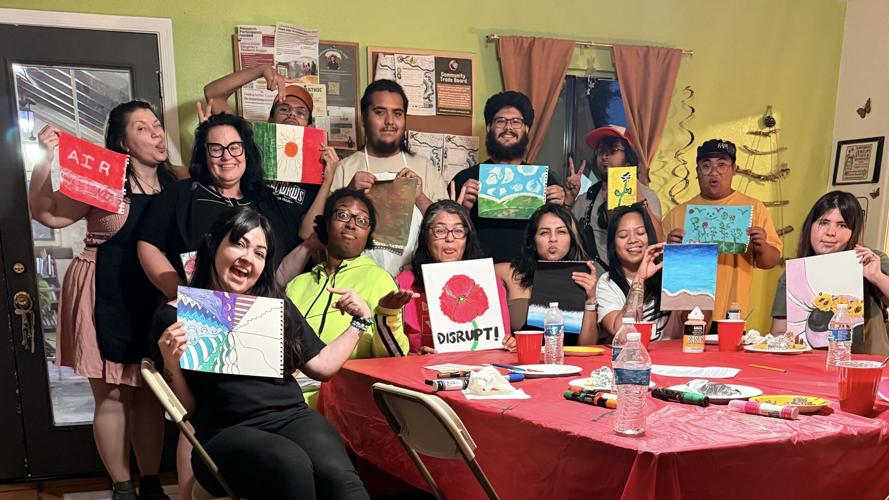

Members of Fuerte Arts Movement’s Express Yourself: Maker’s Collective hold up their work at Andria’s Tienda in Phoenix on May 27, 2026. (Image courtesy of Alma Camarillo/Fuerte Arts Movement)
Xenia Orona and Dominique Medina had spent years as creatives working in Arizona’s immigrant rights spaces. But the more they noticed how deeply art was woven into social movements across the country, the more one question nagged at them: Why wasn’t there more of that in Phoenix?
And when they raised that same question with a colleague, he asked why they didn’t start something themselves.
“And we said, ‘okay, bet,’” Orona said.
That conversation made way for Fuerte Arts Movement, founded in 2019, a Phoenix-based nonprofit that mobilizes civic action via artistic movements and cultural performances.
Ahead of the Nov. 3 election, the Phoenix group is using concerts, zines, community murals and musicians to get people to the polls, betting that art can reach voters in ways that sometimes a two-minute conversation with a canvasser can’t.
Orona, co-founder and executive director of Fuerte, said they wanted to tap into the creative talents of people already working in social justice movements and build something that would “serve a larger community of folks who are looking for that creative outlet in their social justice work.”
“It’s not uncommon to find a former theater kid, or a band geek, or somebody who actually plays in a rock band, or folks who have all sorts of talents,” she said.
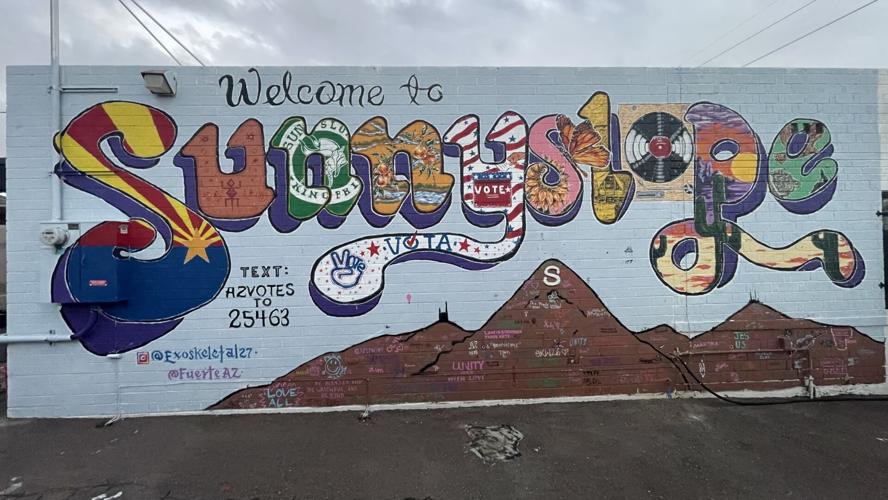
Earlier this month, the group held an unveiling for a “Welcome to Sunnyslope” mural by Moreno Valley, California, artist Jesus Castañeda. The artwork is located on the side of Vinyl Grounds, a vinyl shop at 46 W. Hatcher Rd.
The mural delivers a reminder to vote message and each letter holds a piece of the neighborhood’s story, from the Arizona flag and desert sunsets to Indigenous irrigation canals and the tuberculosis camps that helped give rise to Sunnyslope. Castañeda said he chose those images after talking with locals and reading about the area’s history.
He invited the community to engage with the making of the mural, including having neighbors fill a painted Sunnyslope Mountain with words about what the community means to them.
“It’s not like it’s just me and this… famous artist came and did this thing,” he said. “It’s like, ‘oh, we all did it.’”
That idea runs through Fuerte’s other work. The group has produced zines to act as informational pieces. It also runs community art groups that are open to the public, including the Express Yourself: Maker’s Collective for crafters and visual artists and the Song Action Collective for poets and musicians.
Orona said art can reach people in ways a quick conversation at the door can’t, tapping into emotions and memories.
“Everybody has that song that… when it comes on the radio, they remember a specific time in their life,” she said. Art, she added, “has a quicker impact, a deeper impact.”
Researchers are still working to measure that kind of impact. Stephen Duncombe, a New York University professor of media and culture who co-founded the Center for Artistic Activism, has worked with artists on grassroots voting campaigns, including in Arizona. He said whether art moves people more effectively than conventional outreach is “the most under-researched part of artistic activism.”

Jesus Castañeda’s “Welcome to Sunnyslope” mural on the side of Vinyl Grounds (46 W. Hatcher Rd.) includes reminders to vote in English and Spanish. Neighbors filled the painted mountain below with messages about what the community means to them. (Image courtesy of Jesus Castañeda)
“It’s not an either-or proposition,” he said. “Deep canvassing is going to work for some people, and it demonstrably does work for some people. And artistic approaches are going to work for other people.”
Where art may have an edge, Duncombe said, is with people who don’t think of themselves as political, the ones who would cross the street to avoid a protest but stop to see what an artist is doing. He described a group his center worked with that set up something resembling a circus, drawing in passersby before asking about their plans to vote.
“All of a sudden, you’re kind of sucked into this thing that you didn’t think was about politics,” he said.
Fuerte’s Tardeada y Taquiza, a free Vote Early Day concert, takes a similar approach. It runs from 5 to 8 p.m. Oct. 24 at Palma Park, 1135 E. Dunlap Ave., with live music, a photo booth and free food for the first 100 attendees. Orona said the goal is to give people “a joyful experience” with voting.
The key, Duncombe said, is turning that moment into action, such as helping people make a plan to vote before they leave an event.
“How do you translate that affect into effect?” he said. “And that’s the key thing that artists often leave out, and it’s where activists partnering with artists can be really helpful.”
Orona said Fuerte tracks its impact in several ways, from the “very quantitative,” such as how many people click on or comment on its content online, to the more personal.
At one documentary screening, she said, attendees described how the film reminded them of their own lives. She also watches for people who come to one event and keep coming back, sometimes becoming what she calls “our super volunteer.”
“The one that’s most impactful to me is just seeing folks continue to engage with us,” she said, “and also to tell us, this spoke to me.”
Voting, Duncombe said, is one of the easier outcomes to measure. Groups can follow up with attendees to ask whether they voted, invite them to share “I Voted” sticker photos or partner with student researchers to survey people who stop at, or walk past, a piece of public art.
Orona described Fuerte as nonpartisan, though she said the group engages with candidates who share its values. According to its website, the group centers the perspectives of Arizona women of color and LGBTQ+ people, but Orona said its work is open to anyone who wants “a brighter future for the Black-Brown working class.”
She said apathy, fear and hopelessness are some of the biggest obstacles keeping people from the polls this year. Her advice to anyone who feels stuck is to start small.
“Just pick one thing,” she said. The key, she added, is remembering why: “I’m either doing this to build a better life for myself, or I’m doing this to build a better life for somebody who matters to me a lot.”
Jamie Montoya is a Phoenix-based journalist and writer covering community, culture and accountability. She earned a master’s degree in investigative journalism from Arizona State University’s Walter Cronkite School of Journalism and Mass Communication and has a background in investigative reporting and private investigation. Her work focuses on the people, communities and systems shaping Arizona.







(0) comments
Welcome to the discussion.
Log In
Keep it Clean. Please avoid obscene, vulgar, lewd, racist or sexually-oriented language.
PLEASE TURN OFF YOUR CAPS LOCK.
Don't Threaten. Threats of harming another person will not be tolerated.
Be Truthful. Don't knowingly lie about anyone or anything.
Be Nice. No racism, sexism or any sort of -ism that is degrading to another person.
Be Proactive. Use the 'Report' link on each comment to let us know of abusive posts.
Share with Us. We'd love to hear eyewitness accounts, the history behind an article.