
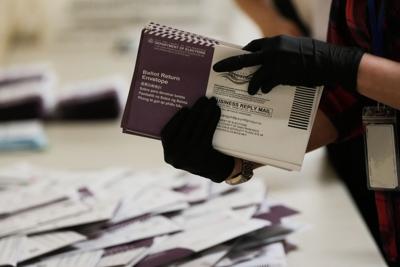


Department of Elections workers sort mail-in ballots for the California primary election at City Hall on Tuesday, June 2, 2026, in San Francisco. (AP Photo/Jeff Chiu)
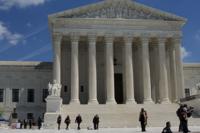
The U.S. Supreme Court on Monday ruled against the Trump administration's plan to limit mail-in voting ahead of this year’s midterm election. The controversial plan would have upended both how voters receive mail-in ballots and how states administer elections.
Last month, the court cleared the way for the administration to begin implementing a March executive order that would create a federal registry of all eligible voters in the country. The second part of the order, which would direct the U.S. Postal Service (USPS) to deliver mail-in ballots only to those federally recognized voters, is what was rejected on Monday.
In a to-the-point three-sentence explanation, Justice Ketanji Brown Jackson wrote that the executive order is “unlikely to succeed on the merits of its challenge.” Conservative justices Samuel Alito and Clarence Thomas dissented.
The court cleared the way in late August for the Trump administration to begin restricting mail-in voting, but left the door open to future litigation.
California Gov. Gavin Newsom quickly confirmed California would sue to stop the rest of the executive order from taking effect just months ahead of midterm elections.
“Today is a good day for democracy, the rule of law and the American people looking to exercise their Constitutional right to vote,” Newsom said in a statement on Monday.
California Attorney General Rob Bonta said the decision is “a victory for our democracy and a powerful affirmation of the rule of law.” California was joined by 25 other states in suing to block the USPS changes.
Attorney General Todd Blanche said on Tuesday that the administration will comply with the court ruling.
Trump rebuked the court — specifically conservative justices Brett Kavanaugh, Neil Gorsuch and Amy Coney Barrett — who agreed with the majority opinion, writing on Truth Social that the three are “merely a shell of their original selves.”
Trump has falsely claimed for years that mail-in voting leads to fraud, often using the idea to falsely claim he won the 2020 election. Voting fraud is extremely rare and there has never been reliable proof provided of widespread fraud in 2020, including from the Trump administration.
Kavanaugh wrote a concurrence to Jackson’s decision explaining “state and local election officials do not have sufficient time to reasonably implement the rule before the elections.”
With less than two months before the Nov. 3 midterm, a change to USPS’ delivery of mail-in ballots would have “upend[ed] mail voting programs upon which tens of millions of voters rely,” California’s August lawsuit reads.
Under the executive order, USPS would have had sweeping authority to control which voters received mail-in ballots, based on whether their names appear on USPS-approved lists, as well as change election administration procedures.
“Now, we can finally move forward and get back to what we do best: conducting our elections without a dark cloud hanging over us — fairly, openly, for the people, by the people. No questions asked," California Secretary of State Shirley Weber said in a statement.
The SCOTUS decision came the same day California Sen. Alex Padilla disclosed that he had received a whistleblower report that details “serious allegations of illegal and inappropriate activities” within the Department of Homeland Security (DHS) related to an operation aimed at finding voter fraud.
According to the report, DHS and U.S. Citizenship and Immigration Services (USCIS) leadership pressured staff within the Fraud Detection and National Security Directorate (FDNS) to misrepresent themselves on all 50 states’ voter registration websites to access private voter data, violating state laws.
The report claims hundreds of FDNS personnel were pulled off their typical work on Aug. 21 to watch one training video and on Aug. 25 were directed to hunt for “unlawful voters.”
Once they accessed the voter data, staff were instructed to investigate whether individuals were “unlawful voters” based on unreliable information and immigration history, the whistleblower reported. Staff then created federal records against these voters which are maintained by immigration enforcement and “carry significant downstream impacts on individuals.”
According to the disclosure, U.S. citizens have had these records created against them.
“This sudden surge indicates that the Department’s top priority is now manufacturing evidence for election conspiracy theories, rather than FDNS’s fraud detection and national security mission,” reads Padilla’s letter to DHS Secretary Markwayne Mullin and USCIS Director Joseph Edlow.














(0) comments
Welcome to the discussion.
Log In
Keep it Clean. Please avoid obscene, vulgar, lewd, racist or sexually-oriented language.
PLEASE TURN OFF YOUR CAPS LOCK.
Don't Threaten. Threats of harming another person will not be tolerated.
Be Truthful. Don't knowingly lie about anyone or anything.
Be Nice. No racism, sexism or any sort of -ism that is degrading to another person.
Be Proactive. Use the 'Report' link on each comment to let us know of abusive posts.
Share with Us. We'd love to hear eyewitness accounts, the history behind an article.