
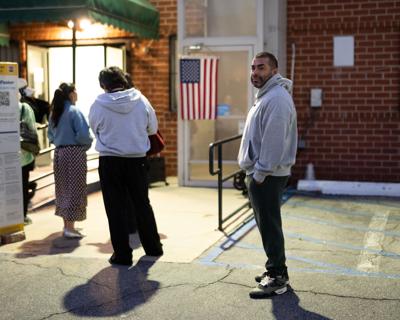


Job Garcia waits in line to vote on Election Day in the parking lot of the New Presbyterian Church in East Hollywood. (Photo by Jeremy Lindenfeld)
This article was produced by Capital & Main. It is published here with permission.
Last June, Job Garcia — a U.S. citizen — was tackled to the ground by federal immigration agents while he was filming an ICE raid at a Home Depot in Hollywood. Yesterday, Garcia cast his ballot for the midterm elections at a church less than two miles from where he was arrested, overcoming his fears that ICE agents might show up at the polls.
“I’ve been looking forward to this day since what happened to me last year,” said Garcia, 38, who was detained for 25 hours after being arrested last summer. “While there isn’t an ICE policy directly on the ballot … It’s a very intentional vote that I’m making to hopefully shift the power over to individuals that are going to help make those changes [to immigration policy] possible.”
The issue of immigration loomed large over last week’s elections in Los Angeles — the county with the largest population of foreign-born residents in the country and ground zero for the Trump administration’s ICE crackdown last year.
Capital & Main spoke to more than 30 voters at eight polling places in neighborhoods across L.A. County that were hard hit by the immigration crackdown. Some expressed frustration with the cost of living, others were motivated to come to the polls by Proposition 40, a ballot measure aimed at taxing the state’s wealthiest residents, and still others said the hotly contested Los Angeles mayor’s race brought them out to vote.
But most voters interviewed mentioned their opposition to President Donald Trump’s immigration crackdown as an energizing concern this election season. Some, like Garcia, came out to vote in person in spite of fears that they would encounter ICE agents when they got there.
When Garcia arrived at his polling place in East Hollywood after work Tuesday, he was struck by how few voters were lined up compared to what he remembered of previous elections, and was concerned that the Trump administration’s attempts at voter intimidation may have depressed turnout. In the weeks leading up to the election, the administration stepped up immigration enforcement activity across California and launched a sweeping campaign to find evidence of noncitizen voting.
But those aggressive tactics may have backfired. Early voting surged in the state. Turnout in L.A. County for Tuesday’s election outpaced levels reached during the last midterms in 2022, according to the voter data firm Political Data Inc., with some of the biggest increases in areas with large immigrant populations.
In the southeast L.A. County city of Bell, where more than 40% of residents are foreign-born, turnout more than doubled, jumping from 16% in 2022 to 33%. A more than doubling of turnout also occurred in Paramount, a city with a sizable Latino immigrant population that was the site of a large militarized presence during last year’s ICE surge. Ballots are still being counted.
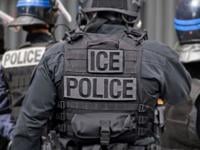
While there were no verified reports of ICE agents at L.A. voting centers on Tuesday, voters in immigrant communities had reasons to be concerned leading up to Election Day. Trump had refused to rule out deploying ICE agents at polling sites last May, and administration officials had given mixed messages as to whether there would be a federal law enforcement presence at polls. In late October, Department of Homeland Security officials said ICE would not be targeting polling places.
Enrique Velázquez, an organizing director at Proyecto Pastoral, a social justice nonprofit in Boyle Heights, wasn’t taking any chances.
Early Tuesday morning, before polls had even opened, he huddled with volunteers to prepare for a full day of monitoring ICE activity. Later that morning, the group spread out to three polling stations in Boyle Heights, a heavily Latino neighborhood where ICE reportedly detained a man on Oct. 31, to monitor any ICE activity.
“Remember, we are not there to intervene, just to watch,” Velázquez told the volunteers. “But we will play a different role if la migra shows up — then we’ll activate the rapid response.”
Velázquez said the past few days had been quiet, but when he arrived at his monitoring post in front of the East Los Angeles YMCA, he almost immediately received a message about potential ICE activity just a few blocks away. That alert ended up being a false alarm, but the group remained prepared to report any ICE activity to community members and election workers.
Maria Beltran, who was working at a polling site in Panorama City in the San Fernando Valley and has been a poll worker in L.A. County for over a decade, said this year was the first time she had been equipped with the number of a hotline to call if ICE agents showed up to voting centers.
At a voting center in Boyle Heights, 73-year-old Samuel Galván said he was relieved not to see any armed officers at Tenrikyo Church, but pointed to the Trump administration’s lawsuit preemptively challenging a Democratic victory in Alaska’s Senate race as evidence that the federal government was still “trying to suppress our vote.”
In California, weeks before the election, the Justice Department sued state and L.A. County officials, attempting to set aside 20,000 of the state’s ballots that the administration claimed may belong to noncitizens. The effort was rejected by a federal judge, the Ninth Circuit Court of Appeals and the U.S. Supreme Court. Trump said Tuesday night that he would accept the results of the midterm election, which resulted in the Democrats taking back both the House and Senate, helped in part by large leftward swings among Latino voters in states like Texas and Florida.
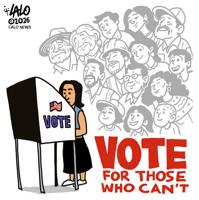
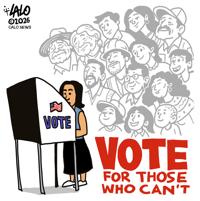
In Panorama City, one of the neighborhoods hardest hit by ICE raids last year, Crystal Brito, 34, was motivated to vote for the first time after seeing the impacts of immigration enforcement in the neighborhood. “I want to make a difference for the people that can’t vote — uncles, aunts, families,” Brito said.
Olga Blanco, 18, had her undocumented family members on her mind when she cast her first ever ballot yesterday. So did Alexa Vasquez, 25, who was worried about her relatives who had curtailed their hours working as street vendors in response to reports last month of the 45-day ICE operation across California.
“There’s people who I know and grew up with who have been deported,” Vasquez said. “It’s made it that much more important to come out and vote.”
In the San Fernando Valley neighborhood of Van Nuys, Fernando Vasquez, a 55-year-old firefighter, has seen firsthand the impacts of ICE activity in the area, as he’s been called to treat both immigrants and agents who need medical care. But unlike many of the voters Capital & Main interviewed, he supports the Trump administration’s immigration crackdown and he said he hoped for a “Red Wave” this election.
“They’re taking care of business. ICE is doing their job,” Vasquez said.
That wasn’t the view of Angus Johnson, a 26-year-old who was arrested and sentenced to 14 days in prison for spitting at federal officers during anti-ICE protests last summer. After his arrest, Johnson said he became disillusioned about the effectiveness of electoral politics, but he ultimately came around to the idea of voting.
“Nothing has ever been perfect in this country, and it’s nice to hold onto the hope that life will get better,” Johnson said. “I can’t hope for that if I’m not at least doing the one easy little thing I can do to make any sort of difference at all.”
Garcia had just left his East Hollywood polling place when he heard news of the overwhelming Democratic victories in Senate, House and governor’s races across the country. The rebuke of the Trump administration was somewhat cathartic for Garcia, but he resisted joining in the jubilant chorus of left-leaning voices online.
“We’ve been in this boat before. It happened during the midterms in his first administration,” Garcia said, adding that “everyone celebrated” when Democrats won a big majority in the House of Representatives in 2018 only to see Trump win the presidency again in 2024.
“I’m hoping [ICE violence] will continue to be at the forefront of people’s minds. I’m hoping that there’s a momentum that will prevent us from getting into a position where this is normal.”
Jessica Goodheart contributed to this report.
Reia Li is a California Local News Fellow.











(0) comments
Welcome to the discussion.
Log In
Keep it Clean. Please avoid obscene, vulgar, lewd, racist or sexually-oriented language.
PLEASE TURN OFF YOUR CAPS LOCK.
Don't Threaten. Threats of harming another person will not be tolerated.
Be Truthful. Don't knowingly lie about anyone or anything.
Be Nice. No racism, sexism or any sort of -ism that is degrading to another person.
Be Proactive. Use the 'Report' link on each comment to let us know of abusive posts.
Share with Us. We'd love to hear eyewitness accounts, the history behind an article.