
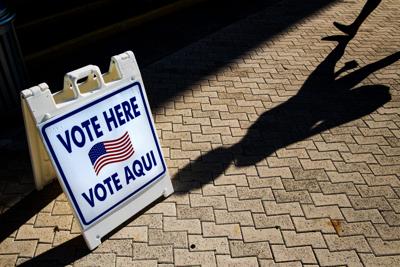


Bloomberg Creative/Getty Images.
This article was produced by Capital & Main. It is published here with permission.
An estimated 36 millionLatino adults are eligible to vote in the upcoming midterm elections. In the 2024 election, Democrats were shocked to see those voters, especially men, choose Donald Trump by the highest margins Latino voters had given a Republican in decades (Trump won an outright majority of Latino men, but Kamala Harris still edged him in Latino women). As Nov. 3 draws near, those same voters are once again an object of bipartisan fascination, speculation and organizing.
“The old days of, you know, 75-25 split with Hispanics, Latinos to the Democrats? Those days are gone,” said Mike Madrid, former longtime Republican political strategist and campaign manager who is now an Independent. “That chapter in Latino and American political history has closed. And I think a lot of Democrats are having a lot of trouble coming to terms with that.”
U.S. Latinos numbered 68 million as of 2024, according to the Census Bureau, making up about 20% of the population. Madrid said that the two big parties’ long-held fantasies of a cohesive Latino vote based on ethnic affinity — like the ones forged between Black voters and the Democrats, or White evangelical Christians and the Republicans — look less realistic than they did even a few years ago.
It might be more accurate to talk about “the Latino votes,” rather than strain for a unitary definition of voters with different family histories, economic and regional interests. Pollsters, consultants and politicians seem to be getting it, slowly. There are certainly commonalities among Americans with roots in Mexico, Puerto Rico, El Salvador and Venezuela. But there is also parochialism, particularity and power at play.
Trump’s overperformance among Latino voters in 2024 saw state Republican parties getting ready for nothing less than a generational realignment in American politics. As the 2026 races entered their final weeks, not only has that realignment turned out to be a fantasy, but Latino backlash is making a number of House and Senate races closer than expected.
Latino voters, writ large, have soured on President Trump, and on Republicans. They are unhappy about the failed promise of an economic turnaround, and the severity of immigration enforcement. Polling shows a nearly 20-point decline in Latino support for the president and his party since the 2024 elections — the speed and ferocity of which is unusual in modern politics. Support for Trump among Latinos has declined from 45%-48% at the ballot box in 2024, to 42% net unfavorable in September 2026 polling, with only 27% of Latinos approving. Those numbers don’t look good for the GOP, which is already bracing for big losses in the midterms. By October, just 26% of Hispanic respondents told Reuters/Ipsos pollsters they planned to vote Republican. But those whiplashing levels of support also mean the Latinos and their views are more relevant than ever and, at least in the views of political strategists, still up for grabs as candidates from both parties fight to gain or hold onto power.
The future Madrid had long promised — or threatened — for the two big parties, of a growing Latino vote across the country with no permanent party loyalty, has arrived. He is feeling vindicated. “With America’s largest minority voting 50-50, how can you say that being a minority makes you a Democrat? Like, you can’t credibly say that. Because it’s not true.”
After decades as a Republican operative, Madrid no longer recognized his party as President Trump, the real estate developer and TV star, tightened his grip on the GOP. Madrid said he now sees “swingy,” courtable, Latino voters as “the only rational voters in a representative system” because they will not loyally award their votes to parties that lie to them, whether it’s Democrats about the economy during the Biden years, or Republicans about the blunt force social trauma of immigration enforcement in Trump 2.0.
“Shooting people in the face and hunting people down is not immigration policy. That’s government overreach. Racial profiling is not immigration policy, it’s government overreach,” Madrid said. “And that is what is moving the needle broadly.”
In recent national polling, an overwhelming majority of Latinos reached the conclusion that the country is on “the wrong track,” like voters in the wider electorate. But they got there earlier than other Americans, and stayed there.
When BSPResearch, a political polling and consulting firm, asked Latino voters nationwide to name the most pressing issues as they made their choices for the midterms, the top three they named were the cost of living and inflation, immigration and deportations, and jobs and wages.
* * *
In closely watched South Texas counties, especially along the Rio Grande Valley, more people turned out to vote in the Democratic primary earlier this year than voted for Kamala Harris in the 2024 general election. It is a potent signal of enthusiasm and urgency to have primary numbers exceed general election turnout. Latinos vote at lower rates than other Americans. They usually turn out in lower numbers in midterm years than in presidential years, and usually vote in primaries at even lower rates. State Rep. James Talarico won the Democratic nomination for the U.S. Senate with strong support in Texas’ Latino-majority counties. Overwhelming support from those same voters in September is contributing to Talarico’s polling lead over Texas Attorney General Ken Paxton in the general election.
At the same time Democrats are trying to lure Latinos “back home” in more rural, more conservative border communities, the party must also come to terms with the upwelling of support for the Democratic Socialists of America, whose candidates have won key primaries from the Los Angeles mayor’s race to two New York City congressional seats and Florida’s U.S. Senate race. Once upon a time, Rep. Adriano Espaillat’s insurgent campaign signaled the arrival of Dominican-American voters as a political force in New York. In 2016, Espaillat won the seat vacated by the retiring Rep. Charles Rangel, who served almost half a century in Congress. In 2026, it was Espaillat’s turn to be the “old guard,” challenged, and defeated in the Democratic primary, by DSA challenger Darializa Avila Chevalier, 40 years his junior. At the same time, a 2025 survey from Pew Research found the “socialist” label heavily unpopular among Latinos.
In Florida, retired Lt. Col. Alexander Vindman led in U.S. Senate primary polls through the spring and into the summer, but was trounced by a lightly funded DSA-endorsed state representative from Jacksonville, Angie Nixon, who is facing incumbent Sen. Ashley Moody in November’s special election to fill now-Secretary of State Marco Rubio’s unfinished term. In the primary, Nixon won heavily Latino South Florida counties like Miami-Dade and Broward, and midstate Osceola and Polk by even larger majorities.
However, Matt Barreto, UCLA political scientist and president of the polling and research firm BSP Research, said he understands the appeal of the DSA in a political moment when economic issues stand head and shoulders above the rest among younger and Latino voters.
“They’re good at saying, ‘This isn’t working for you. Child care is too expensive. Why not make child care free? Why should you pay a penalty to have kids? You should be able to work, and contribute to the economy, while not going broke trying to put your kids into day care,’” he said. “Those are sensible arguments for working class communities, and I think that’s what people are wanting to hear right now.”
Ronnie Lucero, congressional liaison of the Republican National Hispanic Assembly, a 60-year-old national organization of Latino conservatives, said there has been “a slight dip” in Latino support for the Trump presidency, but nothing like what pollsters are reporting. His home state of New Mexico has competitive congressional races though Democrats dominate. Lucero hopes the upward pressure on prices caused by expensive oil will ease with an end to the fighting with Iran. He said President Trump successfully shut down the heavy flow of migrants across the country’s southern border, something voters applaud in his border state of New Mexico.
Bettina Rodriguez, a Republican Cuban-American and the former vice mayor of Doral, Florida, said she is not worried about November. The Trump administration, and the Republican Party more broadly, have good news for Latino voters. “From where I sit, the mood among Cuban-American and broader Hispanic Republicans here is more confident than the national narrative usually allows for,” she said.
When it comes to the two issues that matter most to the community — the economy and border security — she said voters and elected officials tell her they feel the Trump administration’s “promises on those fronts have been kept more than broken.”
* * *
Latino polling data over decades shows immigration is rarely one of the top issues driving voting intentions. So-called kitchen table issues — consumer prices, interest rates, the cost of housing, access to medical care, the quality of public schooling — have long outranked immigration in urgency in almost every region, with almost every national group.
Now, the Trump administration’s emphasis on aggressive enforcement, widespread suspension of legal right to remain and the violent physical tactics used to carry out apprehensions has pushed immigration higher in relevance. The administration’s transformation of Immigration and Customs Enforcement, and Customs and Border Protection, into large, heavily funded national police forces, with the support of Republicans in Congress, has altered the way Latinos regard immigration as an issue.
The 10 largest Latino populations in metropolitan America live in the same large, economically dynamic metros where there are large numbers of undocumented people. Many Latino voters have seen federal immigration agents deployed on their streets, know people who have been questioned or picked up, have relatives in the system trying to “get legal” and have watched violent confrontations on local news and social media.
Other Americans might assume an almost automatic interest in immigration as a political issue among Latino voters. But Latino voters, especially from families generations removed from immigrant journeys, heavily supported efforts to pacify and harden the U.S.-Mexico border. In the face of ICE deployment in American cities, the images of masked, armed men making arrests outside of schools, car washes, job sites and street corners have pushed approval numbers down among Latinos.
* * *
Martha Arias sat in a conference room in downtown Miami and poured out her frustrations. An immigration attorney for 20 years, and an immigrant from Colombia herself, Arias has watched as the federal government has turned an already difficult, arbitrary and expensive system into something that inches closer to the Kafkaesque. She described judges who seem to be working with the government’s attorneys, clients held incommunicado, offices mishandling documents and the use of a missing page to declare that a late submission starts the process over, requiring repayment of fees or using that as a pretext for an arrest.
“Children are now homeschooled because the parents don’t want to take them to school, because they don’t have a driver’s license. Or they’re afraid, and they do have a driver license,” Arias said. “They’re afraid of leaving their children alone if they get detained while driving.”
Arias endorses grit and the immigrant work ethic. She describes herself as hostile to the extremes of left and right, and said Latin Americans who come to the U.S. have seen both and know what they are like. What she mourns now is the loss of what she called “social solidarity.”
“That’s why this country thrived. It’s very low now, though,” she said.
Veteran labor leader and now Democratic National Committee vice chair Artie Blanco would endorse that message. Asked before a meeting of Miami-Dade Latino Democrats how she summed up the party’s pitch in the coming weeks, she answered with a question of her own.
“Why can’t we bring back humanity to what we do to govern ourselves, as a country, and as a government?” After all, she added, “We all want the same things”: prosperity, the ability to raise a family, and “a society that we feel comfortable in.”
The challenge for Blanco is that Latino distaste for the Trump administration is not necessarily turning into enthusiasm for the Democratic Party. A UnidosUS poll earlier this year found that even amidst rising anger at Republicans, only 28% of Latino voters said they had a “very favorable” opinion of congressional Democrats. A slim majority said they would support a Democrat in the midterms, with a fifth still undecided. So far in 2026, in special elections Democrats have flipped seats in heavily Republican districts and beaten Trump-endorsed candidates. Madrid thinks that’s a sign of disapproval of Republicans, not a new appreciation for Democratic policies among Latinos.
“If the economy were good, would we be seeing these numbers, these low numbers for Trump, amongst Latinos? No, we wouldn’t.”
Beatriz Lopez of Voto Latino, a voting rights advocacy group, is fully aware of the economic strain Latinos face nationwide. But she does not see the economy as an issue. Instead, she talked about voter suppression, economic distress and immigration enforcement as one super-issue, interconnected and overlapping. She spoke of the challenges of the family table and the threatened ICE units at polling places in almost the same breath.
“The message we’re trying to deliver to our Latino voters, our electorate, is that you are not alone. The community has your back,” Lopez said.
In September, the last states finished their primaries and finalized the head-to-head contests around the country. Gas prices remained high, 30-year mortgage rates topped 7%, the Iran War continued, ICE patrols rounded up noncitizens and in a disturbing number of cases, citizens and legal residents. The drivers of Latino discontent remained in place, even as the president’s approval rating continued to sink.
Pollsters are predicting a strong move by Latino voters away from the GOP high water mark in 2024. But they insist that for Democrats, wiping out Trump’s 2024 gains should not be seen as any kind of homecoming, but rather, just a temporary reprieve.
This story was co-published and supported by the journalism nonprofit the Economic Hardship Reporting Project.





















(0) comments
Welcome to the discussion.
Log In
Keep it Clean. Please avoid obscene, vulgar, lewd, racist or sexually-oriented language.
PLEASE TURN OFF YOUR CAPS LOCK.
Don't Threaten. Threats of harming another person will not be tolerated.
Be Truthful. Don't knowingly lie about anyone or anything.
Be Nice. No racism, sexism or any sort of -ism that is degrading to another person.
Be Proactive. Use the 'Report' link on each comment to let us know of abusive posts.
Share with Us. We'd love to hear eyewitness accounts, the history behind an article.