
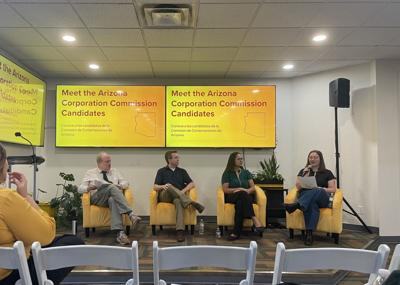

Event moderator Reagan Priest (right) asks Arizona Corporation Commission candidates Clara Pratte, Jonathon Hill and Mike Cease about utility rates, data centers and renewable energy, among other topics, during a candidate Q&A on Oct. 2, 2026, in Phoenix, Ariz. (River Graziano/CALÓ News)
On Friday evening, Arizona Corporation Commission (ACC) candidates Jonathon Hill, Clara Pratte and Mike Cease met with voters and addressed concerns ranging from utility rates and data centers to renewable energy — environmental and economic issues top of mind for voters heading into the Nov. 3 midterm election.
Awareness of the ACC and its responsibilities has grown amid affordability concerns across the state. The commission’s jurisdiction includes proposed utility rate increases, data center energy subsidies and energy source regulation. With two of the ACC’s five seats up for election in November, voters can choose up to two candidates in that section of their ballot.
The Oct. 2 “Meet the Arizona Corporation Commission Candidates” event was hosted by a coalition of local organizations, including Vote Solar, Solar United Neighbors, Poder Latinx and Mi Familia en Accion. Before candidates took the stage, organizers emphasized the importance of voting in down-ballot races and where to find the ACC candidates on the ballot.
The event was held at the BBB ignite Innovations and Events Hub in Phoenix. Organizers also invited candidates Kevin Thompson and Ralph Heap, but they did not attend.
Rising energy costs and data centers
The candidates were first asked how they planned to balance reliable utility services with rate-increase concerns. Major utility companies Tucson Electric Power and Arizona Public Service are requesting rate increases — 13% and 14%, respectively. The commission is set to vote on these cases before year's end.
“A lot of the current commissioners present this as a false choice between reliability and affordability. That's simply not true,” Hill said. “We can and should have both of those things.”
According to Cease, the ACC should halt utility rate increases until companies are held accountable for failing to transition to renewable energy.
“My definition of fair and just and reasonable is not 8% [rate increase], followed by another 8%, followed by another 16%. That's unsustainable, and that's what the utility companies have been doing,” Pratte said.
On the topic of rising energy costs, candidates were asked whether the ACC is doing enough to prevent data center growth from affecting resident utility rates.
“Data centers are wholly unfit to operate in this state,” Cease said. “They waste what I characterize as gargantuan amounts of water, our precious water resources…I do realize that commissioners are not empowered to legislate, but the Arizona Corporation Commission does have oversight capability.”
Pratte praised the ACC’s recent approval of a process that would protect rural energy customers from cost changes associated with large-load businesses, but emphasized the continued need to protect smaller communities from other data center-related issues like water and noise pollution.
“[Data centers] are coming full steam at our municipalities that are wholly underprepared to really think through a lot of the biggest issues,” Pratte said. “It's not that they're not sophisticated…but it's coming so fast, they don't really have time or expertise to wade through all of the issues around data centers.”
The candidates were asked about their stance on formula rate structures, and under what circumstances they would vote for one. All three candidates said they would refuse formula rates in any circumstance.
“They say it's gonna help with regulatory lag, that they've got so much backlog of these rate cases, and if they just went to formula rates, we wouldn't see these [rate] jumps that happen quickly… if we're trying to solve for that problem, there are other ways to do it: showing up to your hearings, and doing them on a regular basis,” Pratte said.
“The commission has been the source of a lot of really bad ideas over the last couple decades. This has got to take the cake,” Hill said. “Why do we have a commission if they're not actually gonna fulfill their constitutional role and actually serve as guardians, as consumer advocates for Arizonans?”
Arizona embracing renewable energy
On whether to urge utility companies to prioritize renewable energy sources, Pratte said a lack of a traditional market structure puts greater responsibility on the ACC to motivate change.
“These are monopolies, right? Unless you incentivize them [with] external pressures, they're not going to do this on their own, and we have seen no further and stronger evidence of that than what has recently happened with the rollbacks of the renewable energy standards,” Pratte said.
According to Hill, utility companies should not only be incentivized to include more renewable sources, but should be required to. Cease echoed the point in his own response.
“[Utility companies] are passing on, to the consumers, the cost of fossil fuel energy dependency, which is not just an Arizona problem, that's a nationwide problem,” Cease said.
Candidates were also asked how virtual power plants, which link residential energy sources like rooftop solar panels and home batteries to the larger grid, should be included in Arizona’s energy future and what role the ACC should play in overseeing them.
“There isn't a reality where we wake up tomorrow and go, ‘oh, we didn't need as much energy as we thought’. It's only going to increase. So why are we not investing in things that'll help to take the pressure off the grid?” Pratte said.
Hill agreed that distributed power generation is advantageous, but said that the net metering rate is no longer high enough to offset the upfront cost of installing solar.
“By slowly eroding these payback rates, [the ACC] have gone beyond just disincentivizing — they've almost kneecapped the home solar industry in Arizona,” Hill said.
The importance of voice and vote
The candidates were asked about the current accessibility of the public comment process and what changes they intend to make as commissioner.
Hill recounted attending an APS rate hearing with Pratte, where ratepayers from across the state came to speak to the ACC. According to Hill, none of the commissioners were physically present.
“Some of [the speakers] were people choosing between energy and medication, people choosing between having lights on in their house versus their medical care — these are terrible choices that are being forced on people, and the very least the commission could do would be to show up and actually interact with the people,” Hill said.
During her response, Pratte said that commissioners who review the records after a hearing are missing out on critical public input.
“When you talk to the commissioners and they say, ‘Well, we listen, we hear the evidentiary record’, what they're telling you is that none of those public comments are part of that record. They are ignoring it if they're not sitting there hearing it,” Pratte said.
In an interview with CALÓ News, Hill elaborated on his extensive background in spacecraft engineering and geology. According to him, while geologists are brought in to testify before the ACC if their decision might affect resources like groundwater, their expertise is often ignored.
“[Groundwater] is such a vital resource, especially now that we've lost Colorado River water allotment,” Hill said. “We're gonna be relying on groundwater even more, but we have to make sure we manage it really carefully… it's not going to recharge in our lifetimes.”
Pratte is a member of the Navajo Nation and grew up in rural Arizona. In an interview with CALÓ News, she emphasized that rural voters deserve representation in the ACC, especially as some communities still lack critical energy infrastructure.
“I had one rural mayor say, ‘I would love to have a data center, not because I think they're the best thing in the world, but because I know they [would] have to build transmission to get to that data center and me, and finally, I can get power to these areas that don’t have it,’” Pratte said.
Both spoke on the importance of getting to know the candidates and the very real consequences ACC commissioners’ votes had on everyday Arizonans.
“I do realize [the ACC] is kind of unknown, and it's kind of a complicated office, but I really think it's in everyone's best interest to be very educated about the candidates for this office, what it does, and what the candidates will do once they're in office,” Hill said.
“I think [voters] should look at their utility bill, and they should think about what it cost two years ago versus what it costs now,” Pratte said. “A lot of people will shake their fist at the utility company. ‘They're raising my prices again.’ Yes, but... who allows them to do that?”
Voters in Arizona must be registered by Oct. 5 to vote in the Nov. 3 election. Early voting ballots are scheduled to be sent on Oct. 7 and should be mailed back by Oct. 27.
River Graziano is a freelance journalist for CALÓ News. They grew up in the Ahwatukee area of Phoenix and later attended ASU in Tempe, where they spent two years as an editor at The State Press. Their reporting with CALÓ News covers advocacy efforts impacting Latine communities across the Valley.









(0) comments
Welcome to the discussion.
Log In
Keep it Clean. Please avoid obscene, vulgar, lewd, racist or sexually-oriented language.
PLEASE TURN OFF YOUR CAPS LOCK.
Don't Threaten. Threats of harming another person will not be tolerated.
Be Truthful. Don't knowingly lie about anyone or anything.
Be Nice. No racism, sexism or any sort of -ism that is degrading to another person.
Be Proactive. Use the 'Report' link on each comment to let us know of abusive posts.
Share with Us. We'd love to hear eyewitness accounts, the history behind an article.