
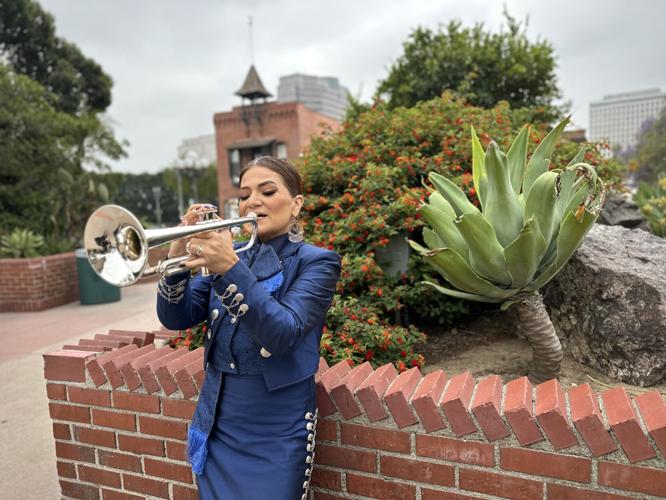

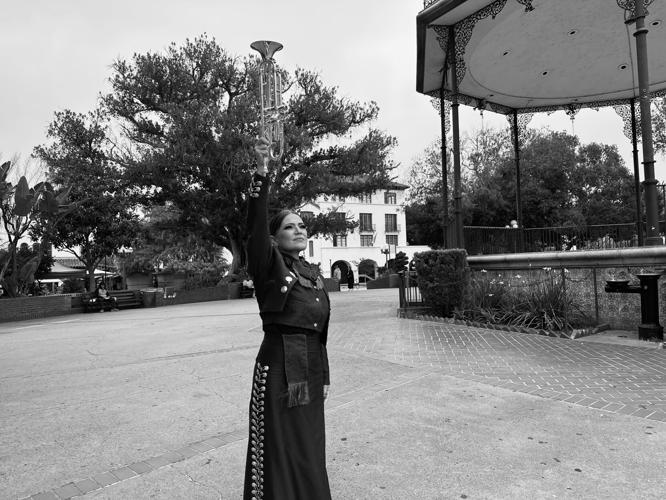


Maricela Martinez, who comes from a long-standing family of musicians from Jalisco, Mexico. Photo by Brenda Verano
For Mariachi Lindas Mexicanas, music has always been more than just a performance; it has been a living testimony that mariachi music can also be a space for resistance and visibility, especially in times of anti-immigration sentiments and lingering patriarchal practices within one of the most male-dominated industries.
The all-female group was founded by Maricela Martinez, who comes from a long-standing family of musicians from Jalisco, Mexico.
Martinez, who has been a member of mariachis on both sides of the Mexico-U.S. border, says that although she has always been aware of the gender inequalities within the mariachi world, she has never given up on making a living out of playing music and it was that exact passion that pushed her to launch Mariachi Lindas Mexicanas in 2007.
Last week, CALÒ News interviewed Martinez in Placita Olvera, the very same spot where almost 20 years ago Mariachis Lindas Mexicanas took the stage for the first time.
“I remember it like it was yesterday,” she said. “It was during the Día de los Muertos night here in Placita Olvera.”
Although Martinez had been on numerous stages before that day, this was the first time she was taking a leap of faith with an all-women's group founded by her, most importantly in the U.S.
Today, they have collaborated with artists like Snoop Dogg, John Legend, Cuco, Snow Tha Product and Natael Cano, among others, as well as played on stages like that of the Latin Grammys and even met former President Joe Biden. Despite all that, the success journey has not been easy.
Martinez still gets emotional thinking about it.
“My entire life was based on immigration, not only to the U.S. but also inside Mexico,” she said.
Before making a living out of mariachi music in Los Angeles, Martinez crossed the U.S.-Mexico border various times, sometimes alone and other times with her family.
While growing up, her father was a musician, part of mariachi ensembles in Mexico. “We would travel city to city,” she said. “He taught me everything I know now, how to play, the business side of being a mariachi, how to talk to people, everything, but we were constantly on the move.”
At age six, the move was bigger. Her father immigrated to the U.S., and Martinez, along with her siblings and mother, joined him just months later.
That was the first time she crossed the border, or attempted to.
“It was a very, very cold night in the desert. I remember a señoroffering my mom a blanket for my two siblings and me. I will never forget that man. He saved our lives that night,” she said. “Not long after that, [Border Patrol] found us and surrounded us as they held and pointed their rifles at us."
Martinez said they were held in custody and released two days later. “My father wanted us to return to Guadalajara, where we were leaving, but my mother wanted all of us to be together, so we tried again," she said.
The second time, Martinez successfully crossed the border in a car. Her siblings and mother followed. She remembers Boyle Heights as the first place where her family lived together in the U.S., as her father would book gigs in Mariachi Plaza.
“We were here for a while, but it did not last long. My parents were always working and their lives had changed so much. This has not been the life they had envisioned, so we went back to Mexico,” she said.
They landed in Juárez, Chihuahua, a place that became her second home. She lived there from the time she was eight until she was 16 years old.
It was also when Martinez began to take music more seriously and began joining mariachi groups or accompanying her father to gigs.
At age 18 she was already leading her own mariachi group, made up of twelve women, but as they were being booked for more events, she also started to feel the need for more resources that she did not have and was not able to afford for herself or for her group mates.
"We would ride around in the back of a small truck with our trajes and sit on the floor so we could all fit. I realized that I needed a bigger truck and that I wanted better trajes for my girls and me, and that's when I thought, ‘OK, to work I go.’ It's the feeling of wanting to persevere, to make life better for you and your loved ones," she said.

Today, Mariachi Lindas Mexicanas continues to perform for weddings, birthdays, Mother's Day, or any other special occasion. Photo by Brenda Verano
She came to the U.S. again, but this time with a visa.
“I remember being on that plane from Tijuana and feeling like my life was going to change, and in fact it did—when I got here, it was an impact, a culture shock, it was my age and even trying to join groups here was hard.”
But she stayed to make enough money to get a car.
“I stayed to chase the so-called American dream,” she said. “Which now I realize is not ever a dream; it's not something magical, it's not a gift. It's not a pot of gold that you find at the end of the rainbow. We make that dream ourselves, it's hard work and dedication.”
Through the years, she was part of well-established all-female mariachi groups such as Mariachi Reina de Los Ángeles and Mariachi Mujer 2000. She would also occasionally book gigs with her dad.
“I love my dad and I respect and learned a lot from the marichis that I was part of, who had men and women, but I always felt more comfortable around women,” Martinez said.
She said it was multiple incidents that made her realize she needed to create her own safe and dignified space for women mariachis.
“We had to look skinny and pretty. There were times when I remember getting told things that did not sit right with me, like being recommended a specific cream for my acne, because I was told it would not look good on stage. Or turning people away because they were mothers and they were afraid that they would not look good or be less available,” she said. “It was very controlling and patriarchal.”
In places like L.A., women working full-time earn about 81 to 88 cents for every dollar men earn and the disparity becomes significantly more severe for Latinas and Black women. Martinez said the uncontrolled gender pay gap is also a reality in the mariachi industry.
“I started noticing that in some groups, after our gig, it was us women who would get paid less than the men,” she said. “I would say something because sometimes I was the lead singer and was also playing the trumpet. It was not fair.”
It was then that she, along with some of her colleagues, formed Mariachi Lindas Mexicanas, a mariachi group made up of mothers, students, community organizers, attorneys and other professionals.
“ It was a dream come true to create a safe space where I could be myself, where I could be a woman. Where we, as women, could say what we want and decide who and who not to work with,” she said. “Today, we are a group of strong, resilient, amazing, intelligent and prepared women and all of us share this passion to bring music to our people here in L.A. They asked me what the most amazing place that we have performed in is and although we have gone to big stages, my most cherished places are in the homes and backyards of our people.”
Martinez and Mariachi Lindas Mexicanas have also bridged the gap between music and social justice. She said she used her music to speak out publicly in favor of human rights. In L.A., Mariachi Lindas Mexicanas sometimes makes appearances at anti-immigration marches like those that erupted in L.A. last June in response to increased and sometimes violent federal immigration enforcement.
More recently, they also participated in the No Kings March and the 2026 May Day March, where they played their music as they walked down the street in protest for immigration rights.
“It's personal for me. I know that wearing this traje means something; it means culture, it means unity, and of course, it’s political because mariachi music is not solely entertainment. It's important for me and for my group to use our voices not only to sing beautifully but also for things that matter to us," she said.
Last month, during her Coachella performance, Karol G performed alongside Mariachi Reyna de Los Ángeles.
Controversy arose after fans accused the group of having MAGA political affiliations. The accusations alleged that Teresa Hernándes, the wife of the group founder, José Hernández, was the president of a prominent conservative donor organization tied to the Trump administration.
Despite Hernández denouncing the accusations, Martinez said that when she was briefly part of Mariachi Reyna de Los Ángeles, she had heard rumors of the husband and wife having Republican Party viewpoints.
When she saw the allegations, Martinez said she felt embarrassed and cried but also had the urge to speak out against the idea of mariachis not being political.
“When I saw the news, I was embarrassed, upset and sad,” she said. “It's not congruent to make your living off mariachi music and be against our people. They do not represent the authentic mariachi singers and musicians.”
Today, Mariachi Lindas Mexicanas continues to perform for weddings, birthdays, Mother's Day, or any other special occasion.
“It is our people that keep us employed and give us steady jobs, but it is hard,” Martinez said. “Sometimes people think we are going to overcharge because we have worked with artists or have gone to places, but that is not the case. This is our community.”
In the future, Martinez wants to create an organization that could support mariachis who are stepping into the U.S. or L.A. scene for the first time. “When I came to the U.S., I wish I had had somewhere to go to help me do my taxes, know about rental assistance, or simply have a space to practice their songs and learn music."
Martinez became a U.S. citizen years ago. She met her husband while playing at an event and now has three kids, all gifts that she says music and hard work helped her attain.
“Sometimes when things get tough, I just want to leave everything behind, take my family and go to Mexico and never look back. But then I remember that this is also my home. I sometimes question if this is all worth fighting for, and yes, of course it is.”








(0) comments
Welcome to the discussion.
Log In
Keep it Clean. Please avoid obscene, vulgar, lewd, racist or sexually-oriented language.
PLEASE TURN OFF YOUR CAPS LOCK.
Don't Threaten. Threats of harming another person will not be tolerated.
Be Truthful. Don't knowingly lie about anyone or anything.
Be Nice. No racism, sexism or any sort of -ism that is degrading to another person.
Be Proactive. Use the 'Report' link on each comment to let us know of abusive posts.
Share with Us. We'd love to hear eyewitness accounts, the history behind an article.