

This story was originally published by EdSource. Sign up for their daily newsletter.
Top Takeaways
- A new law makes it easier to enroll in calculus without prerequisites. Many instructors opposed it.
- Worried that students won’t be ready for calculus, colleges offer prep courses combining algebra and trigonometry material in one semester.
- The new courses are offered on a trial basis through 2027, but so far seem popular with students.
Ari Marchesso planned to spend this academic year at Pasadena City College getting a refresher on precalculus skills.
The second-year student took trigonometry in 2020 at Blair High School and felt “too foggy” on the material to jump straight into calculus, a course needed to transfer as a biology major to a four-year university.
Marchesso’s plan was to enroll in college algebra this semester and trigonometry in the spring — until learning from a counselor that those courses are no longer offered at Pasadena City College for science, technology, engineering and math majors who plan to take calculus. That’s the result of a new, controversial and complicated state law that took effect this fall and limits the number of calculus prerequisites colleges can offer to those students.
Most importantly for students, it has led to the creation of a type of preparatory class that condenses up to three semesters of old sections into one. Across the state, upward of 60 colleges planned to offer new, truncated calculus preparation courses on a trial basis as they comply with Assembly Bill 1705, the law that took effect this fall.
Marchesso is now one of some 200 students enrolled in Pasadena’s version, Math 004Z. It combines topics from algebra and trigonometry, with the college marketing the class as one that provides students with the material that is “essential for success” in first-semester calculus.
Marchesso has had mostly a positive experience in the class, calling it a “needed reminder” on trigonometry topics and adding, “It’s been great for me to learn and get mentally prepared for calculus. And it saves me an extra semester.”
The intent of Assembly Bill 1705, signed into law in 2022, was to prevent students in STEM programs from getting stuck in long math course sequences and potentially never even getting to the calculus class they need. The law allows them to skip the prerequisites and instead enroll directly in calculus, sometimes with a simultaneous extra 1- or 2-unit support class with tutoring, regardless of their background in math.
Pasadena City and other campuses still offer traditional precalculus courses for students who don’t plan to take calculus but want a strong foundation in math.
The law has been highly controversial among math instructors and can be difficult to understand. Many instructors have been worried that students will not be prepared for calculus by abandoning the traditional, longer ladder of preparation courses. The Faculty Association of California Community Colleges, an advocacy group, campaigned against the bill, arguing that it would result in higher failure rates for students in calculus.
Under pressure from faculty, the chancellor’s office for the state’s community colleges backed off somewhat from immediate and strict implementation. Last year it announced that colleges, for now, could continue to offer up to two semesters of calculus prerequisites for STEM majors who didn’t pass courses like Algebra II or trigonometry in high school.
Separately, colleges were also permitted to develop the new, so-called innovative preparatory courses and offer them to any STEM majors on an optional basis before they take calculus.
The classes are being offered on a temporary basis. The new courses and any traditional prerequisites will be reviewed in 2027. Colleges will need to prove that students who take those prerequisites are getting to and passing calculus at rates comparable to similar students who start in calculus.
Some backers of AB 1705 say the new courses are not consistent with the law. They contend that all STEM majors, regardless of their background in math, are better off enrolling directly in calculus and say that even one semester-long preparatory course is problematic.
“The issue is the attrition and that these preparatory courses essentially act as barriers to students getting to calculus and getting on the STEM pathway,” said Jetaun Stevens, an attorney with the civil rights law firm Public Advocates, which advocated for the bill.
Math faculty, though, see the new courses as very important. The classes give students the chance to receive a foundation in math before enrolling in calculus, without dragging out that process over multiple semesters, they emphasize.
“We want to make sure they’re getting that depth of knowledge,” said Corrine Kirkbride, an associate professor of mathematics at Pasadena City and the college’s AB 1705 implementation coordinator. “The whole focus of the course was what students need in first-semester calculus.”
It’s too soon to tell what impact the classes will have on STEM majors and their success in calculus. The state plans to evaluate the courses on a case-by-case basis in 2027. At that point, the state chancellor’s office will either allow the community colleges to continue offering the classes or require them to begin enrolling STEM majors directly into calculus.
The new course at Pasadena City is divided into “three big topics,” said Joshua Robles, who teaches four sections of the class. The first third is focused on algebra concepts, such as exponents and factoring. Another third is dedicated to trigonometry. The final third is something of an introduction to calculus, where students are shown calculus word problems.
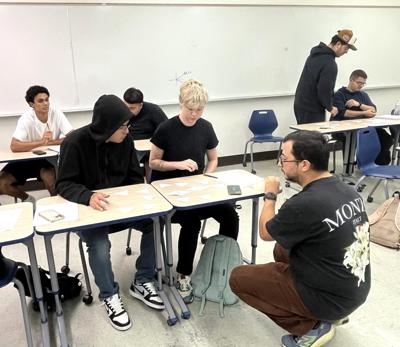
On a recent Tuesday morning in one of Robles’ sections in Pasadena City College’s Robbins Building, students did exercises with the unit circle, a key part of trigonometry. The class of about 20 students broke into groups of two or three and, working at their desks, were tasked with finding sine, cosine and tangent values of various angles within the circle.
The lesson was an easy one for Charly Tapia, who plans to transfer to California State University, Northridge. He said he still remembers much of what he learned in high school more than two years ago, even though he hadn’t taken any math classes since then.
At times, he questions whether it was right to enroll in the preparatory course, rather than going directly to calculus. “Sometimes I feel like I already know this,” he said. He added, however, that he believes much of the material is helpful to relearn, and he is mostly glad he enrolled.
At Modesto Junior College in the Central Valley, a new preparation course similarly combines trigonometry and algebra, but it is offered as a six-unit class with six hours of instruction per week, whereas the course at Pasadena is three units.
“It is a heavy course load. Six units for a class is a lot,” said Angelica Cortes, a math instructor at Modesto. “But our view was that we’d rather them get the precalculus before going into calculus than go cold turkey into calculus.”
Interest in the new classes so far appears to be high. Modesto offered five sections of its class and Pasadena offered eight sections. At both campuses, all sections were full or nearly full, according to faculty.
Math professors, however, are worried that their excitement over the new classes will be short-lived, fearing that the state will bar them from offering them beyond 2027 after it analyzes the courses.
In response to an interview request for this story, the state chancellor’s office referred EdSource to Mallory Newell, a project director for the RP Group, a research center affiliated with the state’s community college system. The RP Group has partnered with the system’s chancellor’s office to help implement AB 1705.
Newell suggested that it’s possible the chancellor’s office could relax the standards on how the new classes will be evaluated, but added that it’s “hard to say” whether that will happen since it’s part of a legislative mandate.
“I can tell you the colleges are really excited about their innovative prep courses,” she said. “But then also there are some that are hesitant because they don’t know if it’s going to meet the standards of the law in two years, and they’re putting in all this work.”







(0) comments
Welcome to the discussion.
Log In
Keep it Clean. Please avoid obscene, vulgar, lewd, racist or sexually-oriented language.
PLEASE TURN OFF YOUR CAPS LOCK.
Don't Threaten. Threats of harming another person will not be tolerated.
Be Truthful. Don't knowingly lie about anyone or anything.
Be Nice. No racism, sexism or any sort of -ism that is degrading to another person.
Be Proactive. Use the 'Report' link on each comment to let us know of abusive posts.
Share with Us. We'd love to hear eyewitness accounts, the history behind an article.