
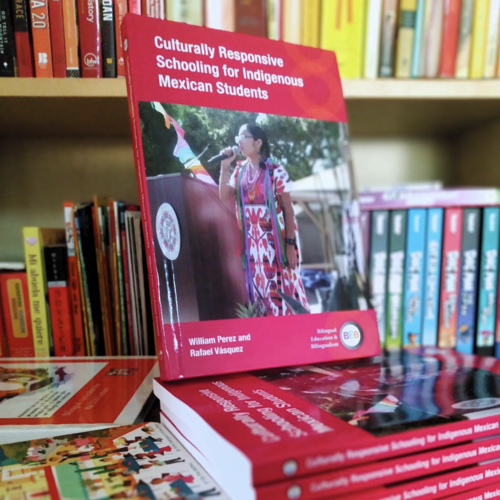
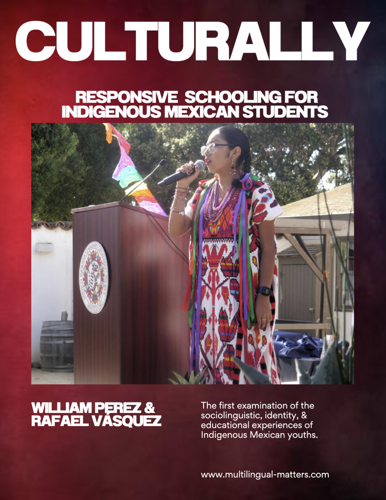


The book “Culturally Responsive Schooling for Indigenous Mexican Students” addresses anti-Indigenous attitudes in schools nationwide and in the state of California. Photo courtesy of Rafael Vásquez
For years, William Perez and Rafael Vásquez have been researching how well California schools recognize students who speak Indigenous languages such as Mixtec and Zapotec, who are often categorized as Latino or Hispanic.
Today, California is home to the largest concentration of Indigenous Mexicans, with an estimated 170,000 to 350,000 residents who have been born or are descended from distinct Indigenous communities, spanning various ethnic and linguistic groups.
Despite the thousands of Indigenous Mexicans with deep ancestral ties and rich social, cultural and linguistic practices, they face many institutionalized and systemic forms of discrimination and suppression, especially, and many times originating in school.
This is the thesis behind Perez and Vásquez's almost two decades of research and their recently published book “Culturally Responsive Schooling for Indigenous Mexican Students.”
Perez and Vásquez said that according to their research, when educators and educational institutions fail to actively affirm Indigenous identities, they risk reproducing ethnic and racial ideologies that cause real harm among young people.
“Academic success and cultural identity don't have to be competing or at odds with each other," Vásquez told CALÓ News. “If students feel they are valued and seen and feel they belong, that can create a stronger foundation for learning.”
Perez said the earliest example of structural practices grounded in anti-Indigenous attitudes is the language placement and proficiency tests given in K-12 education to determine a student's language level as an English language learner.
“When students don't do well on the language placement test, it's often assumed that they don't speak English or Spanish well enough and that's why they don't do well. It never occurs, even to people who have been trained and prepared to work with multilingual students, that many do not do well on these tests because their first language is an Indigenous language,” Perez said.

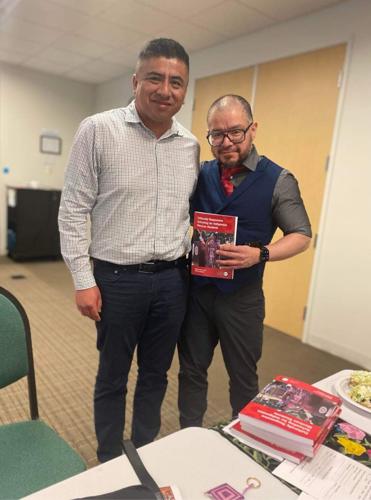
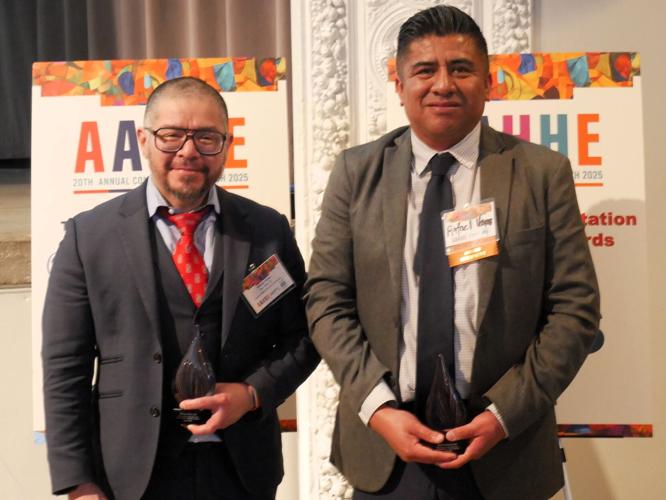
William Perez (left) and Rafael Vásquez (right) have been researching how well California schools recognize students who speak Indigenous languages for nearly two decades. Photo courtesy of Rafael Vásquez
Perez, a professor at Loyola Marymount University and Vásquez, a chief behavioral scientist at the Los Angeles County Department of Public Health and vice president of the board of directors for the California Mixteco Indigena Community Organizing Project, have both centered their research on multilingualism, the experiences of undocumented Indigenous Latino youth in higher education, as well as the importance of academic diversity and social justice frameworks for Indigenous students of California.
Hundreds of copies of their book were purchased by the Los Angeles Unified School District (LAUSD) earlier this summer.
LAUSD, the second-largest school district in the United States, purchased 600 copies of the book, which, among many things, touches on how teachers and educators can develop transcultural practices inside their classrooms that can revitalize a sense of acceptance of Indigeneity and deploy corrective actions to actively demystify anti-Indigenous attitudes.
"They bought 400 copies of the book’s English version and 200 copies of the Spanish version so that educators could use these as a tool to encourage multilingualism,” Perez said. “It was just a great privilege that our work is part of that broader effort. That means a lot because folks pay attention to what New York and L.A. are doing in terms of K-12 schooling. We hope this will get other districts' attention about this issue.”
Perez and Vásquez said that as part research for the book, they conducted a study in Southern California with over 150 Indigenous youth from three groups, Mixtecs, Zapotees and P'urhépechas, which revealed how many Indigenous students continuously negotiate and construct their identities in the face of academic erasure and bullying, like that of the “No Me Llames Oaxaquita” or “Don't Call Me Little Oaxacan” campaign.
In 2012, the anti-bullying and anti-discrimination initiative was launched in Oxnard, California, to stop the derogatory use of the word "Oaxaquita" against Indigenous Mexican people.
At that time, activist groups, including the Mixteco/Indigena Community Organizing Project (MICOP), uplifted the work of thousands of youth in local schools who were denouncing the term "Oaxaquita," which has historically been used as a pejorative label, often targeting individuals of Oaxacan descent based on skin color, height or language. After this, the school district passed a resolution to prohibit the disparaging terms.
The book touches on this campaign as an example of racism and language-shaming that many Indigenous students in schools face, many times verbally by their classmates and other times in silent prejudices by some teachers or staff.

“Culturally Responsive Schooling for Indigenous Mexican Students” is now available in Spanish and English. Photo courtesy of William Perez and Rafael Vásquez
In the book, Perez and Vásquez take a deep dive into the ways popular culture often ridicules Indigenous dialects.
For Vásquez, who is Zapoteco, this was something that hit close to home.
He said that throughout his educational trajectory, he never really saw himself reflected in the campus culture of the different schools he attended or in his studies.
“I noticed overall in the whole campus culture that there was absolutely no discussion or recognition if you identified as an Indigenous person,” he said. “Many times you sort of were frowned upon as being less intelligent.”
In the book, the authors argue that there is progress in Indigenous recognition and respect in cities in places like Los Angeles, yet a lot more work remains.
A pivotal point for the book and the work that Vásquez and Perez were doing in Southern California was the 2022 Los Angeles City Council leaked audio recording that revealed racist and derogatory remarks made about Indigenous immigrants.
The recording captured a private meeting between former city council president Nury Martinez, councilmembers Kevin de León and Gil Cedillo and Los Angeles County Federation of Labor President Ron Herrera. The audio showed Martinez and others disparaging Indigenous immigrants from the Mexican state of Oaxaca living in Koreatown, using derogatory terms and describing them with offensive physical remarks.
“That audio leak was heard around the world,” Vásquez said.

Rafael Vásquez (left) and William Perez (right) holding their new book. Photo courtesy of Rafael Vásquez
After that incident, Vásquez was among the organizers, along with the Indigenous Oaxacan Work Group, aimed at redressing harms caused to Indigenous communities and advancing language justice and Indigenous-led initiatives in L.A.
The group helped in the introduction of two motions and a resolution aimed at addressing gaps and ensuring that all cultures and languages are represented at the city level.
“We've sort of seen that in Mexico, a lot of apologies for the racism, so for us it was important to remedy it and really have direct actions institutionally,” Vasquez said. "We took this as an opportunity to inform and educate the council members but also try to push a motion that was symbolic of not putting our Indigenous brothers and sisters down.”
The book promotes creating culturally responsive environments where Indigenous languages are uplifted, traditional dress is celebrated and Indigenous histories and knowledge systems are integrated into the curriculum.
It also invites training teachers to recognize and challenge their own biases to hold school systems accountable when discrimination occurs.
For Perez, the lives, languages and legacies of Indigenous peoples deserve not only space in schools but also respect and celebration.
“The book brings forth the question of what teachers could do in the classroom that both engages and validates the heritage the students bring with them. It [includes] the best classroom practices [that are] culturally responsive to these students' lived experiences and encourages youth to feel pride and maintain connection to their culture, language and heritage,” Perez said.
Vásquez and Perez said part of the book's mission is to also help with statewide initiatives that can advance the protection and inclusivity of Indigenous Mexicans. They said California Assembly Bill 1581 (AB 1581), a 2025–2026 legislative proposal that requires public schools to collect and report the specific tribal affiliations, is something that gives them hope for the future.
“AB 1581 has the potential to fill in that gap so that we at least have a better sense of the body of students in our schools,” Perez said.
Vasquez said schools miss out on proper funding and culturally appropriate programs when educational surveys ask if a student is Hispanic or Latino first before asking about other races and identities.
"Starting next school year, school districts will have to collect and include tribal affiliation data, not only for Native American and Alaskan Native populations, but also for those that would potentially open up the opportunity for Indigenous Mexican and Indigenous Latino students to write Otomi, Purépecha, Zapoteco and so forth on this data collection,” Vásquez said.
“Culturally Responsive Schooling for Indigenous Mexican Students” is available in both Spanish and English. Apart from sharing their book, Vásquez and Pérez continue to work at the state and local levels in defense of Indigenous Mexicans' lives, languages and legacies.




(0) comments
Welcome to the discussion.
Log In
Keep it Clean. Please avoid obscene, vulgar, lewd, racist or sexually-oriented language.
PLEASE TURN OFF YOUR CAPS LOCK.
Don't Threaten. Threats of harming another person will not be tolerated.
Be Truthful. Don't knowingly lie about anyone or anything.
Be Nice. No racism, sexism or any sort of -ism that is degrading to another person.
Be Proactive. Use the 'Report' link on each comment to let us know of abusive posts.
Share with Us. We'd love to hear eyewitness accounts, the history behind an article.