
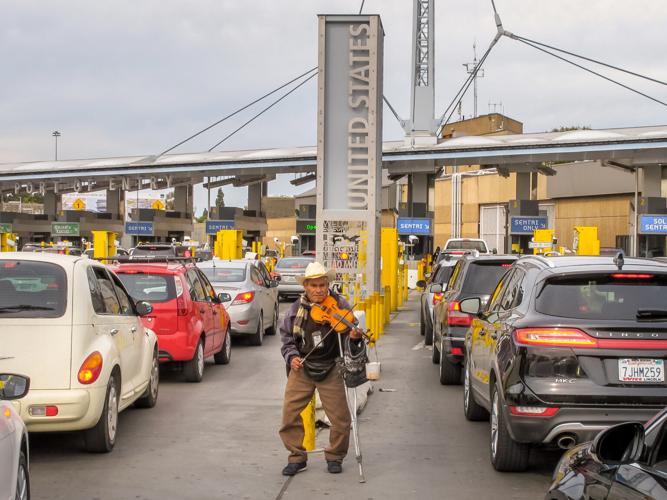

A man plays his violin among the dozens of cars queued at the border station between Tijuana, Mexico, and San Ysidro, California, waiting to cross into the United States. Binational students cross the border daily to pursue their education in the U.S. Credit: Photo Beto
This story was originally published by EdSource. Sign up for their daily newsletter.
Most students at San Diego State wake up in the morning just in time to race to class. But a small group of students get dressed and pack a lunch hours earlier, before crossing the U.S.-Mexico border to make it to class on time.
To attend school in San Diego from Mexico, some transborder students wake up as early as 4 a.m., waiting at the border for car inspections and passport checks before finally arriving on campus.
There is no official tracking of transborder college students, but nearly 21% of high school freshmen and sophomores in San Diego are transborder students, according to a 2017 study conducted by the Center for U.S.-Mexican Studies based at UC San Diego.
In California, under Assembly Bill 91, students living within 45 miles of California’s border region may qualify to attend community college in San Diego while paying California resident tuition. Once attending community college in California, transferring to a four-year institution becomes a reality for transborder students.
EdSource recently interviewed former transborder students to find out why they do it and whether the effort is worth the stress, time and cost.
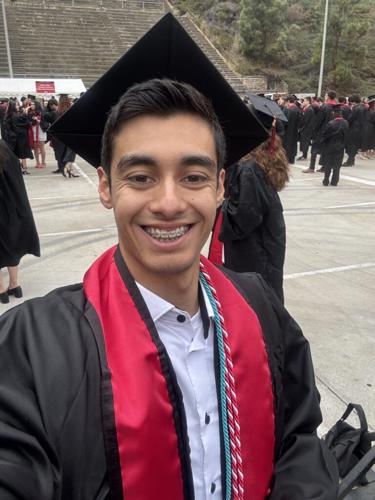
Jose Acevedo
Journalism B.A. 2025, San Diego State

Jose Acevedo commuted from Tijuana to San Diego during his senior year of high school until his last day at San Diego State.
Acevedo was born in San Diego but grew up in Tijuana. He heard about others in his community who went to school across the border. His older sister wanted to study in the U.S., but because his parents worried about her safety, she didn’t get the chance.
Wanting something more for himself, Acevedo enrolled in Otay Ranch High School in Chula Vista using the address of his mother’s godmother.
“I never thought about going to the United States,” Acevedo said. “I felt like I was in a new world by myself. At first I thought, ‘What am I doing?’ My routine changed, I felt tired and started thinking it wasn’t the best decision.”
Today, Acevedo says he is glad he endured the hard times.
“I had a lot of early mornings. I was dropped off at the border, then had to take a trolley, and sometimes a bus, to get to school,” he said. “I remember on the third day of my senior year, I missed the last trolley and bus to get to school on time. I was running 30 to 40 minutes late and remember thinking, ‘Should I even go to school?’ It was stressful, but I managed.”
He didn’t have a car, so he couldn’t stick around and hang out with his new friends.
“I was the only one in my friend group who lived in Tijuana. While they were planning to have dinner, I was crossing the border back to Mexico. I would have to plan for my commute back, plus two hours to get home once I crossed.”
Going to high school in the United States helped prepare him for college.
“I was able to improve my English. My first year studying in the U.S. helped me adjust my schedule and to the learning system here,” Acevedo said. “Teachers and professors were more willing to help, which I was not used to.”
After graduating from high school, Acevedo enrolled at Southwestern College, where he received his Associate of Arts in Communications before transferring to San Diego State.
“SDSU was the only school I could think of because it’s close to the border,” Acevedo said.
He continued commuting via public transit while attending the community college.
When Acevedo first started his journey as a transborder student, his parents constantly worried about the cost of the trolley, lunches and Uber rides back to his house. Acevedo says his parents were paying for everything out of pocket, but eventually his family bought another car that he could use, and he was able to get a part-time job on campus.
“I was always tired, I had to sacrifice my sleep,” Acevedo said. “I would wake up and think I don’t really want to go to school, but then I always reminded myself, I have to because I have the privilege of studying in the U.S.”
The Trump administration’s new immigration laws have not deterred Acevedo.
“With everything going on [regarding immigration], I would definitely do it again,” Acevedo said. “Staying at home, I always had someone to lean on. Studying in the U.S. helped me become more independent and learn more about myself.”
Ina Lelevier
Public Relations, San Diego State

Ina Lelevier was born in Chula Vista but grew up in Tijuana. She crossed the border for school every day from kindergarten to eighth grade.
“It just felt like a long ride to school,” Lelevier said. “I wasn’t fully aware that I was crossing the border.”
Waking up early every morning to attend Our Lady of Mount Carmel in San Ysidro, Lelevier says she enjoyed it.
“Making sure I’m up on time and ready to be at school really taught me discipline,” Lelevier said. “I remember in fourth and fifth grade, there was a time where I would wake up before my parents. I was tired of consistently being late, but looking back, I would’ve told myself that I was OK.”
Lelevier said she also appreciates the community that crossing gave her.
“Almost everyone at my school crossed from Tijuana, even the teachers knew, and they were very understanding,” Lelevier said. “There was a time where traffic at the border was really bad, and everyone was late; the school had no choice but to excuse our tardiness.”
Most days, her parents would drop her off and pick her up from school.
“I was also able to make friends with people who were crossing the border every day, and sometimes we would arrange whose parents we could carpool with.”
The experience allowed her to bond with other transborder students, helping her feel she wasn’t missing out on social experiences by not living in San Diego.
“Most students I knew were crossing every day, so I never had a fear of missing out on anything,” Lelevier said. “I knew from early on that I was working towards a better future, so I’m so grateful for the experience I had having to cross for school every day.”
But, after finishing middle school, her parents wanted her to feel more connected to her roots, so they took her out of school in the U.S. and enrolled her in high school in Tijuana.
“My first day of school in Mexico was so stressful,” Lelevier said. “It was such a culture shock and hard transition. I was very anxious and would throw up in the bathroom.”
Even after having adjusted to the school system in Mexico, Lelevier knew she wanted to pursue a career in the humanities at a four-year university in the U.S. When schools transitioned to online learning due to Covid, she took advantage of the time and reenrolled in school in the U.S.
Lelevier completed her senior year of high school online.
She now lives with her uncle in order to attend San Diego State, where she is pursuing a bachelor’s degree in public relations with a theatre minor.
“I feel like my whole life I haven’t made a decision for myself, but everything I went through taught me so much and really did benefit me in the end,” Lelevier said. “I’m so grateful for it.”
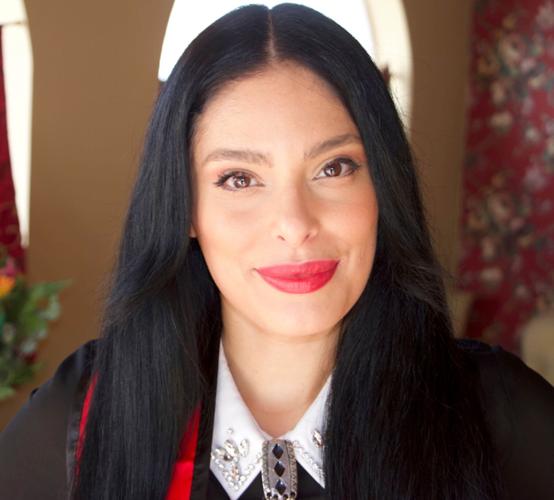
Vannessa Falcón Orta
Researcher and professor, San Diego State

Vannessa Falcón Orta is a transborder professor at San Diego State’s Imperial Valley campus. For Falcon Orta, crossing the border is not something new — she grew up in a transborder family.
Born in Los Angeles, she recalls living a transnational life from an early age due to economic hardship.
“We were living on both sides of the border,” Falcón Orta said. “In the United States, we didn’t have a stable living arrangement. We would sleep in the car and do homework from under the light of the lampposts.”
“But in Tijuana, we had a little trailer from Los Angeles we lived in,” she added. “It became home, and then we had the option to choose which place to stay in, and we chose both.”
As her family transitioned into living on both sides of the border, Falcón Orta remembers what it was like to cross the border daily.
“In elementary school, I would wake up as early as 4 in the morning, then we would cross and my dad was dropped off at work first,” she said. “Then after classes, my brother and I would do homework at the park or wherever we could. Dinner would be in the car, then we would arrive home at around 10 p.m. and do the whole thing all over again. It was exhausting. I remember me and my brother thinking, ‘Is this normal?’”
“I’ve never been more tired than when I was a kid, but it gave me my foundation for resilience today,” Falcón Orta said.
After high school, the transborder commute did not end for Falcón Orta. She studied at San Diego State while earning her undergraduate degree in psychology, attended Long Beach State for her master’s in counseling, and then returned to SDSU for her Ph.D. in education.
Now, Falcón Orta is dedicated to helping other transborder students by researching and understanding the transborder student population and implementing inclusive practices in her classroom.
“I try my best to bring in an inclusive, validating, and supportive environment for my population of transborder students because transborder students are prevalent throughout the education pipeline,” she said.
Knowing the dedication transborder students put into attending school daily, Falcón Orta tries to refrain from canceling her classes at the last minute. If she does, she’ll start a Zoom meeting so her students still have the opportunity to learn.
“There are psycho-social stressors that come with crossing the border every day,” Falcón Orta said. “Students have to deal with long border wait times, stress and exhaustion from their very rigorous schedules, and then that student has to be in class all day, or they factored in an entire commute for just one class.”
She said transborder students also face double jeopardy. “Obstacles they face as people of color in the United States, chances are they also face that in Mexico.”
“Transborder students are not only physically involved with the two countries, they are involved socially, academically, professionally, civically and even politically,” Falcón Orta said. “But, it’s not black and white. They end up living this transnational life for reasons beyond their control, such as economic hardship, being born into mixed immigration status families and continuing as part of a long lineage of a transborder family.”
“By default, they are binational citizens, bilingual, biliterate and significantly engaged in leadership on both sides on the border because they see firsthand a lot of the hardships at the borderlands,” she added. “And, they’re like you and me — they’re human and have hopes and dreams.”
Falcón Orta assisted in organizing a transborder graduation in Mexico. Additionally, she serves as a director for SDSU’s Imperial Valley Cross-Cultural Center, which offers students opportunities to engage with their community through social justice events and provides access to student peer mentors.
“When students first start to live a transborder life, it’s very difficult,” Falcón Orta said. “Students feel like they don’t belong anywhere.”
Cindy Avila is a journalism student at San Diego State. She is a member of EdSource’s California Student Journalism Corps.








(0) comments
Welcome to the discussion.
Log In
Keep it Clean. Please avoid obscene, vulgar, lewd, racist or sexually-oriented language.
PLEASE TURN OFF YOUR CAPS LOCK.
Don't Threaten. Threats of harming another person will not be tolerated.
Be Truthful. Don't knowingly lie about anyone or anything.
Be Nice. No racism, sexism or any sort of -ism that is degrading to another person.
Be Proactive. Use the 'Report' link on each comment to let us know of abusive posts.
Share with Us. We'd love to hear eyewitness accounts, the history behind an article.