
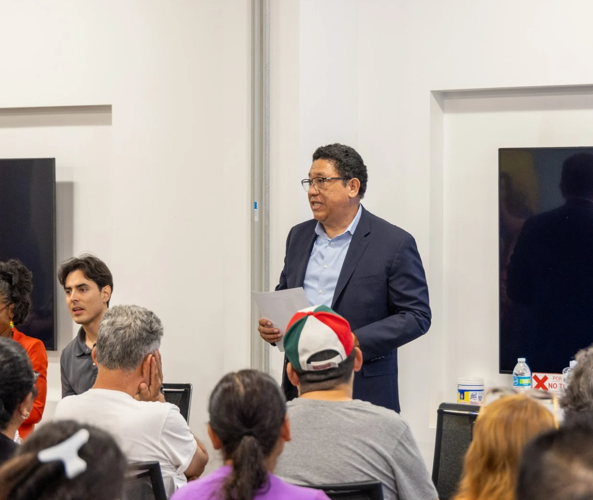



Dr. Aguilar presenting at one of the L.A. Care and Blue Shield Promise Community Resource Centers. (Credit: L.A. Care.)
As families enjoy summer break, healthcare providers are reminding parents that the months before school resumes are an ideal time to catch up on annual checkups and preventive health screenings.
Dr. Felix Aguilar, medical director of quality improvement at L.A. Care Health Plan, is raising awareness about the importance of early detection and how it can save lives while also addressing the challenges many Latino families face in accessing preventive care and sharing practical ways to stay on top of their health.
Summer is the best time for annual checkups, he said, because children are out of school and schedules tend to be more flexible. Aguilar noted that one of the biggest barriers many Latino families face is taking time off work, with patients often telling him they postpone appointments because they cannot afford to miss a shift.
“A lot of people do not have sick time to go see the doctor; sometimes they don’t have child care or taking kids out of school is another impediment,” he said.
Research on California’s child care crisis shows that the rising cost of care is placing a heavy burden on families with young children, often forcing parents to leave the workforce or reduce their hours, creating a major cost-of-living challenge for families across the state.
And despite California having high poverty rates, many low-income parents spend a large portion of their paycheck on child care. According to the Upjohn Institute for Employment Research, in 2023, the average annual cost of child care in California was $11,900 per child.
Aguilar suggested that when parents cannot take time off work, they should consider asking another trusted family member to bring their children to annual checkups, emphasizing that preventative care plays a critical role in keeping children healthy.
He also pointed to other barriers that can prevent Latino families from accessing care, including language access, gaps in health education, transportation limitations and not knowing what healthcare resources are available to them.
“A lot of people in our community only go to the doctor when they’re sick… instead of making [a doctor’s visit] a preventative health service,” Aguilar said.
While many parents and guardians ensure their children receive required vaccines before starting school, he said that preventive healthcare often goes beyond meeting school requirements.

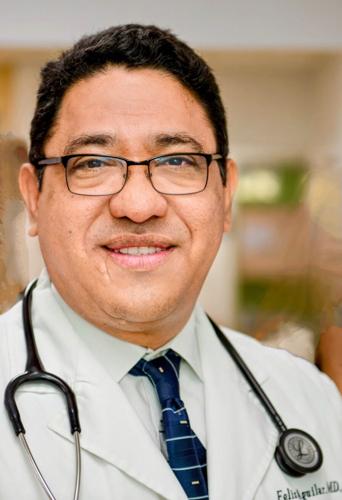
Dr. Felix Aguilar, medical director of quality improvement at L.A. Care Health Plan (Credit: Edward Carreon)
Aguilar told CALÓ News that he encountered a woman in her 50s undergoing her first Pap smear, highlighting how some patients go decades without screenings. These exams are typically recommended starting at age 21 and should be done every three to five years to screen for cervical cancer, according to the Centers for Disease Control and Prevention.
According to the Pew Research Center, Latino screening rates for many preventable diseases, including some cancers, continue to lag. In a 2025 health survey, nearly two-thirds (64%) of Latinos said they delayed or skipped routine checkups and recommended screenings, such as mammograms and colonoscopies.
Aguilar said that many screenings for women are crucial, such as breast cancer and cervical cancer screening. “When you catch cancer early, it is quite curable but when it’s detected late, it’s very difficult to cure,” he said.
According to the American Cancer Society, only about 52% of Latino adults age 45 and older are up to date on colorectal cancer screenings, compared with 61% of non-Hispanic white adults.
Currently, Latinos still face disproportionately high rates of chronic conditions like type 2 diabetes, cardiovascular disease, obesity and chronic liver disease. Factors such as genetics, cultural diets and barriers to accessing healthcare, including high rates of uninsured individuals, contribute to health disparities within the community.
Aguilar said adults ages 40 and older should be screened for high-risk chronic conditions, even if they are hesitant or believe it may be too late to address them. He emphasized that early detection can help identify health concerns and provide opportunities for treatment and management.
“In our community, there is a long-standing belief that there is nothing we can do, that we belong to death and that our fate is already predetermined,” Aguilar said.
He added that while some individuals may hold this belief, he encourages his patients to look at the bigger picture, emphasizing that family plays a powerful role in health. Aguilar explained that many Latinos see themselves not only as individuals but as part of a larger family and community.
By prioritizing their health, he said, they are also taking care of the loved ones who depend on them, which can motivate more people to schedule checkups, screenings and seek treatment when needed.







(0) comments
Welcome to the discussion.
Log In
Keep it Clean. Please avoid obscene, vulgar, lewd, racist or sexually-oriented language.
PLEASE TURN OFF YOUR CAPS LOCK.
Don't Threaten. Threats of harming another person will not be tolerated.
Be Truthful. Don't knowingly lie about anyone or anything.
Be Nice. No racism, sexism or any sort of -ism that is degrading to another person.
Be Proactive. Use the 'Report' link on each comment to let us know of abusive posts.
Share with Us. We'd love to hear eyewitness accounts, the history behind an article.