
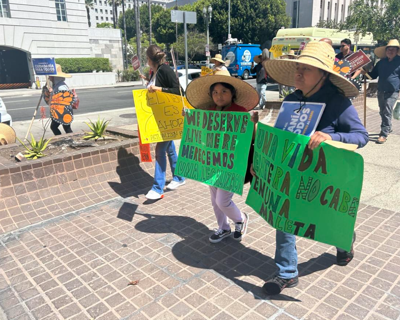


Protest in Los Angeles. (Photo by Amairani Hernandez.)
Since President Donald Trump took office, he has kept his promises of mass deportations and has eliminated several immigration programs, triggering widespread fear in Latino communities and raising concerns about the toll on their mental health.
According to the Center for Migration Studies, 5.8 million U.S. households are home to at least one person without legal immigration status. Of those households, 4.7 million are composed of both undocumented residents and those with citizenship or other legal status.
CALÓ News spoke with Estela Zarate, dean and professor at Loyola Marymount University (LMU), about the wide-ranging effects of federal immigration enforcement on both children and adults, and how to prepare school and community-based mental health professionals to respond to the urgent needs of Latino communities during these critical times.
For children regardless of their age federal immigration enforcement actions have affected them in significant ways. A lot of them have had to witness scary and violent events in their lives that have created trauma and oftentimes stress as well.
“We don't see the symptoms of trauma in very obvious ways, and we instead see them in subtle ways that they present in the classroom,” Zarate said. “They may be distracted, unable to focus, they may have the young children [who] cry spontaneously, but those are all ways in which immigration enforcement affects them.”
She also shared instances in which children witness immigration officials detaining members of their families or communities. “The uncertainty that follows when someone is taken into detention creates profound distress events that bring trauma not only to children but also to the adults around them. Children, in particular, are really good readers to the emotions of the adults in their lives, making them especially vulnerable in these situations,” said Zarate.
When it comes to supporting students experiencing immigration-related stress or trauma, Zarate emphasizes that schools are more than places for academic learning. “Students bring their whole selves into the classroom, including their community and family values, practices, as well as the challenges and hardships they face,” she said.
When the children experience a significant event, Zarate said that they bring that emotional impact to the classroom and that schools are not in a position to ignore that. “If we are serious about children being able to learn fully in the capacity that they have, then we have to address their mental health so that they can be the learners that we want them to be,” Zarate shared.
In the last two years, local students have been staging walk-outs from their schools to stand in solidarity with those being affected by immigration operations. It became a nationwide movement. Some schools have demonstrated their support to their students voicing their freedom of speech and letting students out to protest while others schools haven’t.
In February, hundreds of students at Synergy Quantum Academy (SQA) High School joined schools across Los Angeles in a walkout to protest ongoing ICE raids. Ricardo Lopez, a Los Angeles high school teacher, was terminated the next day after intervening to protect students during a second walkout attempt.
During the first walkout, SQA administrators refused to open the gates and students had to climb and jump over to exit the campus. Students suffered multiple injuries, including cuts to their hands and twisted ankles. Lopez was terminated for prioritizing student safety during a second walkout on February 5. “I saw students who were hopping the gate and that’s really dangerous. And seeing other students attempting to hop the gate, I felt the safest thing to do at that moment was to open the gate to ensure their safety. I was just worried that they would get hurt jumping the gate again,” he said.
Zarate told CALÓ News that there's different ways of resisting and that students are demonstrating that. “When individuals feel they have ownership control of their destiny, including their emotions and their future, they are in a better mental health space. So certainly some acts of resistance are part of what allows adolescents to feel like they have agency in their lives,” Zarate said.
She also shared that schools and the administrators are under pressure to make sure that those acts of resistance are safe. “The challenging role of a school leader is to allow the space for resistance and agency, and also to be able to do it safely. There are schools that have very open dialogue with students and they treat them as partners in shaping what resistance can look like in a safe way,” she said.
Zarate explained that the pressures families are facing are contributing to growing mental health challenges. To build trust with families who may be hesitant to engage with institutions due to immigration concerns, she said it is essential for schools and community organizations to come together and establish consistent, two-way communication.
Zarate also pointed to examples of schools that have effectively organized volunteers to help safeguard routes to and from school, while providing families with resources to better understand their rights, positioning themselves as trusted sources of support during uncertain circumstances. “Effective leaders are often part of the community, so they're viewed as members that are in it with the families and that's certainly a very authentic way of building trust,” she said.
Led by Dr. Monique Escobedo, the Parent Institute for Quality Education’s (PIQE) latest research investigates the impact of these pressures on traditional kindergarten (TK) and kindergarten attendance and highlights how caregivers are striving to keep their children learning despite fear and uncertainty caused by immigration operations.
Several of the 2025 presidential executive orders often-racially motivated ICE operations have been linked to a 22% rise in absences among young children from mixed-status or undocumented families in California’s Central Valley.
Zarate noted that she has seen schools take effective steps to address and better understand the reasons behind rising student absences. “Are students not attending because they're afraid of the walk to school, or is it because they have a lot of anxiety and mental health issues around what they're witnessing,” she said.
She also explained that there are two different ways of helping students and their families cope with those issues. The first step is for schools to identify what is the dominant reason for the absences. The second step is identifying what staffing is needed for mental health support and understanding the reasoning behind kids not showing up to class.
For Zarate, it is crucial that individuals not miss opportunities to support families affected by the current political climate around immigration. She emphasized, “Anytime these challenges arrive at our doors, even if it’s not what we envisioned our profession to be, at least here at LMU, we see it as an opportunity to uphold the dignity of others. And if we are in a position of privilege to do so, then we should take it."







(0) comments
Welcome to the discussion.
Log In
Keep it Clean. Please avoid obscene, vulgar, lewd, racist or sexually-oriented language.
PLEASE TURN OFF YOUR CAPS LOCK.
Don't Threaten. Threats of harming another person will not be tolerated.
Be Truthful. Don't knowingly lie about anyone or anything.
Be Nice. No racism, sexism or any sort of -ism that is degrading to another person.
Be Proactive. Use the 'Report' link on each comment to let us know of abusive posts.
Share with Us. We'd love to hear eyewitness accounts, the history behind an article.