
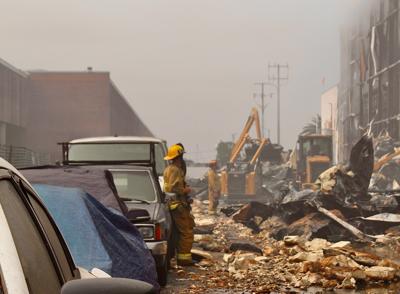


(Photo by Staff reporter Brenda Verano.)
While Los Angeles county and city officials have stated that smoke from the Lineage cold storage warehouse fire does not currently pose a significant health risk, the ongoing fire has now entered its seventh day, raising questions about the potential effects of prolonged smoke exposure.
CALÓ News spoke with Dr. Reza Babapour, a physician practicing in South Los Angeles, who has been a dedicated advocate for addressing public health disparities and expanding access to care for more than a decade.
He said that what is happening in Boyle Heights is both terrible and tragic. He expressed concern not only about the immediate health effects of the ongoing warehouse fire, but also about the potential long-term consequences of prolonged exposure.
Dr. Babapour noted that seven days of continuous exposure can have significant health effects, particularly for vulnerable populations. He emphasized that children, older adults, pregnant women and individuals with respiratory conditions are especially at risk during prolonged smoke exposure events.
A research study found that pregnant women are exposed to an average of 45 different chemicals, which are found in food, water, air pollution and among other things. Pregnant women exposed to these chemicals can impact how early a child is born or a child’s weight at birth.
On June 22, California Governor Gavin Newsom declared a state of emergency after Los Angeles Mayor Karen Bass asked for state disaster support in the wake of the fire.
Dr. Babapour expressed concern that despite the emergency declaration, there has not been a substantial response to extinguish the fire, raising concerns about the city of Boyle Heights being a doctor's desert due to the shortage of physicians.
“There's hardly any doctors available, the nearest emergency room is the L.A. County General, one of the busiest emergency departments in the country. In 2025 it was ranked number nine in the country, with a total of 148,004 patients in one year of visit,” he said.
Dr. Ilan Shapiro of AltaMed explained to CALÓ News that even if many local residents are not currently experiencing symptoms, they should remain aware of potential delayed health effects.
He shared that individuals who live near the area can actually start having certain inflammation in their body and that includes a runny nose, itchy nose, watery eyes, sore throat, cough, headaches, shortness of breath and even sneezing.
“We need to be worried more about kids, elderly people, and those with chronic diseases, especially asthma and emphysema, because these types of conditions can become worse and lead to asthma or emphysema attacks,” Shapiro said.
He recommended seeking medical attention immediately if symptoms persist for an extended period or become more severe. He also suggested preventive steps and recovery measures for families who have already been exposed to the smoke for several days.
Dr. Shapiro said that the most important thing individuals can do right now is stay home, closing doors and windows. He also advised residents to avoid using air conditioning units that draw in outside air, noting that they can pull in and concentrate smoke particles from the fire indoors.
The third recommendation he made was getting a hold of free air purifiers provided by the county. “People can call 211 and local representatives can add them on the waiting list or give them the air purifiers when available,” he said.
Both the city and county have set up two smoke relief centers. These centers are open 24 hours and people can pick up masks, food, water, pet assistance, temporary shelter and public health information.
Dr. Shapiro also recommended avoiding exercising outside and suggested that individuals that still need to go to work in the area affected by the fire to use N95 or industrial respirator masks at all times.
He also emphasized the importance of providing health education about smoke exposure in Spanish, particularly in Boyle Heights, a predominantly Latino community, doing so through trusted community organizations.
“The best way that we respond as humans is someone that is close to us, understands our language and culture and using our promotora de salud and our community trusted allies [who] can always bridge that gap and actually share the information faster than other ways that we can traditionally think of,” Dr. Shapiro said.






(0) comments
Welcome to the discussion.
Log In
Keep it Clean. Please avoid obscene, vulgar, lewd, racist or sexually-oriented language.
PLEASE TURN OFF YOUR CAPS LOCK.
Don't Threaten. Threats of harming another person will not be tolerated.
Be Truthful. Don't knowingly lie about anyone or anything.
Be Nice. No racism, sexism or any sort of -ism that is degrading to another person.
Be Proactive. Use the 'Report' link on each comment to let us know of abusive posts.
Share with Us. We'd love to hear eyewitness accounts, the history behind an article.