


A new digital collection has gathered dozens of photos and community-curated stories of Palo Verde, La Loma and Bishop, neighborhoods in the area later designated as Chavez Ravine.
The collection titled “Chavez Ravine: An Unfinished Story” is a digital public history project produced by Loyola Marymount University (LMU) and some of the former residents and families that lived in those three displaced neighborhoods.
The newest archival collection contains more than 200 photos, oral histories and manuscripts that showcase the life and traditions of those thriving communities before they were displaced by the City of Los Angeles via eminent domain to build public infrastructure.
The collection was started in 2015 by Palo Verde resident Carol Jacques and Priscilla Leiva, associate professor of Chicana/o and Latina/o Studies at Loyola Marymount University and historian of race and urban history.
Jacques grew up on Paducah Street within those communities before she and her family lost their home when she was only eight years old. She explained that this had a major influence on her becoming a lifelong social justice organizer in Los Angeles.
When she met Leiva, a historian who had researched the contested landscape where Dodger Stadium now sits, the partnership began. They began to collaborate with Los Desterrados, the cultural historical association of displaced residents from the three communities.
In 2018, the archival project arrived at LMU after Jacques, Leiva and Los Desterrados decided to also partner with the school’s William H. Hannon Library.
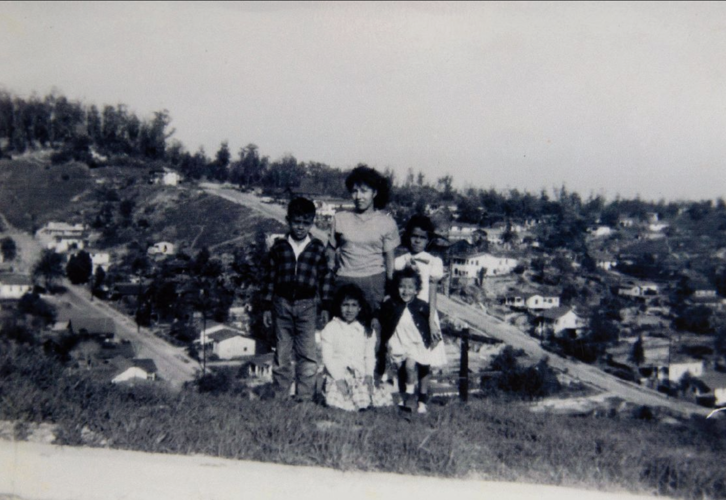
The new photos are part of the archival project showcase: entire families posing, playing, and enjoying life in their homes; baseball players on local fields and views of the mountains and hills that once distinguished Palo Verde, La Loma and Bishop.

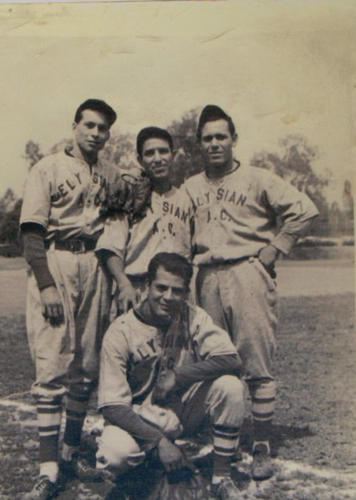
Four players on the Elysian A.C. baseball team, the Bulldogs, representing Palo Verde neighborhood, pose together on a sandlot. Photo courtesy of Robert A Rodriguez
One of the new photos added to this collection is of Palo Verde’s Elysian A.C. baseball team, which once competed in regional star games and local organized club matches.
This June marked 68 years since the L.A. Dodgers acquired the land.
In 1958, the City of L.A. approved a referendum to trade the site to team owner Walter O'Malley.
Less than a year later, May 9, 1959 — which came to be known as “Black Friday” — is remembered as a day when sheriff deputies and bulldozers forcibly evicted the final Mexican American residents to clear the land for the construction of Dodger Stadium.
Since then, the hills, once home to thousands of families, have been the home of the professional baseball team.
The violent uprooting and displacement of these families was photographed and documented and has become a driving image for displaced families in the city throughout the years.
As shown in some of the photographs, oral histories and manuscripts of “Chavez Ravine: An Unfinished Story,” La Loma, Palo Verde,and Bishop made up a tight-knit community of mostly Mexican families who knew and respected each other.
The three neighborhoods intertwined to form the 315-acre area, a valley a few miles northeast of Downtown L.A. that housed more than 1,800 families. Despite the perspectives of outsiders and L.A. officials, who labeled the community as a “vacant shantytown” or the “slums,” the three communities were fully autonomous, vibrant and cohesive, serving as a hub for homeownership and economic development and growth for people of color.
One of the most documented families in this archive is the Ayala family, which once lived on Paducah Street in the Palo Verde neighborhood. The archives have documented some of the family's marriages, children and ordinary life.
Some of the newly acquired archives were presented earlier thai month at an annual community picnic organized by Los Desterrados. The gathering is a tradition spanning more than 50 years, where every year families from parts of Palo Verde, La Loma and Bishop, and their descendants, gather to be in community with each other.
A few days after the picnic, on July 23, 2026, the L.A. Dodgers visited the White House and President Donald Trump as part of their 2025 World Series championship celebration.
The Los Angeles Dodgers’ net worth was valued at $7.73 billion, according to a March 2025 valuation by SportsPro. The sports organization has come under attack recently due to the White House visit, immigration raids taking place outside of the stadium and because Guggenheim Partners, the multibillion-dollar ownership group behind the franchise, had a stake in the GEO Group, a major private operator of immigration detention centers in the U.S.
According to LMU, the project's signature piece is a “community-curated digital archive, centering community members as experts of their own experience" and offering a first-of-its-kind window into the daily life of the three neighborhoods.
Some of the collection pieces are now available through the LMU archival collection at https://library.lmu.edu/archivesandspecialcollections/chavezravine/.







(0) comments
Welcome to the discussion.
Log In
Keep it Clean. Please avoid obscene, vulgar, lewd, racist or sexually-oriented language.
PLEASE TURN OFF YOUR CAPS LOCK.
Don't Threaten. Threats of harming another person will not be tolerated.
Be Truthful. Don't knowingly lie about anyone or anything.
Be Nice. No racism, sexism or any sort of -ism that is degrading to another person.
Be Proactive. Use the 'Report' link on each comment to let us know of abusive posts.
Share with Us. We'd love to hear eyewitness accounts, the history behind an article.