
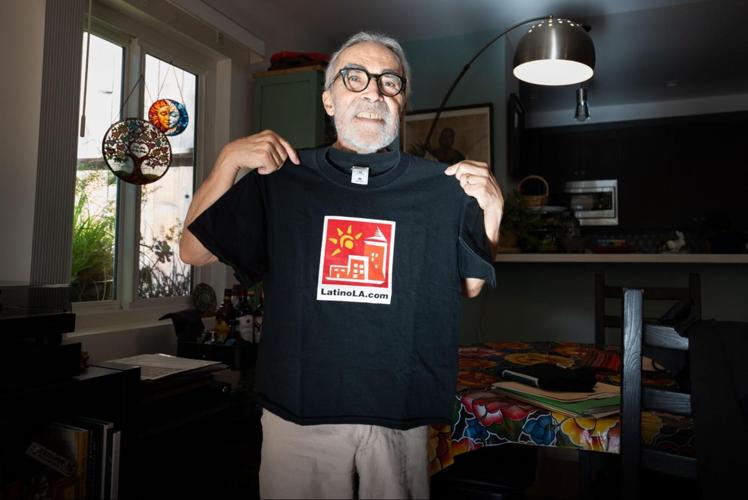


Photo Caption: Abelardo de la Peña Jr. at his home on August 12, 2026. Photo by Susana Canales Barrón.
In the late 1990s, Los Angeles was changing faster than its media institutions could keep up.
The Latino population was growing, Latino political power was becoming harder to ignore , and a generation of English-speaking Latino Angelenos was coming of age between cultures.
Spanish-language television and radio had enormous audiences, yet Latino media still received a remarkably small share of the nation's advertising dollars.
The internet was changing, too. In 1998, only about 15 percent of Latino households in the United States were online. Connections were slow, websites were clunky and no one knew quite what the new medium would become.
There was no Facebook, Twitter, Instagram, TikTok or YouTube.
There was, however, LatinoLA.

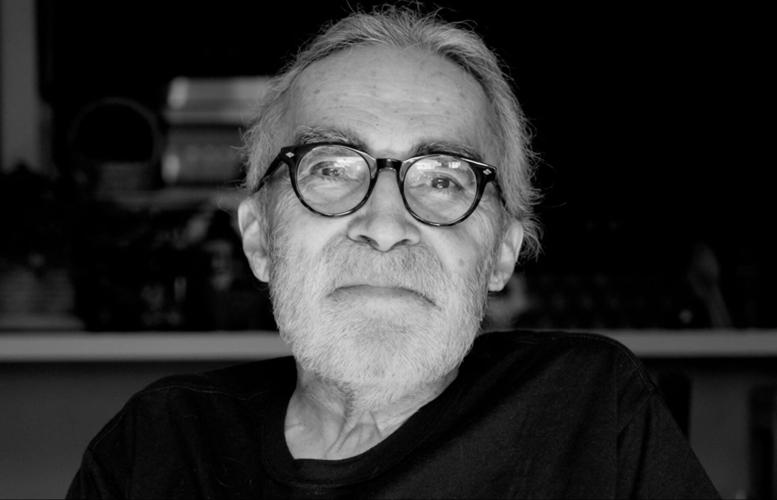
Photo Caption: Abelardo de la Peña Jr., co-creator of LatinoLA, on August 12, 2026. Photo by Susana Canales Barrón
The website launched in July 1999, growing out of an email newsletter that Abelardo de la Peña Jr. began a year earlier. His idea was simple: create a place where Latino Angelenos could find out what was happening in their community and where they could tell the community what mattered to them. In English.
In retrospect, LatinoLA looked remarkably like social media before social media had a name.
Looking for a place to belong
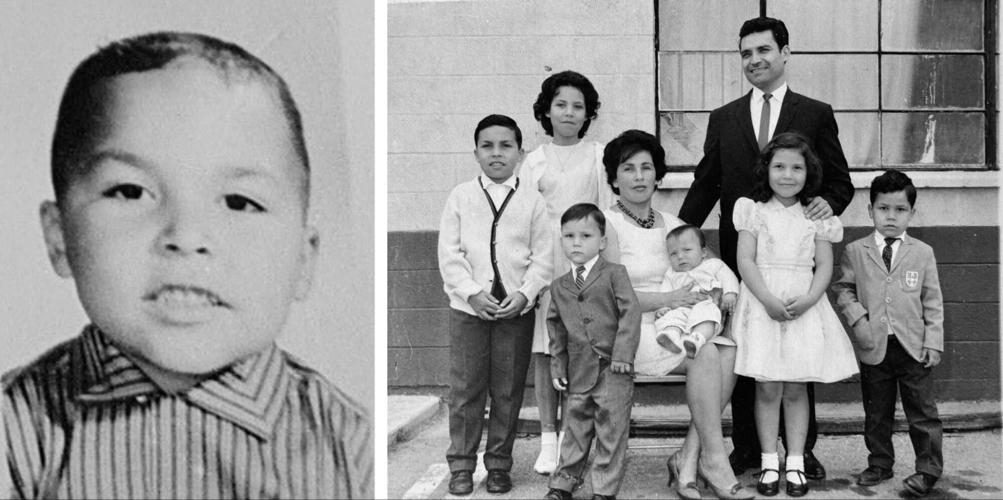
De la Peña grew up in Wilmington, the second of six children in a Mexican household. Journalism was part of the family landscape. His father wrote a Spanish-language column for a local English-language newspaper, and de la Peña edited his college newspaper. Eventually, he helped create, along with his father and a brother, the Wilmington Reader, a small community newspaper they wrote, laid out, printed and distributed themselves.

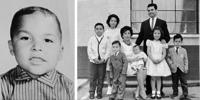
Photo Caption: Childhood photo of Abelardo de la Peña Jr. (left). De la Peña is on the far left in his family photo (right). Photos courtesy of Abelardo de la Peña Jr.
It was an early lesson in community storytelling.
But de la Peña also grew up between cultures. As a teenager in the 1960s, he was drawn to the music, art, literature, and political movements of the broader American culture around him. His parents consumed Spanish-language media, but he was primarily an English speaker and turned to publications such as the Los Angeles Times, Time, and Life.
What he didn't find was a publication that reflected the particular cultural space he inhabited.
Latino life wasn't absent from the media. It was often presented in pieces, through someone else's lens.
As he grew older, he explored his own culture more deliberately. Music became one way in: Rubén Blades, Tito Puente, Celia Cruz, Cafe Tacvba. He wanted to learn more about Mexican American culture and the wider Latino world.
And he wanted to participate.
There was just one problem: He couldn't find one place that could tell him what was happening.
“LA Weekly,” he recalled, “would occasionally list Latino-type events and stories.”
That wasn't enough.
An inbox becomes a community

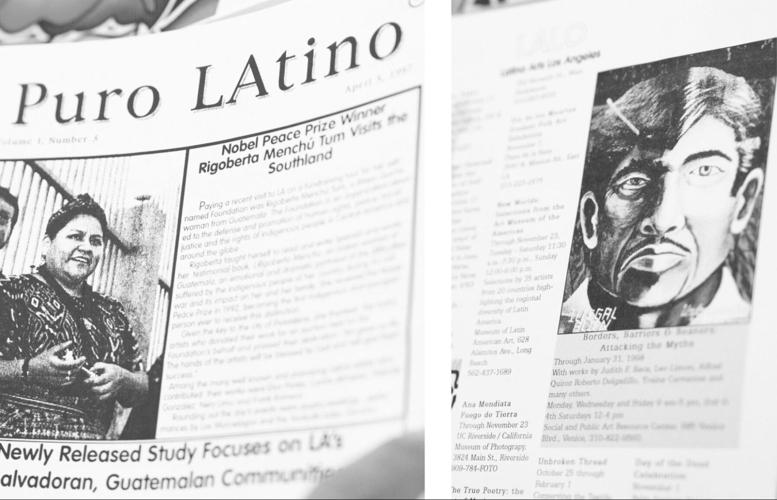
Caption: Photos of “Puro LAtino,” a newsletter de la Peña created around 1998.
Around 1998, de la Peña began assembling an email newsletter from information he collected at events around Los Angeles and sent the information to a growing list of contacts.
At first, the newsletter was primarily a calendar.
Then people began sending him their own things.
“People would want to start sending me information,” he said.
The newsletter grew into something larger: community announcements, scholarships, job opportunities, requests and reports about things happening around Los Angeles. The people generating the information were often the people living it.
The list eventually grew to roughly 8,000 subscribers.
Then a friend suggested putting the newsletter online.
De la Peña had no background in web development. But EarthLink was offering users a small amount of free web space.
“I said, ‘Well, how do I do that?”
He figured it out. LatinoLA launched in July 1999, with the help of two short-term partners.
De la Peña later used Dreamweaver to build and maintain pages, moving elements around manually and spending hours on tasks that now take a few clicks.
But technology wasn't the important part.
The people were.
Give people a voice
From the beginning, de la Peña wanted LatinoLA to be different from a conventional publication.
His guiding principle was simple: “Give people a voice.”
Contributors could submit poetry, short stories, restaurant reviews, recipes, health information, opinion pieces, news and calendar listings. The editing was intentionally light.
“I wanted their voices to come across,” he said.
Some opinion pieces made readers angry. That was fine with de la Peña.
“It didn't matter to me,” he said. “They had their point of view. They wanted to express themselves. Let them do it.”
Readers could respond in the comments or submit their own story.
In 1999, that was an unusual idea: a publication where the boundary between writer and reader was deliberately porous.
Los Angeles was changing, too
LatinoLA emerged as questions of Latino identity, immigration and political power reshaped California.
The aftershocks of Proposition 187 were still being felt. At the same time, Latino media was demonstrating the size of its audience. In Los Angeles, Spanish-language television had moved well beyond the margins. KMEX-TV, the local Univision station, could outdraw every other local station during particular prime-time hours.
But LatinoLA wasn't competing with Univision.
It was interested in something more granular: the life between the headlines.
In October 1999, only months after LatinoLA launched, the Los Angeles Times highlighted the website as an outlet for Latino arts and cultural events, particularly grassroots activities that might otherwise receive little attention.
That was exactly the gap de la Peña had set out to fill.
A community became its own archive
One of the things de la Peña remembers most clearly is LatinoLA's coverage of the Chicano Moratorium.
Every August 29, the site could revisit the 1970 East Los Angeles march against the Vietnam War through the memories of people who had participated.
For de la Peña, that was more than anniversary coverage. It was history being preserved by the people who had lived it.
“I think that that was something that we were meant to do,” he said.
Looking back, he sees LatinoLA as a time capsule of Greater LA's Latino community.
Some contributors later became professional journalists and authors. Gustavo Arellano, who would become one of Southern California journalism's most recognizable Latino voices, was among those published by the site early in his career.
Others found jobs or scholarships through its listings.
And some simply found somewhere to say something they had been carrying.
“Some were very personal,” de la Peña said. “They talk about relationships and talk about tragedies in their life.”
Poetry and short stories gave those experiences a place to live.
Social media before the algorithm
The architecture of LatinoLA now feels familiar.
Contributors could submit material and have it published. Events could be entered into a calendar. Readers could respond. People could disagree publicly.
But there was no algorithm between the person submitting the story and the person reading it.
There was no follower count determining whether someone had earned the right to be heard.
People didn't have to cultivate a personal brand.
They could simply arrive.
“You didn't have to, you know, follow anybody,” de la Peña said. “You just show up, state your point of view, write your story, write your poem, write your opinion. And it's out there for everybody.”
That is social media stripped down to its most basic idea: people sharing with other people.
But LatinoLA had something today's platforms often struggle to provide: a sense of human connection.
“We didn't have a lot of the tools,” he said. “We didn't have the technology, but we were personable. You know, we were human.”
That human connection was part of the infrastructure.
A dream bigger than the resources
LatinoLA attracted advertisers and attention. De la Peña brought in partners and formed a board. There were plans to expand the concept into Latino Cities, a network of community-focused sites serving Latino communities around the country.
But there wasn't enough money, technical support or time. De la Peña often worked on the site around a regular job, getting up early to work on it, returning to it during lunch, and continuing in the evenings and on weekends.
He raised money through Indiegogo campaigns, bringing in a few thousand dollars at a time. Merchandise and advertising helped cover servers and other basic costs.
But the project remained largely an act of “sweat equity.”
Eventually, the technology itself became a problem. The site would break, and finding someone who could repair it became increasingly difficult.
De la Peña now believes he may have tried to expand too quickly.
“I think I made the mistake of trying to jump from LatinoLA to Latino Cities without really fixing LatinoLA first,” he said.
Eventually, the nonprofit Latino Media Collaborative acquired LatinoLA for very little money, according to de la Peña. Today, LatinoLA.com redirects to CALÓ News, an initiative of the Latino Media Collaborative. Fragments of the original site remain in the Internet Archive.
By then, however, LatinoLA had already accomplished something that had little to do with technology.
LatinoLA was intensely local at a moment when the internet was becoming global. It gave people something that would later become the defining promise of social media: the ability to speak, to be heard and to find one another.
But LatinoLA was never really about technology. It was about people sharing what they knew with one another.
“I wanted to share what I know but also wanted the person or whoever is out there to share with me what they know,” he said.
Abelardo de la Peña Jr. is a contributing copy editor for CALÓ News.








(0) comments
Welcome to the discussion.
Log In
Keep it Clean. Please avoid obscene, vulgar, lewd, racist or sexually-oriented language.
PLEASE TURN OFF YOUR CAPS LOCK.
Don't Threaten. Threats of harming another person will not be tolerated.
Be Truthful. Don't knowingly lie about anyone or anything.
Be Nice. No racism, sexism or any sort of -ism that is degrading to another person.
Be Proactive. Use the 'Report' link on each comment to let us know of abusive posts.
Share with Us. We'd love to hear eyewitness accounts, the history behind an article.