
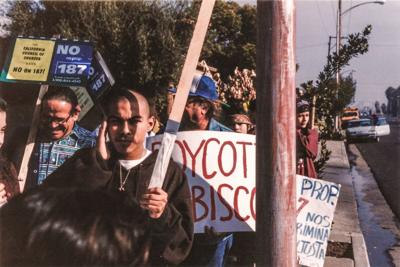

Marchers denounce Prop 187 in Fresno California, 1994. (Via Wikimedia Commons. Credit David Prasad.)
The 1994 ballot initiative passed with 59% approval but was ruled unconstitutional in the courts. The proposition, however, is credited for spurring Latinos to register to vote and help turn California into a deeply blue state.
“I see a similarity in the rhetoric and the cruelty between (then-Gov.) Pete Wilson’s California in the early 90s and (President) Donald Trump’s federal government in 2026,” said Castro, who grew up in San Antonio where he was that city’s first Latino mayor.
“Of course, Trump has carried out an anti-immigrant agenda much more extensively and with even more cruelty,” Castro said. “But I also see a similarity in how people have been repulsed by Trump’s overreach and the overreach of Pete Wilson with Proposition 187.”
That sentiment — especially pronounced in heavily Latino stretches of the country, places like Texas’ Rio Grande Valley or the Central Valley in California — found its full expression on Nov. 3 when voters delivered what is now being called one of the greatest political upheavals in modern U.S. history.
The Blue tsunami
Democrats, whose political brand just months earlier had been seen as toxic and whose chances of electoral victory seemed modest at best, overwhelmingly swept both houses of Congress, taking states long seen as deeply and, the thinking went, permanently red.
That includes Texas, where Democrat James Talarico handily defeated his Republican opponent for the U.S. Senate, Ken Paxton and where Gina Hinojosa is set to become the state’s first Latina governor, defeating incumbent Gov. Gregg Abbot. (California, meanwhile, is also set to seat its first Latino governor, Xavier Becerra.)
A mid-September poll by the Latino Community Foundation revealed that Latino voters in Texas and California have much in common. Half of them are not confident they can make ends meet financially, and fear their personal economic situation will worsen.
More than a third of Latinos – who gave 55% of their votes in Texas to Trump in 2024 – blame the president and his economic policies for bumping up the cost of living. A solid majority (70% in California and 67% in Texas), meanwhile, say they want changes to how Immigration and Customs Enforcement (ICE) operates in immigrant communities.
Even before Tuesday’s results were announced, there were growing indications that Latino support for Trump had cratered.
“There’s no question that the last 18 months have been very difficult ones for the community for a number of reasons, from overreach by ICE to a difficult economy, rising inflation, rising housing costs,” said Castro, now executive director of the Latino Community Foundation.
Castro, whose foundation expanded its grantmaking to Texas in August, cited these as factors in Texas’ historic pivot toward the Democrats.
A 'dealignment from both parties'
Still, says political observer and never-Trump Republican Mike Madrid, the Democrats would do well not to squander the opportunity by taking Latino political fealty for granted.
The author of “The Latino Century: How America’s Largest Minority Is Transforming Democracy,” Madrid argues that yes, Latino voters are rebuking the Republican Party. That does not mean they are embracing Democrats.
Texas Latinos’ brand of politics is more conservative than their brethren in California, he said. They are moving away from Trump and Republicans, not going toward Democrats. “The Democrats’ popularity numbers are not going up. Or if they’re going up, it’s very marginal,” cautioned Madrid.
Madrid, who called Tuesday’s election results a “Super El Niño” — comparing Latino turnout with the global weather phenomenon — does not believe Latino voters in Texas are suddenly turning into Democrats, much like what California Latino voters did in helping the state go blue. “This is a broader dealignment from both parties,” he said. “It’s not a realignment, which is what we saw in 1994 (in California).
Republican political strategist Mike Madrid discusses Latino support for Trump in 2024 and the voting bloc’s apparent shift back leftward during an August virtual ACoM news briefing.
“We also saw dramatic increases of the naturalized immigrant voter becoming U.S. citizens and registering to vote,” Madrid said of California Latino voters. “All of those factors are not happening in Texas. None of them are happening.”
Additionally, said Madrid, white voters in Texas remain conservative unlike in California where that voting bloc, especially in wealthy areas, tends to be more progressive with its politics. “In Texas, it doesn’t matter whether you’re rich or poor or middle class, if you’re white, you’re a pretty conservative Republican,” he said. “White voters (in Texas) don’t vote for Democrats very often.”
He continued, “The demographics are different. The political environment is different. The states are different.”
He pointed to Tejano singer Robert Pulido, who defeated Republican incumbent Mónica De La Cruz in Texas’ 15th Congressional District which stretches about 280 miles from the Mexican border to the northeast of San Antonio. De La Cruz won two years ago by 14.2 percentage points.
“Bobby is very conservative. He’s a Blue Dog Democrat,” said Madrid.
An upset in CA's Central Valley
In California’s San Joaquín Valley, Democrat Randy Villegas became the first Latino in the Valley to be elected to the House of Representatives, defeating Republican incumbent David Valadao in the 22nd Congressional District. Pollsters rated the race as “lean Democrat” in a heavily Latino and Democratic district that was changed by California’s Proposition 50 to include more Democratic-friendly areas of Fresno County.
“Everybody has always believed that the way to beat Valadao was to be kind of more conservative, more centrist,” said Madrid. “I think Randy’s going to upend that because he is very progressive.”
Residents in Texas’ 15th District and California’s 22nd District are better equipped to know what kind of representative they want than politicians in Washington, D.C., said Madrid.
“Both Bobby and Randy run against the Democratic Party and they don’t hide it,” he added.
Dr. Mark P. Jones, a political professor at the University of Houston, tends to support Madrid’s thinking that Texas is far from turning to a shade of blue, especially when Latino voters are concerned about the economy.
A 'swing vote' in Texas
Adding to Trump’s low approval ratings, Republicans damaged their chances when their gerrymandered Congressional districts assumed the Latino shift to the GOP in 2024 would continue. “That is clearly not the case,” said Jones. “What’s really hurting Trump is that a large majority of Latino voters in Texas do not believe that Trump kept his promise of economic prosperity.”
Latino voters, he said, switch their votes in different elections based on the candidate quality as well as national and state-level conditions. “There are more Latino voters that are in a center space and towards the center than, say, white voters and black voters,” said Jones.
What Texas Latino voters are trending toward, said Jones, is becoming more of a swing vote than their counterparts in California.
Talarico’s win, he explained, is a “momentous occasion for Democrats.” But, said Jones, there is no guarantee future elections will feature an unpopular Republican president, a slumping economy and a flawed candidate like Paxton, whose record of corruption and malfeasance dogged his campaign from the start.
Cal Poly Pomona professor Jarred Cuéllar said Texas politics “has definitely changed over the past 10 or 15 years” with Beto O’Rourke’s close 2018 challenge to Sen. Ted Cruz in the Senate race.
“There was this notion that in 2024 that Latinos had swung (right) and become Republicans,” said Cuéllar. “It mostly came down to the inflation crisis.”
Latinos in Texas tend to be third or fourth generation whose ancestors moved there during the Mexican Revolution, while California Latinos are more likely to be more recent immigrants, said Cuéllar. “We’re talking about vastly different experiences.”
Castro, the leader of the Latino Community Foundation, predicted the results would spur both parties to reach out to Latino voters. The foundation’s poll shows 40% of Latino voters had not been contacted by either party.
“They absolutely should not take the community for granted,” said Castro.
JUAN ESPARZA LOERA
Juan Esparza Loera has covered California’s Central Valley for more than 50 years, as an editor and journalist with the Spanish language newspaper Vida en el Valle and as the former opinion editor for the Fresno Bee.
This article first appeared on American Community Media and is republished here under a Creative Commons Attribution-NoDerivatives 4.0 International License. 








(0) comments
Welcome to the discussion.
Log In
Keep it Clean. Please avoid obscene, vulgar, lewd, racist or sexually-oriented language.
PLEASE TURN OFF YOUR CAPS LOCK.
Don't Threaten. Threats of harming another person will not be tolerated.
Be Truthful. Don't knowingly lie about anyone or anything.
Be Nice. No racism, sexism or any sort of -ism that is degrading to another person.
Be Proactive. Use the 'Report' link on each comment to let us know of abusive posts.
Share with Us. We'd love to hear eyewitness accounts, the history behind an article.