
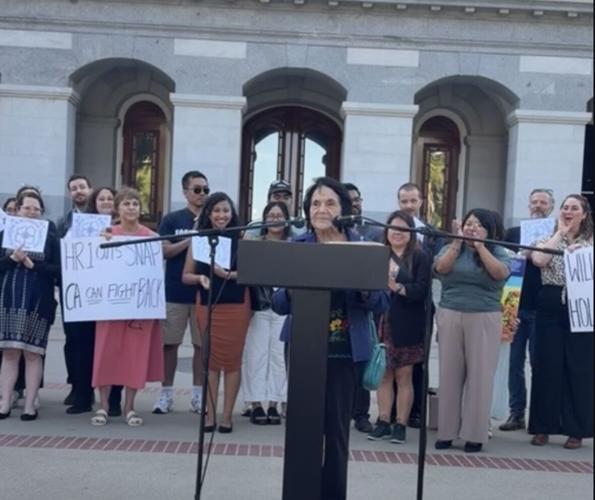


Labor and civil rights leader Dolores Huerta spoke at a press conference on Monday with anti-hunger and youth advocates calling for legislators to dedicate funding to fighting what advocates say is a hunger crisis in California. (Screenshot from End Child Poverty California livestream)
With only a few weeks left in the legislative session, advocates are in the final stretch of calling on California lawmakers to meet certain benchmarks, including securing food assistance for humanitarian immigrants and other vulnerable populations.
End Child Poverty California (ECPCA) gathered on the west steps of the California Capitol on Monday to demand that state leaders allocate and strengthen food assistance for populations targeted by President Donald Trump’s H.R. 1, the One Big, Beautiful Bill Act. The group was joined by anti-hunger and youth advocates as well as labor leader Dolores Huerta.
“It's time for us to call again on our California legislators,” Huerta said. “We want them to appropriate the money that we need to continue to make sure that no child in California is left hungry. That nobody who is disabled is being deprived … now is the time for our legislators to step up and fulfill the promise to Californians that has already been [made].”
Huerta pointed out that many farmworkers, “the very people that feed us,” may themselves become ineligible for food benefits because of strict working requirements, despite still working arduous jobs.
The group has three main asks for state leaders:
Protect food assistance for humanitarian immigrants through the California Food Assistance Program (CFAP);
Fund a one-time food supplement for families impacted by the federal cuts; and
Maximize food support for vulnerable populations, including foster youth, those experiencing homelessness and individuals who require in-home services.
H.R. 1 enacted strict working requirements for most adults to be eligible for the Supplemental Food Assistance Program (SNAP), known as CalFresh in California. The bill also resulted in humanitarian immigrants, including refugees, asylum seekers and survivors of human trafficking, not being eligible for SNAP.
Over 34,000 humanitarian immigrants have already lost their CalFresh benefits due to federal changes to SNAP, according to the California Department of Social Services. The Legislative Analyst’s Office estimates around 72,000 individuals will lose their CalFresh due to the new requirements.

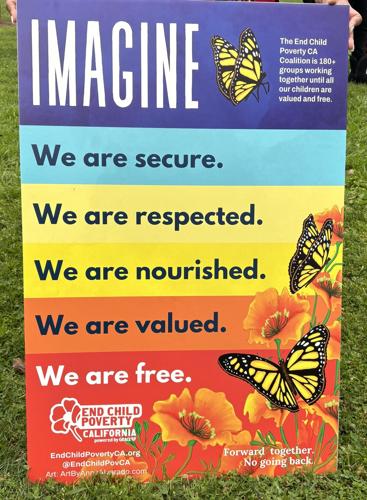
End Child Poverty California's Imagine 2026 agenda calls for bold investments to keep California families secure, respected, nourished, valued and free. (Andrea Valadez / CALÓ News)
“California is the fourth largest economy in the world and is often described as the state that feeds the nation,” said Yesenia Robancho, associate director of policy and strategy for ECPCA. “Yet right here in California, we are entering a crisis where families are getting kicked off of benefits solely because of their immigrant or working status.”
The advocates are hoping to expand CFAP, a program created to make the exact same benefits available to populations who lost their CalFresh benefits. Some lawfully present immigrants are currently not eligible for the program.
In 1996, Congress enacted a series of welfare reforms that reduced federal funding for low-income families, replacing it with state grants. Legal immigrants also lost access to public benefits, including food assistance.
Soon after, California implemented CFAP statewide to provide food assistance for the affected populations.
“In that moment, we saw California choose a different path,” said Benyamin Chao, supervising health and public benefits policy manager at the California Immigrant Policy Center. “To build a stronger, more inclusive safety net … so I ask, 30 years from now, when we look back at this moment, will we be proud of how our state responded?”
There are still last-minute budget negotiations happening, as lawmakers have until Aug. 31 to pass bills, and California Governor Gavin Newsom has until Sept. 30 to sign or veto bills for this session.
Robancho said the coalition has not heard if Monday’s policy points are a top priority in the final weeks of negotiations.
The 2026-27 budget, as it stands, invests $14 million in the CalFresh Outreach Network and provides $108 million to food banks across the state, though advocates say there is still much work to be done.
The $352 billion budget also sets aside an extra $6.4 billion for 2027-28, driven by higher-than-expected revenue over the past year, which Huerta pointed to before saying “there is no excuse why these programs should not be fully funded.”
“These are your final months in office and you have the opportunity to leave a legacy that Californians will remember for generations,” Chao said of Newsom. “You can lead California to say clearly that we refuse to let hunger follow immigration policy.”






(0) comments
Welcome to the discussion.
Log In
Keep it Clean. Please avoid obscene, vulgar, lewd, racist or sexually-oriented language.
PLEASE TURN OFF YOUR CAPS LOCK.
Don't Threaten. Threats of harming another person will not be tolerated.
Be Truthful. Don't knowingly lie about anyone or anything.
Be Nice. No racism, sexism or any sort of -ism that is degrading to another person.
Be Proactive. Use the 'Report' link on each comment to let us know of abusive posts.
Share with Us. We'd love to hear eyewitness accounts, the history behind an article.