
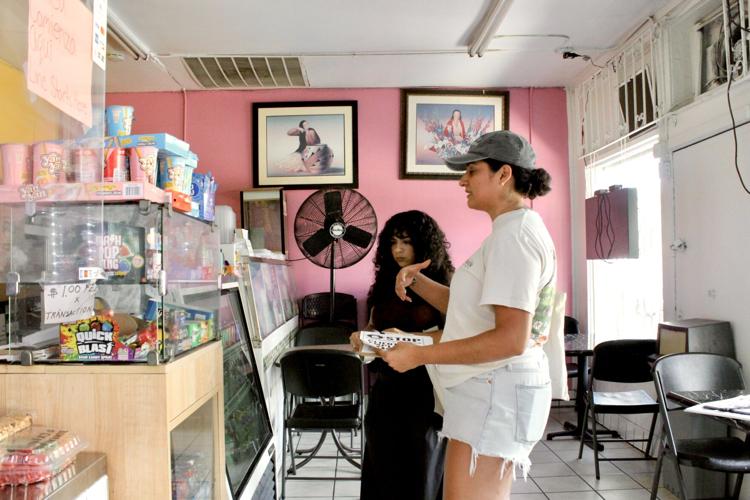








(front) Alejandra Quintero and Karina (back), both community organizers with Organize Power In Number inside a Lincoln Heights small business. Photo by Brenda Verano
One of the ways U.S. Immigration and Customs Enforcement (ICE) has scaled up nationwide enforcement actions is by issuing audits or federal inspections to small and local businesses that help identify workers who might not have a work permit or are undocumented.
The audit starts when ICE serves a Notice of Inspection (NOI), many times targeting workplaces such as restaurants, car washes and agricultural farms, among other places.
Community organizers say these types of operations lead to a high number of detentions as well as an increase in public fear and anxiety.
What many employers and small businesses do not always know is that they have at least three business days to hand over requested forms, payroll records and employee lists.

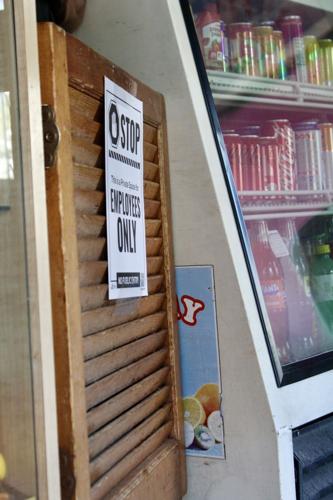
Signage inside a small business. Photo by Brenda Verano
"One of the things that we know that federal agents are doing is using an audit as a tactic to try to scare employers and employees. The government is allowed to ask businesses to check the information on the status of the workers, but the truth is that business owners actually have 72 hours to provide that information. They do not have to give that information right away,” said Alejandra Quintero, a community organizer with Organized Power In Numbers (OPIN). “By [us] giving this information to business owners, managers and workers, we ensure they're able to exercise their rights.”
Last week, members of OPIN, a labor organizing and digital advocacy non-profit group, walked into neighborhood businesses around Lincoln Heights to inform employers of their rights and responsibilities to protect their businesses and workers from ICE.
In Lincoln Heights, Latinos make up about 66% to 70% of the neighborhood population, many of whom are powering the local economy daily.
Similarly, Latino workers make up roughly 40% of the City of Los Angeles municipal workforce and about 48% of the broader workforce across the Los Angeles County region.
Maria Contreras, owner of Maracas Café and Catering in Lincoln Heights, explained to CALÓ News how the raids have impacted her business. She said her restaurant, which has been at the intersection of Gates Street and Broadway Avenue for 16 years, has been a second home to her and in the last months as ICE continues to racially profile Latinos, her employees' well-being and safety have taken priority.
“We all should support ourselves and our employees, their livelihood and their families,” she said. “I would hate for one of my employees to get arrested for coming to work to support their family.”
The story of Maracas Café and Catering began in 1961, when the Mendez family immigrated from Chiapas, Mexico and settled here in L.A. Contreras’s mother-in-law, Mama Leonor Mendez, was a single mother who began working in L.A. restaurants before taking the leap of faith and opening her own restaurant as well.

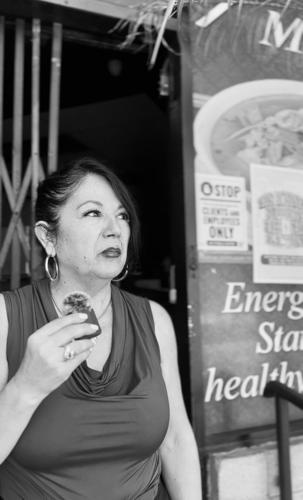
Maria Contreras, owner of Maracas Café and Catering in Lincoln Heights. Photo by Brenda Verano
Maracas initially opened on Main Street in Downtown L.A. in 1963, where she served food for 48 years before a major earthquake destroyed her first restaurant, forcing the family to relocate down the street. In 2010, the restaurant moved again. Since then, it has been operating in Lincoln Heights under the new leadership of Contreras and Mama Leonor Mendez’s son, Miguel.
For many business owners like Contreras, the ICE raids are closely tied to the upcoming general elections in November, as well as the current administration. “The way the Trump administration is handling this: total discrimination. Our rights are being violated,” she said.
Outside of her family’s restaurant, Contreras has signage that reads, "This business supports free plus fair elections; we are ready to protect our neighbors and our vote and stand up for all working people this November.”
Contreras said visual representation of her values is important to make her community feel safe and appreciated, especially in times of mass deportations. “If I could help in any little way, even with a poster or with some kind of sign, that is what I will do,” she said.
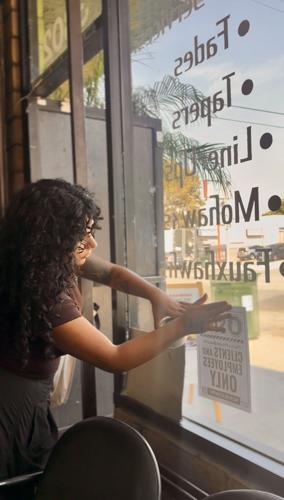
As part of their time in the Lincoln Heights neighborhood, OPIN members also sat with business owners and helped them with posting “employees only” signage to prevent ICE from entering back rooms or cooking areas.
This is part of the organization’s Neighborhood Defense Training, which looks to inform business owners that federal agents cannot legally enter private areas of a workplace without a judicial warrant signed by a judge.
As part of the training, organizers explain the difference between a valid judicial warrant and an administrative warrant, as well as walk owners through what a worker audit looks like and the rules behind it.

Karina helping a small business tape signage to protect workers. Photo by Brenda Verano
“We're talking to business owners about their Fourth and Fifth Amendment rights to protect themselves, employees and their customers in case of an ICE raid,” Karina, a local organizer with OPIN, said. “On top of that, we are also sharing information with them about actions they can take to defend democracy.”
Karina said organizations like OPIN are organizing against the Trump administration's efforts to regulate elections. “We are seeing that [Donald] Trump and his administration are trying to interfere with the legitimacy of the midterm elections, trying to restrict mail-in ballots,” Karina said.
She said that despite national attempts to restrict mail-in ballots and decrease voters' participation in the upcoming elections, business owners hold great influence when it comes to incentivizing their local neighborhood to move towards civic engagement and to vote and stand against mass deportations.
In January over 700 businesses across the state of Minnesota shut down in solidarity after the death of civilians, including Renée Nicole Good.
This July, in the city of Houston alone, 50 businesses also closed in solidarity with Lorenzo Salgado Araujo, a 52-year-old Mexican shot and killed by ICE agents in the East End neighborhood of Houston, Texas.
“That's just one of the many things that small businesses can do to fight back,” Karina said.
Don Ricardo, co-owner of Raspados Nayarit, also in Lincoln Heights, said business has taken a while to pick up since the ICE raids have hit the different communities in L.A. He said his wife, son and he have continued to keep their doors open but understand and sympathize with community members for whom a stroll or walk in the community is not an easy decision.
Karina and Quintero sat with Don Ricardo for nearly 30 minutes, educating him about his rights as a business owner. He said he hoped business would pick up soon, as that is his family’s main source of income.
"We know that an attack on one group of workers is an attack on everyone. This includes immigrant workers,” Quintero said.

In Lincoln Heights, Latinos make up about 66% to 70% of the neighborhood population. Photo by Brenda Verano
She said OPIN has trained 3,500 people in the last year to inform small businesses of their rights. Quintero said that for her, who lives just a couple of blocks away from Don Ricardo’s raspado business, the work she does with OPIN is very personal.
“When Trump won the second administration, we knew that one of the things that they were going to try to hit was businesses because we know that immigrants are workers, and in fact, that's the one place that they're kidnapping them and taking them to ICE detention centers,” she said. “Despite this, people want to protect their communities, and it has been so incredible to see this across the country.”
There are approximately 36.2 million small businesses in the United States, according to data from the U.S. Small Business Administration. In recent years, Latino entrepreneurship has surged, leading to employer-firm creation by Latino entrepreneurs outpacing non-Hispanic counterparts significantly.
“Small businesses are pillars of the community that can take power collectively,” Karina said.








(0) comments
Welcome to the discussion.
Log In
Keep it Clean. Please avoid obscene, vulgar, lewd, racist or sexually-oriented language.
PLEASE TURN OFF YOUR CAPS LOCK.
Don't Threaten. Threats of harming another person will not be tolerated.
Be Truthful. Don't knowingly lie about anyone or anything.
Be Nice. No racism, sexism or any sort of -ism that is degrading to another person.
Be Proactive. Use the 'Report' link on each comment to let us know of abusive posts.
Share with Us. We'd love to hear eyewitness accounts, the history behind an article.