
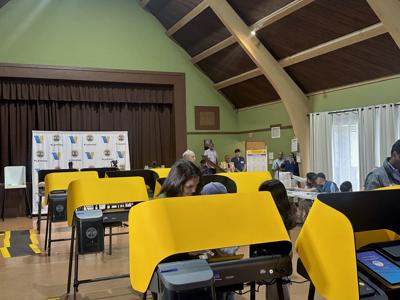


A voting center in Los Angeles. Photo by Brenda Verano
Just four months away from this November’s general election, voting rights advocates and organizers held a virtual conference to discuss the changing landscape of voting rights, election access and the challenges facing American democracy in the upcoming months.
The virtual briefing was hosted by American Community Media and featured voting rights experts, including Thomas A. Saenz, president and general counsel of the Mexican American Legal Defense and Educational Fund (MALDEF); DaHae Kim, policy advocacy manager at VoteRiders; and Annelise Pierce, founder and managing editor of Shasta Scout.
The featured guests stated that as the 2026 election season unfolds, voting changes throughout the United States could have a disproportionate impact on minority, low-income, elderly, rural and first-time voters.
MALDEF, the nation’s leading Latino legal civil rights organization, has worked to protect and defend the rights of all Latinos living in the U.S., including voting rights. Saenz said the upcoming general elections in November may be the most important election this country has held because of what is at stake, including the control of the House of Representatives and the U.S. Senate.
"Traditionally, midterm elections have had lower turnout than presidential elections in other years. This is something that needs to change this year. We need to see a heightened involvement,” he said.
Saenz told the forum attendees that it is more important than ever to access reliable information and not spread fear among voters. He referenced the proposed Safeguard American Voter Eligibility (SAVE) Act, championed by President Donald Trump, which would require individuals to provide proof of U.S. citizenship and present a specific photo ID to cast a ballot in federal elections.
“The President of the United States has no authority to regulate elections,” Saenz said. “This is why Trump is pushing so hard now to get federal legislation to require voter ID and to restrict the ability to cast a remote ballot, but under our Constitution, only Congress has the authority to regulate federal elections.”
He said these types of actions cause confusion and disproportionately affect people of color from casting their vote.
“What needs to occur in response to these measures is [for] all voters to become aware of what is required in their state to cast a ballot so that they know months in advance if they need to obtain a particular kind of identification, whether that's a driver's license or a state-issued ID or other form of identification,” he said.
This has led organizations like MALDEF to provide information online on what each state requires from voters.
“When the November election comes around, we will need to grapple with attempts to deter participation by putting out misinformation and disinformation [alerts] about the date of the election, about where you have to vote and about what it takes to cast a ballot,” he said.
He said the organization has already come across misinformation about who can vote, the locations of polling places and voter fraud.
Kim said VoteRiders supports millions of voters each year with voter ID education and free direct assistance for people to obtain the identification needed to vote. Kim said volunteers help with voter registration, transportation to the DMV, and translation services, among other things.
She said today, more than ever, VoteRiders has seen heightened attempts to silence eligible voters with overly complicated voter ID laws.
“Now, new and stricter voter ID laws create widespread barriers for eligible voters,” she said. "The ever-changing landscape of voter ID laws creates confusion for voters who will often stay at home rather than face shame or get turned away or intimidated for potentially not having the correct form of ID.”
Pierce, founder and managing editor of Shasta Scout, a nonprofit news media organization located about an hour from Oregon, said she has seen what it is like to live in a place where secessionist movements have thrived and where there's been a lot of antagonism towards the California government.
"We're in the very far north of California and it's a really radically different place than the majority of California, where political viewpoints are quite far to the right and have been quite conservative for quite a while,” she said.
Pierce openly talked about Measure B in Shasta County, a voter-approved measure that gained 56% approval in Shasta’s June primary.
The voter-approved measure seeks to mandate voter ID, eliminate most mail-in voting, implement a hand count of votes and separate Shasta’s voter rolls from state oversight.
Many of these election procedures contradict current state laws.
Despite being approved by voters, it has already been contested by state officials.
California Attorney General Rob Bonta announced on Tuesday, June 30, that the state would continue to challenge Shasta County’s Measure B in a lawsuit now being brought to Shasta County Superior Court.
“Our position remains unchanged: Measure B is legally indefensible,” said Bonta. “With our lawsuit now filed in Shasta County Superior Court, we will next seek expedited relief to prevent the measure from interfering with voter registration and election processes in advance of the November midterm election. No city or county gets to unilaterally rewrite our election rules.”
For more information on other virtual forums like this one, visit https://americancommunitymedia.org/.






(0) comments
Welcome to the discussion.
Log In
Keep it Clean. Please avoid obscene, vulgar, lewd, racist or sexually-oriented language.
PLEASE TURN OFF YOUR CAPS LOCK.
Don't Threaten. Threats of harming another person will not be tolerated.
Be Truthful. Don't knowingly lie about anyone or anything.
Be Nice. No racism, sexism or any sort of -ism that is degrading to another person.
Be Proactive. Use the 'Report' link on each comment to let us know of abusive posts.
Share with Us. We'd love to hear eyewitness accounts, the history behind an article.