









Mutual aid workers, immigration attorneys and activists are exhausted. How do they keep going?
This story is part of ICE vs. LA, a collaborative reporting project by LA Public Press, CALÓ News, Capital & Main, Capital B, LA Taco, and Q Voice.
Six Los Angeles newsrooms worked together to report what actually happens when immigration enforcement arrives — how people mobilize, look out for each other and try to keep their families intact. Read more from the collaboration here.
Since June 6, Los Angeles has been the epicenter of resistance against the Trump administration’s aggressive anti-immigration campaign.
As armies of federal agents have descended on cities, bent on racking up deportations, organizers, volunteers and families have been fighting day and night to protect the vulnerable people in their communities.
Cities are on edge and communities are under heavy stress. Mutual aid workers, immigration attorneys and activists are exhausted. Organizers say burnout is taking a toll on their networks. To better understand how those on the front lines are coping, we reached out to community members in the middle of the struggle and asked, “How do you keep going?”
Here are the practical strategies people are actually using to keep showing up for this work, while making sure they are taking care of themselves.
Katherine Tello

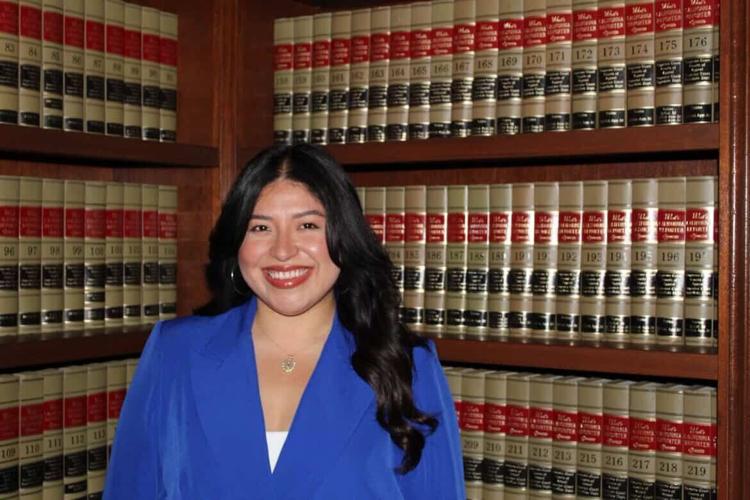
Courtesy of Katherine Tello.
She/Her/Ella
Staff Attorney and Legal Fellow, United Farm Workers Foundation
Bakersfield, CA
Katherine Tello grew up in Kern County. She was raised by immigrant parents and surrounded by farmworkers her whole life. From a young age she understood her purpose: advocacy and service. Now she’s part of the legal staff at the United Farm Workers Foundation, which advocates for farmworkers and immigrants by mobilizing organizations across the country to push for more equitable policies—immigration reform, pesticide protections, heat standards, hazard pay and other worker protections.
“Understanding the current administration’s draconian enforcement methods and the fear they create within the community fuels my drive to keep pushing forward,” Tello said. “But my roots and passion aren’t the only things that help me stay grounded. I also hold my faith and spirituality at the center of my life. I am a practicing Catholic, and I believe that each day is a new opportunity to do my best with what God allows, trusting that He will handle the rest. I find strength in surrendering to Him.”
She also practices yoga about three to four times a week, and lifts weights. “This work is demanding, often requiring us to be alert and on edge; therefore, moments of calm and peace are essential,” she said “These practices, along with my family, provide me with moments to breathe, reflect and recharge.”
There’s also camaraderie in the struggle, she said. “Every person I encounter in this line of work is not a coincidence but part of a larger purpose. We spend countless hours together, understanding the demands and supporting one another through it all.”
Complete distraction from the stress around you is impossible, she said, but self-care is still crucial. “Self-care means different things for everyone,” she said. ”Doing what makes you smile, laugh, feel peace and feel renewed. These practices are vital for sustaining the passion and resilience needed to continue this important work.”
Jack Murillo
He/Him
Activist and artist
Los Angeles, CA

Courtesy of Jack Murillo.
Jack Murillo is a Latinx-Indigenous artist and activist of Nahua, Otomí and Cree-Métis descent, and an alumnus of the two-year Conservatory Program at The Lee Strasberg Theatre and Film Institute in Los Angeles. Murillo was diagnosed with anxious hypervigilance from his time in the Marine Corps Infantry, where his mind was reshaped to seek and neutralize threats.
“Reentering the real world meant learning to relax, to stop scanning every street, crowd and corner,” he said. “For nine years, I’ve wrestled with this demon disrupting my life. And now that same demon is once again my ally, for at any moment masked thugs with guns could descend on me or my community, or this regime could peddle another hateful, deceitful narrative—and I remain watchful, aware and ready to respond.”
Since his honorable discharge, he’s reformed his mind, worked to reconnect with his cultures and he said, reclaimed his humanity.
“I was inconsolable when I realized I’d been trained to be a tool of imperialism, but from those ashes, I rose,” he said. “I now carry the warrior spirit of my ancestors, honed by the fire of the Marines, to fight not for the empire, but for the liberation and dignity of my people as they seek prosperity here in the United States.”
That struggle takes the form of advocacy, community and education, he said: challenging social conditioning, exposing history that was intentionally hidden, remaining meaningfully involved with community and taking to the streets as often as he can.
“I treat my passion like a flame. Amidst so much injustice, the flame burns bright, but if we’re not careful it will consume all and leave nothing but scorched earth in our hearts. If my engagement is a full-force charge every time, it’ll leave me drained, at which point I’d begin to distance myself from the fight to preserve my sanity. Before long I won’t be in the fight at all,” he shared.
Murillo also said that he is currently treating this era as a deployment, not in terms of violence, but in terms of operational sustainability.
“Rotations, logistics, rest and relaxation, assessing the battlefield, holding to principles, staying informed but not flooded, keeping in touch with loved ones, and leaning on the community. All of these things coalesce to ensure a sustainable operation. This regime is counting on us quitting, so we must resist the instinct to do so and maintain our presence. Even if your only motivation is pure spite, stay in the fight,” he said.
In this struggle, he’s witnessed the most unlikely, hardened people change. “These experiences prove that it is still worth doing and gives me hope for the future,” he said. “And as a wise man once said, ‘Las rebeliones se construyen sobre la esperanza.'”
Valerie Sigamani
She/Her
Immigration Attorney
San Diego, CA

Courtesy of Valerie Sigamani.
Before becoming an attorney Valerie Sigamani used to work at immigration and humanitarian nonprofit organizations. In January, Sigamani started working as an immigration lawyer, and the work hasn’t let up. Sigamani constantly feels like she has to put on a brave face and be the strong person her clients need. She’s also constantly adjusting and reacting to new fronts on the immigration enforcement battle.
“I’m constantly thinking, strategizing and learning how to get a positive result for my client,” she said. “I’m consistently learning how to work with people on the other side in order to keep my clients from getting detained. I have changed my strategy at least every other month.”
She’s not sure how she’s keeping distracted, but her faith and trust in God has kept her afloat.
“The summer was nice because I spent a lot of time in nature after or before work,” she said. “But now I’ll have to see how I can unwind even if the sun isn’t up to be in nature.”
Ashley Rios
Organizer, member of Organizing for a Better Change
She/Her
Bakersfield, CA

Member of Organizing For a Better Change Ashley Rios, at a protest she attended in Bakersfield. Courtesy of Ashley Rios.
Ashley Garcia Rios, one of the original founding members of Organizing For a Better Change, has had her political sensibilities shaped by her childhood, when she constantly feared her parents would be taken away.
On October 20, Rios, a U.S. citizen, was detained by immigration agents, put in handcuffs and put in the back of a truck. She said it was the longest hour of her life.
“I didn’t realize how lucky I have it by having a simple piece of paper and many other documents that other people would like to have in order to go back home and visit their family,” she said. “Nuestras familias no solamente cruzaron fronteras físicas, pero fronteras lingüísticas y culturales.” (“Our families didn’t just cross physical borders, but linguistic and cultural borders.”)
From being a little girl who was scared in 2016 that her family would get separated, she’s now an adult using her voice and her privilege to fight to keep families together. “Soy y siempre seré orgullosamente hija de padres inmigrantes,” she said. (“I am and will always be a proud child of immigrants.”)
Organizing For A Better Change is a nonprofit organization in Kern County created by a youth group of eight high school students and one college student. This organization not only advocates for education but also for immigrant rights and for those who are unable to stand up for themselves.
Along with working two part-time jobs and organizing, Rios is also a college student. She tries to keep herself busy and distracted by working and going to school. She sometimes goes on her phone to distract herself but often-times finds herself looking at difficult news. “The first thing I always see is the latest news of immigration of families being kidnapped off the streets,” she said.
“I wonder how the immigration officers go home and tell their kids that they just ripped someone’s dad away from their side?” she said. “How the immigration officers have the heart to do that when they come from the descent of immigrants as well?”
Now families are being separated by borders that never naturally existed, she said. “I love my home, and I love my roots.” Garcia also leans on family and friends for support and to distress on days where she feels overwhelmed.
Karla Alejandra Zamora
Childcare worker
Oxnard, CA
It’s very surreal, Karla Alejandra Zamora said, working with kids at a daycare amidst chaos in her community.
“It can be very hard trying to be present with the children, planning activities for them and going about my day with them all while knowing that there are raids going on in the community,” she said. On July 10, immigration agents raided Glass House Farms in neighboring Camarillo, arresting hundreds of workers. Zamora had people calling and trying to reach out to her seeking information, giving her information on what was happening and all the while she was at work trying to keep it together and care for children.
“Trying not to alert them too much on what was happening so they wouldn’t get scared,” she said. “Because a lot of these kids get scared. They fear for their family and themselves.”
She woke up again to videos of a military grade vehicle rolling down the street in front of a panaderia her family has gone to since they came to Oxnard from Mexico. She spent the day contacting family and close ones to make sure they were okay, all the while trying to keep an upbeat and fun attitude with the kids at work. “It’s hard to cope with what’s going on,” she said. “Especially because I am hard on myself and I feel like I could be doing more, but I can’t be out there like I would like to be.”
She says she copes by focusing on her job, caring for the children, “making it so that at least when they are with me, they don’t feel fear or sadness with what’s going on. I try to bring as much joy and care as I can to them.”
Ron Gochez

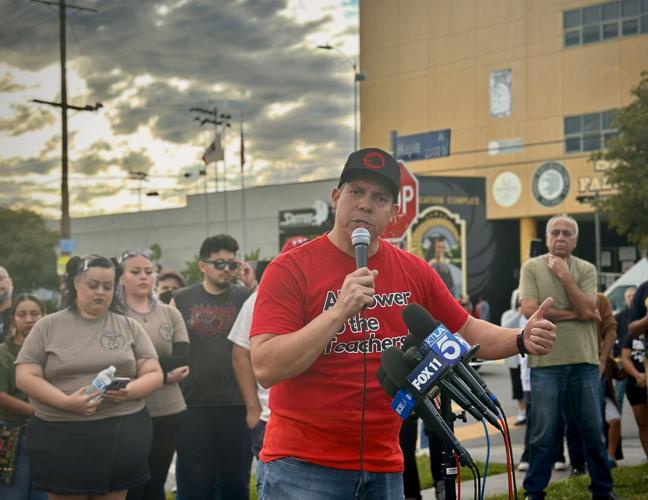
Ron Gochez. Photo credit: Brenda Verano
Community Organizer, Union del Barrio
He/Him
Los Angeles, CA
Ron Gochez usually has 12-hour days, some longer.
Gochez is a community organizer with Union del Barrio, an independent political organization at the forefront of the community patrol and rapid response efforts against the ongoing ICE raids in Los Angeles and Southern California.
The 44-year-old begins his days at 5 a.m., rain or shine. Some days, he gathers with volunteers around 6 a.m. to patrol neighborhoods, looking for and alerting residents to any ICE activity. As the sun rises, Gochez is on the move, organizing with other volunteers via phone calls or text and providing updates for community members.
Then he drives to his job as a teacher at a public school in South Central Los Angeles, where he works from 8:30 to 3 p.m. After clocking out, he goes back to community duties, organizing demonstrations, press conferences, community patrol trainings and teacher teach-ins aimed at educating other teachers on how to better protect their students and communities.
His days end around 6 p.m., as the sun goes down.
Despite the long hours, Gochez told CALO News he remains committed to protecting the community he loves, while also admitting that feelings of burnout have also tapped on his door from time to time.
“It’s an absolute honor to do the work that we do,” he said. “If I told you that I feel that I’m balancing things and that I am handling things well in terms of not burning out, that wouldn’t be honest.”
There are days that are harder than others, mentally and physically, and when those days come, he said it is his family and “strong political conviction” that keep him going.
Aside from organizing and educating, there is another hat he wears proudly: being a father to his two-year-old son.
“To me, self-care is seeing my son and being able to spend time with him,” he said.
Apart from much of his TV or online presence, where he is usually shown in the front center of a demonstration talking passionately and loudly about the right to organize and the power within communities, fatherhood has led him to enjoy the moments of play and stillness.
“I love spending any free time just doing any silly, fun stuff with my son,” he said. “Not so long ago, on a day when I had no meetings, we went to a theme park and we just had fun like normal people. It was great. That, for me, is self-care.”
Balancing family and self-care time, along with his role as an organizer, is something he continues to practice and learn to do. He said his wife, who is also a community organizer with Union del Barrio, is the driving force not just for the work the organization does but also for their family.
At the peak of the ICE raids in L.A., when he was answering dozens of daily calls on the local rapid response hotline, his mental health struggled the most, he told CALÒ News.
“People would call us crying in panic or sometimes even whispering, telling us they had taken or were taking their parents, family members [or] neighbors. The phone would just ring and ring,” he said. “And that gets to you; it really does.”
In difficult times like this, it is his colleagues and the dedication from local self-defense organizers that inspire him to continue. “I’m not trying to paint a picture that we’re some kind of heroes, not at all. We’re doing the best that we can with what we have.”
His political conviction and political upbringing are inspired by the Salvadorian revolution. Gochez was born to a Salvadoran mother and a Mexican father.
“I was raised more Salvadorian; my people, we come from revolution and a lot of my political upbringing was from revolutionaries from El Salvador, people who were in combat and literally sacrificed everything and they still didn’t give up. They still didn’t quit. They didn’t surrender,” he said. “That’s what we call political conviction. I truly believe in what we do.”
Being part of Union del Barrio, which is made up solely of volunteers, means taking care of members has been a top priority, he said. A lot of them feel guilty saying no when asked to do another training or teaching, knowing people are asking because they want to be involved, participate or learn—and there’s a big need in the communities.
When they’ve seen members experience fatigue or signs of burnout, they’ve stepped in.
“When we start to see that in some of our members, we’ve had to send them home in the past, even booked them a room in other cities or had them decompress, spend time with family and just breathe,” he said. “Our folks are committed and they’re disciplined, but we have to remind them we need them for the long haul; we can’t afford to burn out.”
“I’m not in a position to just give up. Our people depend on us to do this work and I’m not complaining about it. The people who are having their family members kidnapped—that’s what is truly painful.”











(0) comments
Welcome to the discussion.
Log In
Keep it Clean. Please avoid obscene, vulgar, lewd, racist or sexually-oriented language.
PLEASE TURN OFF YOUR CAPS LOCK.
Don't Threaten. Threats of harming another person will not be tolerated.
Be Truthful. Don't knowingly lie about anyone or anything.
Be Nice. No racism, sexism or any sort of -ism that is degrading to another person.
Be Proactive. Use the 'Report' link on each comment to let us know of abusive posts.
Share with Us. We'd love to hear eyewitness accounts, the history behind an article.