
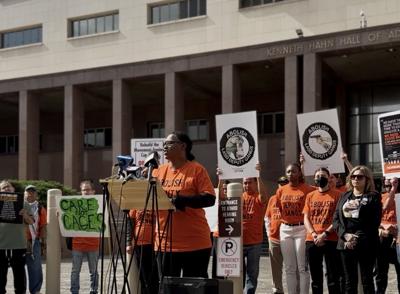
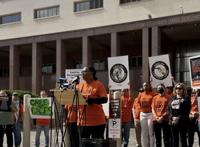


Community organizations outside of the L.A. Board of Supervisors meeting. Photo by (Brenda Vernao / CALÓ News)
Banditos, Compton Executioners, Ghetto Birds, Little Red Devils and Wayside Whities are just a few of the 27 identified deputy gangs within the Los Angeles County Sheriff’s Department (LASD) that were listed in an L.A. County motion that seeks to bring more accountability and further investigation into police gangs.
The motion was pushed back on Thursday afternoon, after hours of public comment, with the L.A. County Board of Supervisors arguing the delay was necessary for county attorneys and labor relations officials to be able to identify whether compiling reports on deputy gangs would trigger a "meet and confer" bargaining process with pro-deputy unions, such as the Association for Los Angeles Deputy Sheriffs.
The board directed the county CEO, in conjunction with the sheriff, county attorneys and employee relations officials, to review the proposals included in the sweeping motion by Supervisor Holly Mitchell aimed at detailing the extent of deputy gangs within the department. The CEO was instructed to return to the board with a report in 30 days.
Janet Asante, lead organizer with Justice LA Coalition, told CALÓ News that police unions use "meet and confer," a legal requirement under California labor laws, to stall or block investigations into deputy gangs by arguing that a labor agreement and bargain with sheriff's unions must come first.
“[‘Meet and confer’] basically means that when a new law or a policy is introduced, the union is able to negotiate with the county to figure out how it gets implemented. But when you sit in that process of negotiating for years, it means that the community never sees accountability and that's exactly what these sheriff's unions are doing,” Asante said.
Community organizers and survivors of police violence expressed their frustration with the delay, as they said that secret internal cliques and gangs within LASD are not new and instead remain a persistent issue dating back to the 1970s.
The motion was delayed at a time when there had already been multiple attempts to investigate the sheriff gangs, including some dating to five years ago when Congresswoman Maxine Waters (CA-43) requested the U.S. Department of Justice to investigate the Executioners, a sheriff gang that at that time operated within the Compton Sheriff's Station.
The motion sought to move forward investigations and confidential reports by independent and county departments, such as the Los Angeles County Counsel, the Office of Inspector General (OIG) and the Sheriff Civilian Oversight Commission, that would help with identifying all deputy gangs in the county and any shared tattoos or iconography used among the members.
The motion would have also directed the sheriff and county counsel to collaborate and jointly provide the L.A. County Board of Supervisors with a summary of the status of any pending administrative investigations relating to deputy gangs, cliques and secret subgroups.
Although community organizers and survivors of police violence applaud the introduction of the motion, they say this has been long overdue and is only a first step to real accountability and repair from what deputy gangs have done to families and entire communities.
Janet Asante, lead organizer with Justice LA Coalition, told CALÓ News that the motion reflects years of LASD not cooperating with independent investigations, as well as its inability to conduct thorough self-investigations within its own facilities.
“The sheriff’s department has refused to cooperate, forcing the board to take this step,” Asante said. “While this motion will not give us the true accountability we need, it is an important first step that will require the gangs and their illicit activities to be explicitly identified by LASD.This motion will also reveal whether LASD has been investigating its officers and the gangs and to what extent. If the reports show that they have not, it will be a huge red flag.”
History of deputy gangs among LA law enforcement
Deputy gangs have existed in the Los Angeles County Sheriff’s Department for years.
The first documented case of them dates back to 1973. The first deputy gang that LASD acknowledged was the Little Devils, which operated out of the East Los Angeles Sheriff’s Station and was said to have emerged in the aftermath of the Chicano Moratorium, during which three people died following interactions with LASD. In 1973, there were 38 members of “Little Devils,” who bore sequentially numbered tattoos of a devil.
In 2012, the Citizens’ Commission on Jail Violence (CCJV) found that deputy cliques existed in patrol and on certain floors of Men’s Central Jail (MCJ), a jail where hundreds of men have died and taken their own lives.
For years, mothers like Vanessa Perez have demanded transparency on what is happening to inmates inside MCJ, where six years ago her son Joseph Perez was brutally beaten by sheriffs who were part of the Industry Indians gang.
Perez said that at the time of his arrest, Joseph was experiencing a mental health crisis.
Perez has since filed an ongoing civil lawsuit against the County of L.A. and the sheriff's department.
Perez said her son has been left with seizures lasting up to two minutes since he was beaten.
“Two of the seven officers who beat him have been confirmed deputy gang members,” she told CALÓ News on Tuesday. “He had five lacerations to his scalp and 30 stitches to his face and his ears. What they did to Joseph is unspeakable, and if I can make sure that it does not happen to anyone else, then that's what I will continue to do.”
Although the motion would help with identifying all deputy gangs in the county, it will not identify the members, something that for mothers like Perez leaves justice “at a halt.”
“We are asking [L.A. County Sheriff] Robert Luna to embrace the responsibility of moving this county beyond simply documenting deputy gangs and towards actually identifying the deputies who belong to them and holding them all accountable,” Perez said. “These conversations cannot only happen behind closed doors."
In a statement, Luna said that he and the department "recognize the serious issue that deputy gangs pose to the department and communities.”
He also said the department has implemented most of the 26 recommendations laid out by a Civilian Oversight Commission’s 2023 report. One of these recommendations is a “Two Captain” model, where LASD assigns a senior captain and a newly promoted captain to stations known to have a large number of deputy gang members. The model aims to ensure maximum supervision, but Asante said this implementation only increases the LASD budget.
At the L.A. Board of Supervisors meeting Tuesday morning, Luna gave a lengthy presentation outlining what he called a series of measures taken during his administration to root out gangs within the department, saying he maintains a zero-tolerance policy.
He added that the primary thrust of the motion, which is identifying the names of deputy gangs and tattoos, will not do anything to address the issue. He said investigations of deputy gangs need to focus on actual documented gang activity, not names and symbols.
“This motion is about addressing the system that allows this problem to continue,'' Mitchell said. “It seeks to determine what we know about deputy gangs, how we identify these subgroups and what options are available to this board to hold these groups responsible.”






(0) comments
Welcome to the discussion.
Log In
Keep it Clean. Please avoid obscene, vulgar, lewd, racist or sexually-oriented language.
PLEASE TURN OFF YOUR CAPS LOCK.
Don't Threaten. Threats of harming another person will not be tolerated.
Be Truthful. Don't knowingly lie about anyone or anything.
Be Nice. No racism, sexism or any sort of -ism that is degrading to another person.
Be Proactive. Use the 'Report' link on each comment to let us know of abusive posts.
Share with Us. We'd love to hear eyewitness accounts, the history behind an article.