
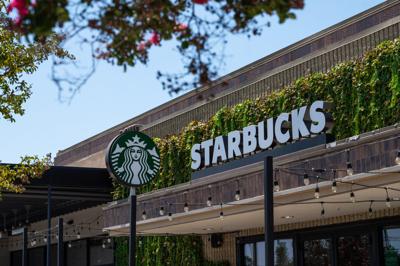


A Starbucks store in Los Angeles. Photo: Semantha Raquel Norris.
This article was produced by Capital & Main. It is published here with permission.
Soon after Starbucks introduced a new blending powder, Destiny Valencia, a barista in San Jose, California, began experiencing headaches and feeling fatigued after mixing drinks that use the new ingredient.
“It was multiple days until I connected the dots that it maybe had something to do with the powder,” said Valencia. “So, anytime I would make a drink with the powder after that point, I would just hold my breath.”
Baristas nationwide have reported experiencing headaches, coughing, sore throats, hives and other health problems in recent weeks after working with a new blending powder used in Starbucks Blended Refreshers, which they say can form a fine, airborne dust.
Starbucks Workers United, which represents more than 12,000 baristas at hundreds of stores nationwide, has demanded that the company address concerns about the risks from inhaling powder as part of the health and safety improvements they are seeking as they fight for a union contract.
This week Starbucks removed the blending powder from its stores and said it had no plans to bring it back.
In a statement to Capital & Main, a Starbucks spokesperson said the blending powder was “safe for use in food and safe for use in our coffeehouses when used according to instructions,” and that blended refreshers had been removed in a regular seasonal menu transition.
“We know our collective action prompted the company to direct stores to remove the powder, but the risk of using this product remains, and we won’t stop calling for its permanent removal from every store,” said Jasmine Leli, a union organizer and barista from Buffalo, New York.
When Starbucks launched the drinks on July 14, baristas were instructed to use the powder as a binding agent, scooping it into a blender with ice and flavoring, according to union representatives. But baristas say the process of emptying, scooping and mixing the powder generates clouds of fine dust that they’re forced to inhale.
“We have multiple powders that we use at work, but this one gets airborne significantly easier than any of the other powders,” Valencia said. “You can see it in the air.”
Valencia, who has worked as a Starbucks barista for four years, said she raised health concerns with management. But they were dismissed, Valencia said, and she was not given further instruction on safely handling the powder or provided with protective equipment such as a mask.
Starbucks Workers United recently surveyed baristas, asking if they have felt sick since the powder’s launch. The union received nearly 600 responses and posted some of them on social media.
“I almost passed out after making one of those drinks and the headache came on immediately after I scooped that powder into the blender,” one barista reported.
“I have asthma and I have noticed that ever since I have started crafting the blended beverages with the blending powder, my chest has been hurting so badly and I have had to take my inhaler more than normal,” reported another worker.
Other Starbucks workers reported experiencing sneezing, stuffy noses, itchy or swollen throats or hives, as well as bumps and rashes since the company introduced the new powder.
After receiving the survey responses, the union sent Starbucks an information request seeking details about the silica used in the powder and its potential health effects, said Leli. On July 27 the company posted a statement saying the powder “contains a small amount of food grade silica, an FDA-approved ingredient commonly used in food products that helps ingredients mix consistently and supports a consistent beverage experience” and “is safe for use in food.”
In social media posts, union representatives have said that the company’s response did not address workers’ concerns about the health risks of inhaling the new powder, that there were no warning labels on the powder’s packaging and that the company did not provide additional safety training for working with the new ingredient.
The union posted screenshots from an in-store Starbucks AI system that, when asked if the silica in blending powder is safe when airborne, responded by suggesting employees avoid “breathing dust, as inhalation may cause irritation to the respiratory tract.”
Internal preparation instructions the company provided to baristas and which the union posted on social media said that the blending powder can be “messy” and instructed workers to “pour slowly” to avoid making it airborne.
But workers said those instructions were impractical and at odds with the company’s drive for speed and efficiency.
“There’s no culture at Starbucks where you are asked to move slower,” said Leli, adding that workers are being told to have drinks ready in under four minutes.
Starbucks Workers United, which started in Buffalo, New York, in 2021, has grown to over 700 unionized stores across 45 states, from California and Washington to Texas, Florida and New York. Four years later, the union is bargaining for its first contract and recently added new demands around health and safety, including that the company consult baristas before introducing new ingredients. The union is also calling for higher wages, more consistent schedules, at least three workers in stores at a time for safety and just cause protections against arbitrary termination, among other improvements to working conditions.
“Money that was invested in this product could have been invested in finalizing the contract for Starbucks baristas or giving us more staffing so that partners can get the hours that we need,” said Leli.
“Starbucks needs to finalize a fair contract and stop coming up with new gimmicks that don’t work,” she added.
At the request of Starbucks Workers United, Dr. Peter Orris, who practices occupational medicine at the University of Illinois Hospital and Health Sciences System in Chicago, analyzed the ingredients listed on blending powder packages, including silica, gum arabic, maltodextrin, rebaudioside A and xanthum gum, and also observed workers using the powder in August.
Most of the components are generally considered safe by the Food and Drug Administration when used as intended for consumption, Orris said in an interview, but inhalation is a different route of exposure.
The type of food-grade amorphous silica used in the powder, while considered safe to consume, can still cause adverse health effects when inhaled. Gum arabic may be a skin, eye and throat irritant when airborne, and xanthum gum can cause skin, eye or respiratory irritation if a person is exposed to the dust, concluded Orris in the report, which the union sent to Starbucks headquarters.
“If you have asthma and if you are in fact sensitized to this material … then very low doses are going to cause you significant respiratory problems,” Orris said in an interview.
Besides acute symptoms during airborne exposure, and apart from individuals with specific allergies or asthma, there are no long-term impacts on human health, he said, but Starbucks should have evaluated its effects before exposing employees and customers to the aerosolized powder.
Orris recommended that Starbucks install exhaust ventilators and provide N95 masks to reduce immediate dust exposure. He also recommended a standardized protocol for cleaning the work surfaces. While taking those steps won’t prevent all symptoms, Orris wrote in his report, “It should reduce the breadth of the irritant effects on those working or shopping at Starbucks.”
Valencia, the barista in San Jose, said she hopes the union’s efforts lead to a healthier working environment in Starbucks stores.
“I hope that this is a message to Starbucks that they should do a little bit more research on the ingredients that they’re exposing their baristas to every day,” she said.
















(0) comments
Welcome to the discussion.
Log In
Keep it Clean. Please avoid obscene, vulgar, lewd, racist or sexually-oriented language.
PLEASE TURN OFF YOUR CAPS LOCK.
Don't Threaten. Threats of harming another person will not be tolerated.
Be Truthful. Don't knowingly lie about anyone or anything.
Be Nice. No racism, sexism or any sort of -ism that is degrading to another person.
Be Proactive. Use the 'Report' link on each comment to let us know of abusive posts.
Share with Us. We'd love to hear eyewitness accounts, the history behind an article.