
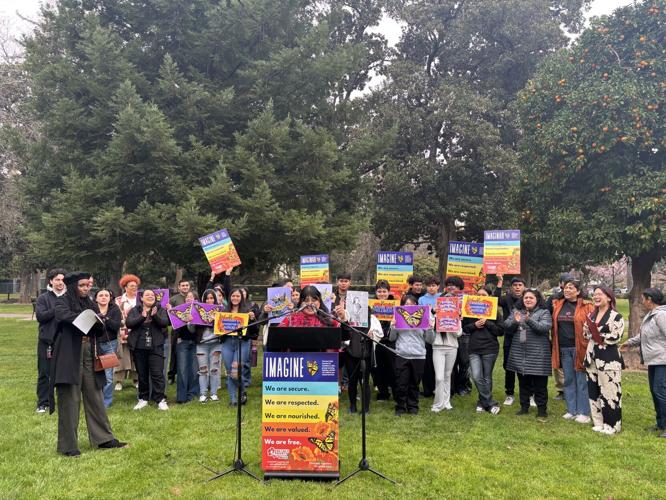


The advocacy group End Child Poverty California hosted a press conference at the California Capitol to call on legislators to invest in services that support families and children. (Andrea Valadez / CALÓ News)
Child and family advocates from throughout California gathered at the Capitol on Tuesday to call for increased funding and investments in “poverty-fighting tools,” including child care assistance, tax credits for families and food aid.
Organized by the End Child Poverty California Coalition (ECPCA), a campaign representing over 180 advocacy groups, the crowd called on Governor Gavin Newsom and the state legislature to work with them to follow through on promises already made, and to prioritize further investments to support families and children. The call to action follows what the group called “draconian federal rollbacks and cuts.”
“California is at a crossroads,” said Yesenia Robancho, associate director of policy and strategy at ECPCA. “Let's be clear, federal cuts are already harming our community. Cuts to Medicaid, nutrition assistance, child care and other essential programs mean fewer doctor visits, empty refrigerators and families forced to make impossible choices ... when the federal government pulls back, California families pay the price.”
California continues to have both the highest poverty (17.7%) and child poverty (18.6%) rates in the nation, according to the Census Bureau’s Supplemental Poverty Measure. Black and Latino Californians experience poverty at close to twice the rate of white residents.
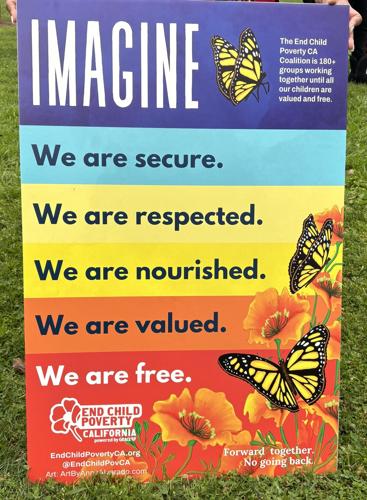
ECPCA points to its Imagine 2026 agenda as a roadmap for how leaders can begin addressing the financial harms families are facing under federal cuts caused by the budget Congress passed last July.

End Child Poverty California's Imagine 2026 agenda calls for bold investments to keep California families secure, respected, nourished, valued and free. (Andrea Valadez / CALÓ News)
The coalition’s policy points include reimagining CalWORKs, a state program that provides cash aid and services to qualifying families, fighting federal cuts to the Supplemental Nutrition Assistance Program (SNAP), known as CalFresh in the state and delivering on the state’s promise to provide 200,000 child care slots and more.
“The Imagine Agenda lays out a clear, responsible path forward,” Robancho said. “One that ensures children are fed, mothers receive health care and California families are supported through fair and just revenues. It asks those who have benefited the most from California's economy to contribute their fair share so our kids can thrive, seniors can age with dignity and our communities can be safe and healthy.”
The proposed solution
There are already multiple pieces of legislation on the table that align with ECPCA’s priorities. One of them, Assembly Bill 1690, authored by Assemblymember Patrick Ahrens (D-Cupertino), proposes expanding the existing Young Child Tax Credit (YCTC) to all families that are eligible for the state's Earned Income Tax Credit.
The YCTC currently expires once the child turns six. This, advocates say, is only the beginning of the financial burden parents face.
“We all know that raising a child doesn't get cheaper when they turn six,” said Kalisha Monee' Goodwin, a Fresno-based marriage and family therapist and consultant. She went on to say, “we need policies that grow with our children, not ones that leave us behind when they enter the first grade.”
One of the biggest asks from the coalition is not so much an ask, but a demand that legislators follow through on promises and legislation they've already agreed to.
In 2021, Newsom signed legislation to fund 200,000 new child care spaces by 2025-26. Data shows roughly 129,000 spaces have opened, while funding for the rest has not been delivered. In 2024, the legislature said it would fund the additional slots in 2026. The governor’s proposed budget, however, makes no mention of this.
In 2016, voters approved Proposition 64, legalizing cannabis and allocating funds from the two new taxes from cannabis sales to youth education, youth leadership and civic engagement programs. Since its passing, one of the taxes has been eliminated and the other reduced.
“This argument of 'there's not enough money to do it’ is just not true,” Jennifer Greppy, director of parent policy at Parent Voices, a grassroots organization fighting to transform child care, told CALÓ News. “We have plenty of money in California to do the things that we want to do and to serve all of those families. It's about priorities. So, instead of funding big corporations and tax breaks to billionaires, we believe that we need to make sure that we are funding families and children and our communities first.”
Greppy said families and children are “counting on” the Legislature and governor following through with their promises.
“We are imagining something better for our children and families,” said Robancho, “and we challenge California leaders to have the courage to make it real.”
Federal and state cuts
H.R. 1, often referred to as President Donald Trump’s “One Big, Beautiful Bill” threatens a range of individuals, including those from low-income households, foster youth, immigrants and people with disabilities in more ways than one.
Changes to SNAP, which faced a months-long legal battle last year, have resulted in fewer people qualifying for the crucial food assistance program. The Trump administration tried to prohibit certain legal permanent residents from the program, changed income guidelines and removed exemptions for veterans, homeless individuals and young adults.
These federal cuts to SNAP will result in losses ranging from $2.3 to $5.1 billion annually to CalFresh and put close to 578,000 families in the state at risk of losing their benefits, according to the California Health and Human Services Department.
Another threat to low-income families is the drastic changes to Medicaid, known as Medi-Cal in the state. The bill introduced strict work requirements, limited coverage for undocumented individuals, reduced federal tax cuts and more.
More than one in three Latino Californians is enrolled in Medi-Cal, according to the California Budget and Policy Center. According to the same report, up to 3.4 million Californians could lose their Medi-Cal coverage due to H.R.1.







(0) comments
Welcome to the discussion.
Log In
Keep it Clean. Please avoid obscene, vulgar, lewd, racist or sexually-oriented language.
PLEASE TURN OFF YOUR CAPS LOCK.
Don't Threaten. Threats of harming another person will not be tolerated.
Be Truthful. Don't knowingly lie about anyone or anything.
Be Nice. No racism, sexism or any sort of -ism that is degrading to another person.
Be Proactive. Use the 'Report' link on each comment to let us know of abusive posts.
Share with Us. We'd love to hear eyewitness accounts, the history behind an article.