
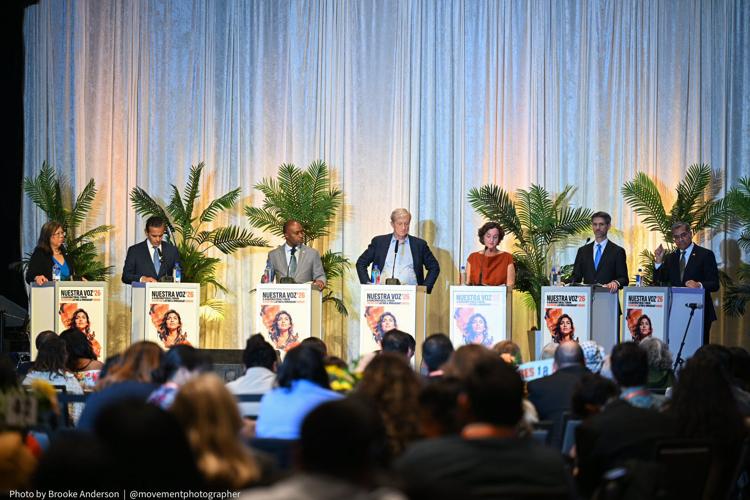




The Nuestra Voz 2026 candidate forum was co-hosted by the California Immigrant Policy Center, the California Latino Legislative Caucus Foundation and ACLU California Action. (Photo credit / Brooke Anderson)
Making up close to 40% of California’s eligible voters, Latino support will be essential to the campaigns of the over half a dozen Democratic candidates running for governor. Knowing this, all the Democrats in the race participated in a forum Tuesday night dedicated to touching on the issues that matter most to Latinos and immigrant families.
Co-hosted by the California Immigrant Policy Center, the California Latino Legislative Caucus Foundation and ACLU California Action, Nuestra Voz 2026 gave each candidate time to answer questions on the topics most on Latinos’ minds.
Despite the sexual abuse scandal plaguing former gubernatorial candidate U.S. Rep. Eric Swalwell’s exit from the race and subsequent resignation from Congress, the candidates stayed on topic and did not mention Swalwell.
Moderated by Jean Guerrero, a contributing opinion writer for the New York Times, and Lupita Baltazar, a reporter for Telemundo Sacramento, the candidates were asked five questions to which they had a minute to answer, two questions from the community and a series of rapid fire questions.
What specific amendments will you make, starting on day one, to ensure that your appointments, judicial nominations and agencies reflect the people who power the state?
Former L.A. Mayor Antonio Villaragoisa pointed out that by the time he left office, 50% of his appointments and his staff were Latino and 70% were people of color.
“The role of the first is to open up the door for the rest,” Villaraigosa said in Spanish.

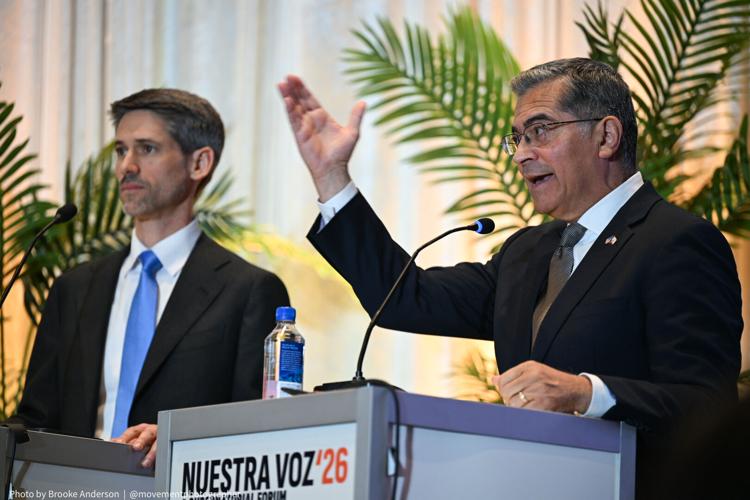
From left: San Jose Mayor Matt Mahan and former California Attorney General Xavier Becerra at Nuestra Voz 2026. (Photo credit / Brooke Anderson)
San Jose Mayor Matt Mahan said he works with staff to look at hiring data to make sure his employees are “reflective” of the diversity of the city.
Xavier Beccera, former California attorney general and Health and Human Services secretary told the audience to get their applications ready because he will “leave the door open so everyone in this audience has the chance to walk in.” Becerra also took the moment to shout out the CHIRLA Action Fund, who recently endorsed him.
Billionaire climate activist Tom Steyer, who is leading in the latest poll, said “diverse organizations are better … diverse organizations make better decisions.”
What is your plan to ensure access to safety net programs for all Californians, regardless of where they were born?
State Superintendent of Schools Tony Thurmond said he would create a pilot program to establish universal child care and add more funding for the subsidized child care programs the state already has. Both ideas were met with cheers from the crowd.
Former U.S. Rep. Katie Porter said the topics of affordability and making ends meet are “not buzzwords for me, they’ve been my life’s work.”
Porter told the audience the next governor needs to remove barriers to safety net programs, but did not expand on exactly how she would remove those barriers.
Becerra said the state “will not go backward,” and committed to expanding MediCal access for all, which California scaled back last year. He said he would expand down payment assistance programs, invest in early education and ensure everyone makes a living wage.

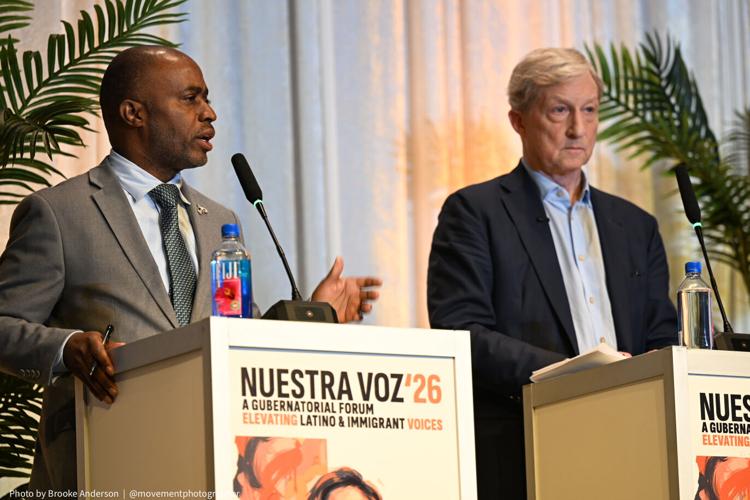
From left: State Superintendent of Schools Tony Thurmond and climate activist Tom Steyer at Nuestra Voz 2026. (Photo credit / Brooke Anderson)
Steyer agreed with many of the other candidates' points on health and child care, but said he was the only one who could "talk about how we pay for it.”
He rolled out a plan to address the state’s structural deficit by closing corporate tax loopholes and taxing oil and artificial intelligence companies in order to pay for such safety net programs.
Where do you draw the line between cooperation with federal authorities and protecting civil liberties to ensure California safeguards the rights of all residents, including undocumented residents?
Steyer stood firm on his stance to abolish Immigration and Customs Enforcement (ICE). He said he would prosecute ICE agents as well as “the people who send them to commit violence.” Steyer also proposed a legal fund to help people who he says have been kidnapped by federal authorities.
Villaraigosa twice compared ICE to the Ku Klux Klan and said if he’s elected governor, “we’ll draw the line on the Constitution,” making sure authorities have the proper warrants.
Porter also called to abolish ICE, calling their activities immoral and unconstitutional. She said there are currently too many “actors” who cooperate with the agency and said the state must make sure no law enforcement, hospitals or schools cooperate with ICE.
What specific actions will you take as governor to protect voting access and ensure voters can cast their ballots safely?
Former State Controller Betty Yee said it will be crucial to work with community partners to get the word out about where and how to vote. Yee said that misinformation will be "rampant" this election season, which will boost the need for comprehensive Know Your Rights training to be offered throughout the state.
Thurmond recommended allowing young people to do early registration and placing safety watches at the polls.
“They've been trying to take away our right to vote since this country was established and we're not going to stand for it,” Thurmond said.
In your first 100 days, what is the single most concrete action you will take to move renters, especially immigrants and Latino families, closer to the possibility of owning a home and achieving real housing stability?
Becerra again pointed to his plan to expand ownership programs, said he supports rent stabilization and added that the state needs to build more. In his first 100 days, he said he would establish a state of emergency regarding affordability.
Becerra also said he will freeze property insurance that “is out of the roof,” as well as freeze utility rates until the state can look into why utility companies are charging residents so much.
Yee echoed the calls for rent stabilization and utility freezes until the state can audit utility companies. She called to bring insurance companies back into the private market and said she would work with the federal government to set up a national insurance program.
Steyer said in the short-term, California needs to protect renters by expanding tax credits and protecting them from rent spikes. In the long-term, the state needs to build more, cheaper housing by making permitting shorter and cheaper and changing rezoning laws, he said.
Porter told the audience that California simply builds housing too slowly, and that she would work with the state legislature to identify all of the policies that are slowing down building.
“It took us decades to get into this problem and it will take us decades to get out,” Porter said.







(0) comments
Welcome to the discussion.
Log In
Keep it Clean. Please avoid obscene, vulgar, lewd, racist or sexually-oriented language.
PLEASE TURN OFF YOUR CAPS LOCK.
Don't Threaten. Threats of harming another person will not be tolerated.
Be Truthful. Don't knowingly lie about anyone or anything.
Be Nice. No racism, sexism or any sort of -ism that is degrading to another person.
Be Proactive. Use the 'Report' link on each comment to let us know of abusive posts.
Share with Us. We'd love to hear eyewitness accounts, the history behind an article.