
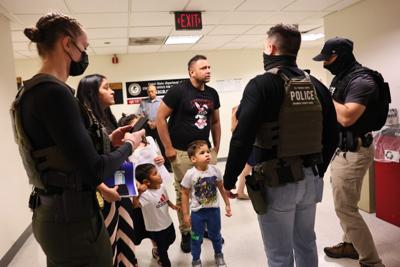


Federal agents attempt to detain an individual, who was later released, as he exited immigration court at the Jacob K. Javits Federal Building on June 30, 2025 in New York City. Photo by Michael M. Santiago/Getty Images.
This article was produced by Capital & Main. It is published here with permission.
Immigration and Customs Enforcement officers put a man on the ground in Hillcrest, New York, in late October, put their knees into his back and shot him with a Taser, according to the Human Impact Project.
The incident is one of more than 300 reports tracked by the project in which immigration officials injured someone to the point that they needed medical treatment.
Run by nonprofit Human Security Initiative, Human Impact Project scrapes court records, media reports, self-reported social media posts and GoFundMe accounts for information about the impacts of the Trump administration’s immigration policies. Though the project uses AI for the initial data gathering, human rights researchers fact-check those findings before adding them to the project website, according to organization founder Julia Neusner.
“The idea was to try to understand the scope of enforcement impacts across all these different sources with a focus on individual people,” Neusner said. “Other folks are tracking numbers. We wanted to track the stories and the impact on people.”
ICE did not respond to a request for comment from Capital & Main.
The project recently surpassed 5,000 published reports, and Neusner and her team began analyzing trends in the data. The results serve as a reminder of the immigration-related news stories that have come out in the past two years — arrests of U.S. citizens, detention of pregnant people in inhumane conditions, deportations to third countries of people who won protection in the U.S. and arrests at courts.
Even though the headlines may be familiar, Neusner said, the volume of stories and the extent of the abuses they describe still shock her.
That includes an Instagram post of a family detained in Key Largo, Florida. The woman, a U.S. citizen who is also pregnant, and her husband were on their way to vote in the recent midterm election when agents detained them and separated them from their young child, according to the database. They remained in custody for about a week.
Neusner said the project also reveals stories that the public — and even journalists — may have missed.
“There’s so many everyday abuses, people being beat up in arrests, horrendous conditions in detention,” Neusner said. “The sheer volume of these stories was quite shocking, and the things happening that don’t make it to mainstream press.”
She said the report of an incident involving ICE officers detaining a father who went to visit his son at a jail in Santa Ana, California, recently caught her attention. The father, a 69-year-old construction worker from Mexico, was the primary caregiver for another one of his sons who is only 13.
She also pointed to several stories where ICE officers mistook someone they detained for someone else or identified them by the wrong name.
That includes a Florida woman originally from Guatemala who is arguing in court that ICE detained her under a name she has never used.
The database also includes the story of a Coachella Valley, California, farmworker whom immigration officials mistakenly detained in December and who — 10 months later — is still in ICE custody.
In both cases, judges have denied their petitions for release from custody, according to the database.
Neusner said people can use the database to learn more about stories happening in their area. It features a map showing where the different incidents took place.
The greater Los Angeles area has the most of any geographic location, with more than 500 stories logged there.
An entry from Nov. 1 there pulls information from an online fundraiser asking for help to pay legal fees for a detained grandfather. Another from Oct. 30 details how ICE officers dragged a Venezuelan man outside his North Hollywood apartment and shot him with a Taser. Witnesses said the officers attempted to hogtie him. One of the officers shoved a nearby dog walker into some bushes and pointed a gun inches from the person’s face.
In another online fundraiser from Oct. 30 cited by the project, a family asks for help after ICE detained the father, a truck driver with a pending application for a U visa, a type of visa given to crime victims. The mother has cancer and has started working as a delivery driver to take care of their children on her own, the database says.
An Instagram post from Oct. 27 documents ICE arresting a food truck vendor operating Emin’s Kebab in the Echo Park neighborhood of Los Angeles.
Neusner and her team supplement the information found online with their own research on the ground. They recently went to Tapachula and Villahermosa in southern Mexico to speak with people from other countries sent there by U.S. immigration officials.
Neusner said she sees several ways that people could use the database. She said when her cousin’s wife had a green card appointment approaching, the family searched to see whether ICE officers were detaining people at the U.S. Citizenship and Immigration Services office in their area. Neusner said she was able to determine that those arrests had happened in other areas, including in San Diego, but not where her family member would soon have the interview.
That information helped allay the family’s worry leading up to the appointment, and the family member now has a green card, Neusner said.
She also hopes the database will connect people, including journalists, to what’s happening near them. Lawyers can look at pages compiled for specific detention centers to pull information about reported conditions to include in habeas corpus petitions to try to get their clients out of custody, she said. The database has catalogued the complaints in more than 1,200 habeas petitions, she said.
In the future, she also hopes the database will serve as a historical record for potential reparations. She said the database archives all of the source documents it uses.
“If there is some sort of future accountability process, these stories will be preserved,” Neusner said.







(0) comments
Welcome to the discussion.
Log In
Keep it Clean. Please avoid obscene, vulgar, lewd, racist or sexually-oriented language.
PLEASE TURN OFF YOUR CAPS LOCK.
Don't Threaten. Threats of harming another person will not be tolerated.
Be Truthful. Don't knowingly lie about anyone or anything.
Be Nice. No racism, sexism or any sort of -ism that is degrading to another person.
Be Proactive. Use the 'Report' link on each comment to let us know of abusive posts.
Share with Us. We'd love to hear eyewitness accounts, the history behind an article.