
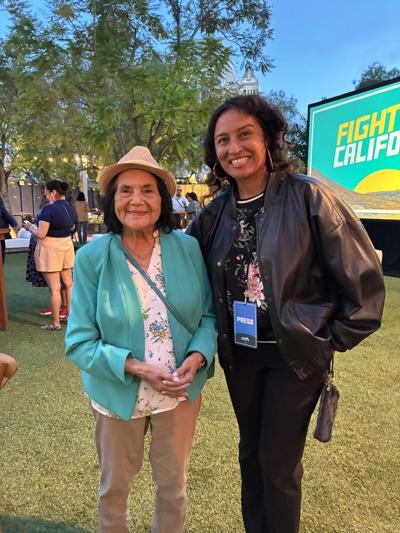


Dolores Huerta, left, and Clariza Ruiz De Castilla. (Courtesy of Clariza Ruiz De Castilla)
It is wise to take advantage of the opportunities that we are given. And that is exactly what I did on Tuesday, June 2, 2026. I attended a watch party for gubernatorial candidate Xavier Becerra at LA Plaza de Cultura y Artes. As an educator and media scholar, I tried my best to be objective; after all, this is what I aim to teach my students. Originally, I wanted to simply observe this political moment, as I had never been to a watch party. This opportunity was new to me.
But then I saw her: the revolutionist Dolores Huerta. That’s when my objective ambition disappeared. I couldn’t contain myself. I was smiling uncontrollably as my heart raced. I knew I had to meet her, to tell her what she meant to me, to tell her what an honor it was to be in her presence.
As soon as I saw that she was alone, I approached her. And at that moment, I became a fangirl. I smiled and shook her hand, followed by introducing myself: “Hi Dolores, I’m Clariza, and I am a fan of yours. I show your documentary, ‘Dolores,’ in my Latino classes. You inspire me.” She smiled sincerely and said, “Thank you.” Before letting her go (others appeared waiting to talk to her), I asked if I could take a picture with her. She generously agreed.
The many ways she has motivated me are too many to count. As a Californian, I learned about the United Farm Workers (UFW) and how they mobilized for their rights. It was Dolores who confidently exclaimed, “Sí, Se Puede” (“Yes, it can be done”). The power of her mantra and her lifelong work is noted by the Chair of the Department of Chicano and Latino Studies (CHLS) at California State University, Long Beach, Dr. Loretta Ramirez: “As co-founder of the United Farm Workers and co-creator of the enduring slogan, Sí, se puede, Huerta spent more than seven decades organizing alongside farmworkers and advocating for marginalized communities. Her work demonstrates the power of collective action and reminds us that meaningful change begins within communities through persistence, solidarity, and grassroots organizing.”
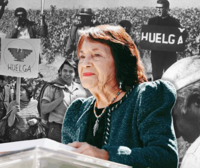
Her power didn’t only lie in her discourse, but also in her Latina representation. The iconic photograph of her standing strong, with the sign “Huelga” (“Strike”), along with the black, stylized eagle above these letters, is just one of many images that captured her resilience throughout the years.
But her efforts didn’t stop in the last century nor in California. Even up to this latest midterm election, in this last year of her life, she was encouraging Latinos to vote in Texas, an especially difficult state for us. I would know: I attended the University of Texas at Austin for 6 years to complete my doctoral degree, as well as living in Houston for one year to teach at a community college nearby. While both cities are progressive, they don’t share the political consciousness of Los Angeles, the Chicano Movement, or even the UFW. Despite this, I am grateful for those years in Tejas, as they helped me realize the differences in Latino advocacy and civic engagement.
Perhaps Dolores knew about this Latino ambivalence in Texas as well. She made the following argument this past June at the Texas Democratic convention: “The eyes of the world are going to be on Texas – what happens in Texas is going to affect the United States of America … You are going to save democracy in Texas, you are going to save democracy in the United States of America.”
No matter how old she was, no matter what she suffered for la causa, that faith that she had in us, Latinos, was magnetic; it was única. She never stopped believing in our collective power, whether it was in the fields or at the ballot box.
It is this communal spirit that I carry with me as an educator, especially now as a new assistant professor. Dolores knew about the power of education as well: she began her public service career as an elementary teacher, educating the children of farmworkers. While she moved on to helping actual farmworkers achieve better wages and working conditions through the UFW, she continued to educate others. In other words, her teaching never ended.
It was in this spirit of her unwavering activism that I would assign her documentary, “Dolores” (2017), in my Chicano and Latino courses. In this 95-minute documentary, viewers learn not only of her political legacy, but also her personal life. She explained: “This might sound kinda corny, but you have to really love people, you know, to want to teach them, to want to help them grow, ’cause you’re giving a lot of yourself when you’re doing that.” This observation couldn’t be more true: in a country and time filled with so much hate and division, such a claim, like the one Dolores makes here, reverberates today more than ever.
And perhaps one way that we may keep her spirit alive is by telling the story of la causa differently. As Dr. Alberto Pulido, a CHLS faculty member at CSULB, argued: “Our work [in ethnic studies] has always been about creating new narratives, creating new truths … What about a new truth or a new narrative that at least minimizes the role of Cesar Chavez, if not erasing Cesar Chavez? Why can’t you tell the history of the United Farm Workers through the lens of Dolores Huerta?”
Dr. Pulido’s rhetorical question brings me back to my original claim: we must remember to take advantage of the opportunities presented to us, just as Dolores did. At that watch party, while I decided to not be objective (despite originally trying to be), it turned out to be the best decision for me. Because I had the chance of a lifetime: to meet an incredible Latina who changed the lives of Latinos all over this country, in different political struggles. May we all seize such opportunities to not only make our own lives better, but the lives of our communities and of our people.







(0) comments
Welcome to the discussion.
Log In
Keep it Clean. Please avoid obscene, vulgar, lewd, racist or sexually-oriented language.
PLEASE TURN OFF YOUR CAPS LOCK.
Don't Threaten. Threats of harming another person will not be tolerated.
Be Truthful. Don't knowingly lie about anyone or anything.
Be Nice. No racism, sexism or any sort of -ism that is degrading to another person.
Be Proactive. Use the 'Report' link on each comment to let us know of abusive posts.
Share with Us. We'd love to hear eyewitness accounts, the history behind an article.