
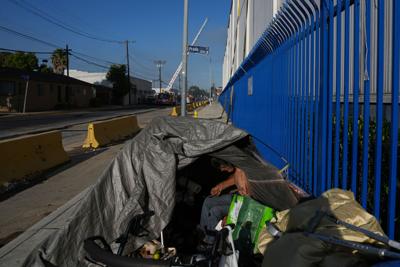


A homeless person camps near the site of a warehouse fire in Boyle Heights on Wednesday, June 17, 2026. (AP Photo/Jae C. Hong)
Los Angeles released new homelessness numbers recently and debate is again focusing on whether overall homelessness went up or down. But the numbers raise two more important questions: Are we treating homelessness the same in every population, even when the crisis looks dramatically different in overlooked communities? Are the elected officials asking to lead Los Angeles prepared to respond to the homelessness crisis that actually exists, or will they continue to invest in solutions that sometimes never reach many of the most impacted?
As someone who has experienced homelessness, managed homelessness systems and worked inside Los Angeles City Hall, the lack of progress is frustrating. Los Angeles remains the epicenter of California's homelessness crisis, spending billions while continuing to struggle with rising need. This year, overall homelessness in the City increased by 3.4%.
For Latinos, homelessness rose another 4.4% this year – nearly four times the countywide increase of just 1.2% – continuing a troubling trend that saw Latino homelessness increase by 76% between 2018 and 2024. These numbers demand a multi-pronged policy agenda that addresses homelessness across Los Angeles with targeted, culturally responsive strategies to confront the unique drivers of Latino homelessness.
We've gotten better at talking about unhoused populations. We've even made progress in understanding who becomes unhoused and why. But we still haven't built a response that reflects how homelessness unfolds in different communities.
For most people, homelessness only enters their consciousness when it becomes visible – someone living in a tent or sleeping on the sidewalk. For many Latino families, though, being unhoused looks different. It’s three families squeezed into a two-bedroom apartment because no one can afford rent alone. It’s a father sleeping in his truck while his children stay with family friends. It’s parents avoiding shelters or public assistance because they worry seeking help could jeopardize their immigration status.
Research led by Dr. Melissa Chinchilla, a research scientist who works at the intersection of homelessness and health, found that the number of people experiencing doubled-up homelessness in Los Angeles County is roughly three-and-a-half times larger than the sheltered and unsheltered homeless population combined. Nearly 77% of those doubled up because of economic hardship are Latino. That's not just a humanitarian problem. It's a policy failure.
By the time many Latino families appear in the official homelessness count, they have already exhausted every safety net they have. A system designed primarily to respond to visible homelessness will always miss communities whose housing instability remains hidden until crisis becomes unavoidable.
The inequities don't stop at the lack of upstream solutions, though. Although Black and Latino residents made up nearly 80% of the unhoused population in the City of Los Angeles in 2025, recent LAHSA data shows that around 44% of those housed through the city’s Inside Safe program have been white – the largest share of any racial group. This raises important questions about whether local and state approaches are adequately prioritizing vulnerability through a racial equity lens.
Meanwhile, federal policies threaten to make things worse through funding freezes, renewed restrictions affecting mixed-status families that could destabilize or displace thousands and aggressive immigration enforcement that discourages vulnerable families from seeking help before they lose their housing.
Los Angeles does not lack answers, however. In 2023, LAHSA convened service providers, researchers, advocates and community leaders for the Task Force on Latinx People Experiencing Homelessness. Earlier this year, it released a practical policy guide calling for greater investment in prevention, better language access, culturally responsive outreach and identification of hidden homelessness and stronger protections for mixed-status families. Further, it calls for more Latino voices in leadership positions across service providers, philanthropy and public sector homelessness response systems. While the County has started exploring implementation, the City has an opportunity—and an obligation—to act as well.
As voters look toward November’s election, they deserve to know how each candidate, especially mayoral candidates Karen Bass and Nitthya Raman, plans to confront the crisis at the center of California's homelessness emergency. Will they commit to implementing the Task Force’s recommendations? How will they improve language access and culturally competent outreach? How will they protect mixed-status families and encourage them to seek help?
The measure of leadership can no longer be who opened more shelter beds or cleared more encampments. California cannot solve its homelessness crisis as long as Los Angeles’ Latino homelessness continues to rise unchecked. Voters deserve a clear plan. If neither candidate has one, we shouldn't be surprised when next year's count tells the same story.







(0) comments
Welcome to the discussion.
Log In
Keep it Clean. Please avoid obscene, vulgar, lewd, racist or sexually-oriented language.
PLEASE TURN OFF YOUR CAPS LOCK.
Don't Threaten. Threats of harming another person will not be tolerated.
Be Truthful. Don't knowingly lie about anyone or anything.
Be Nice. No racism, sexism or any sort of -ism that is degrading to another person.
Be Proactive. Use the 'Report' link on each comment to let us know of abusive posts.
Share with Us. We'd love to hear eyewitness accounts, the history behind an article.