
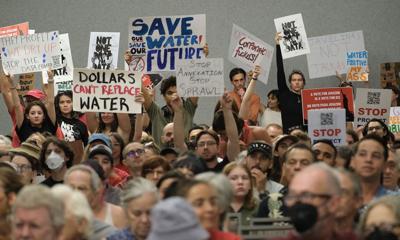


A crowd of about 1,000 attended a community meeting about a proposed data center at the Tucson Convention Center on Monday, Aug. 4, 2025. (Michael McKisson for Arizona Luminaria)
“Just because we can build something doesn’t mean we should,” read the Mayor of Chandler, Kevin Hartke, on Dec. 11, 2025, from a public comment submitted in opposition to an AI data center proposed along the Price corridor. Moments later, the Chandler City Council voted 7-0 to reject the rezoning, sending a clear message to tech companies seeking Arizona land en masse to build the controversial centers.
The proposed Active Infrastructure's 40-acre “tech park” consisted of a five-building campus and a nine-acre AI data center. It was originally projected to use roughly 48,631 gallons of water a day — or 17.75 million gallons a year — amid Arizona’s already declining groundwater supply and a 30% cut from the Colorado River allotment.
At the meeting, Chandler residents raised various concerns, ranging from water use and pollution to rising electricity rates and broader concerns about generative artificial intelligence as a whole — an uneasiness echoed by Arizona residents and concerned citizens nationwide as the rapidly growing AI business model is pushed by tech conglomerates and their deep-pocketed developers.
The center caught public attention when former U.S. senator-turned-lobbyist Kyrsten Sinema implied at a Chandler City Council meeting that state funding would be withheld from those seeking to regulate AI. This did not sit well with the Chandler City Council members or Chandler residents.
Just south of there, locals were already fighting Project Blue, a proposed 290-acre data center near Tucson. City council members also unanimously voted down its annexation, but the project moved forward with Pima County's support and after the Arizona Corporation Commission approved an energy deal, granting its developer the final public vote needed to get construction underway. The deal was contested by Arizona General Kris Mayes early this year.
And a couple of miles northwest, the Town of Marana was experiencing similar backlash from locals after its planning commission recommended rezoning to allow Beale Infrastructure, the developer also behind Project Blue, to convert 600 acres into a massive data center.
Residents in most of these cities, for the most part, were unaware of developments happening until grassroots organizations — No Desert Data Center Coalition, the Tucson Democratic Socialists of America (DSA) and Party of Socialism and Liberation in Phoenix and Tucson — began posting about it on social media platforms, prompting swift backlash from communities and quickly filling city halls with concerned residents.
“Because of the current AI boom, a lot of corporations are using AI as a way to replace human beings with technology, instead of technology being an aid to human beings at their jobs,” said Lexsiri Coronado, an organizer with PSL Phoenix, a local group that has been at the forefront of the fight against AI data centers in the Valley and across Arizona. “We are not against innovation, and data centers have been around for years. What we're against is technology being used as a way to wage this war against working people.”
What is an AI data center?
There are over 3,700 data centers in the U.S., including 146 in Arizona and roughly 10 in metro Phoenix, according to the Data Center Map, with widespread reports coming from communities already being affected by skyrocketing electricity rates, a decrease in employment and heavy output of “digital smog” pollutants that are directly impacting poor and low-income communities.
Although it’s become a modern-day issue, data centers have been around for decades, powered by on-premises generators amid the global demand for cloud computing in the early digital age. They were not, however, as environmentally impactful as today’s new facilities built for specialized AI accelerators that, according to Texas colocation firm TRG Data Centers, “traditional data centers were not designed to handle,” creating a surge in demand that strains “not just the facilities, but also the power grids that supply them.”
Cue the new high-electric-powered, multi-million dollar projects that require large expanses of land, vast amounts of water and have little to no regulations on the generative AI it powers; as directed by President Donald Trump’s recently signed Executive Order 14179, which would “remove barriers” affecting the advancement of AI applications across various sectors. This executive order is one of the administration’s most recent attempts to undermine state laws on AI reform, in hopes of boosting trillion-dollar AI investments in what is being peddled as a “technology revolution.”
“Data centers are being built in residential areas in Phoenix — which is crazy — and they're really putting a strain on the energy and water use here in the Valley, and instead of the corporations behind the data centers paying for the increased energy use, it is instead the day-to-day person who has to pay,” Coronado said. “So the reason why [PSL has] played this intervention and data center struggle is to show people that technology can be used to better our day-to-day lives, and we need to organize and fight back for it to be used in the right way for people, not for profit.”
Arizona at the forefront of an ‘AI revolution’
While the victory in Chandler and the ongoing fights in Tucson and Marana send a resounding message to companies hoping to break ground in Arizona about how locals feel, data center projects continue to pop up throughout the state.
“Now that these are starting to become more popular, they're more in demand. I guess across the nation, more people are waking up and starting to see, hey, these people are being polluted over here, we might be polluted here,” Stephen Brittle, an organizer with environmental group Don’t Waste Arizona, said.
The organization was launched in the 90s to oppose a toxic-waste incinerator. Today, Brittle said, they focus on highlighting environmental hazards, especially as its developers and local governments enter into conversations about the projects under non-disclosure agreements. A similar thing happened with Project Blue.
In January, Don’t Waste Arizona co-signed a letter with environmental groups nationwide calling on Congress to halt the construction and approval of AI data centers. The group was the only Arizona-based environmental organization listed. More and more Arizonans, however, are demanding regulations and oversight amid alarming nationwide reports of pollution and unnerving AI errors.
The latest proposed data center, Project Baccara, is poised for construction at the edge of the West Valley and has already begun attracting responses by community members in Surprise for its plan to build two data center buildings powered by 700 megawatts from on-site natural gas generators.
While the City of Surprise already drafted a list of reports they’d require Project Baccara to submit to them regarding pollution levels and groundwater usage, the Stop Project Baccara Coalition is mounting pressure on Maricopa County officials to reject the 163-acre project that would break ground in an industrial area just north of Luke Air Force Base.
“There's this really big push happening on the national level to make Arizona one of the [states] to basically lead the AI revolution… that also means that we are best poised to lead a fight back against it. And so far from what we've seen, just by organizing and mobilizing people, we have been able to win and really shut down these harmful data centers,” Coronado said of the recent win in Chandler. “The fight doesn't stop there. It doesn't stop when we win at one data center. We have to take this fight to the next level, and really [be] able to defend our wins, and that means considering other approaches, like imposing a state-wide moratorium against data centers or other creative methods.”
With this new era of the digital age being brought forth by multi-million dollar tech corporations hoping to take advantage of Arizona’s steady climate and precious groundwater supply, these groups urge people to activate in their neighborhoods, to become more conscious of the risks of AI and to be on the lookout for when the next project or protest appears in order to keep themselves informed and, most importantly, involved.
“The people will never yield to the interests of elites and oligarchs,” Chandler resident Mark Jung said during his public comment at the Chandler City Council meeting in December. “It’s clear that we will build the economy by the people and for the people, and any avaricious corporations or politicians who attempt to impose greed onto us will see the same opposition of this great city.”
Analisa Valdez (she/her) is a freelance journalist based in Phoenix. Her reporting includes community & culture, social justice, arts, business, and politics.









(0) comments
Welcome to the discussion.
Log In
Keep it Clean. Please avoid obscene, vulgar, lewd, racist or sexually-oriented language.
PLEASE TURN OFF YOUR CAPS LOCK.
Don't Threaten. Threats of harming another person will not be tolerated.
Be Truthful. Don't knowingly lie about anyone or anything.
Be Nice. No racism, sexism or any sort of -ism that is degrading to another person.
Be Proactive. Use the 'Report' link on each comment to let us know of abusive posts.
Share with Us. We'd love to hear eyewitness accounts, the history behind an article.