

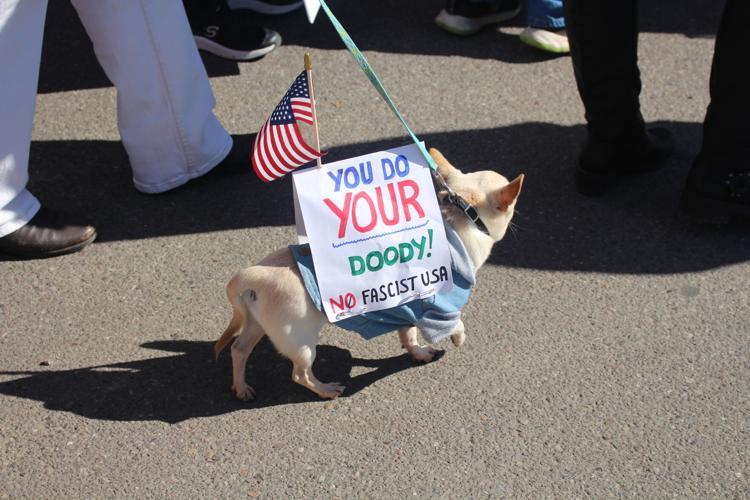

Tucson educators protest alongside students and families against ICE
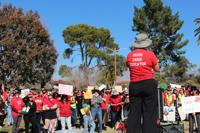
More than 1,400 Tucson Unified School District employees called out on Friday, Jan. 30, 2026, as part of a national shutdown in protest of ICE violence.
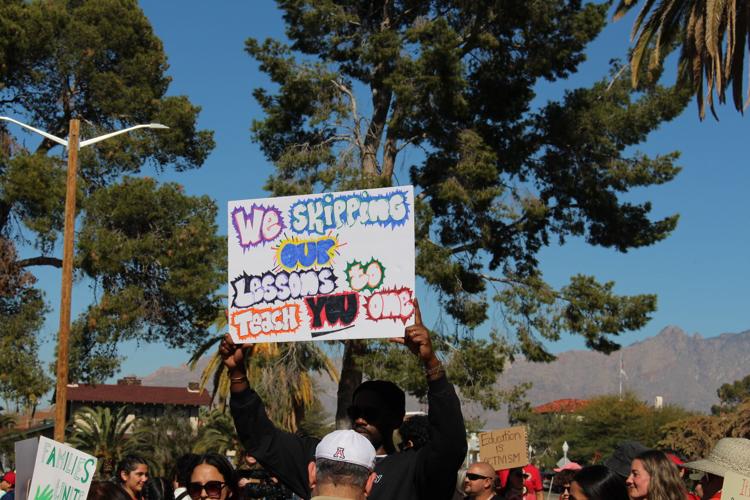
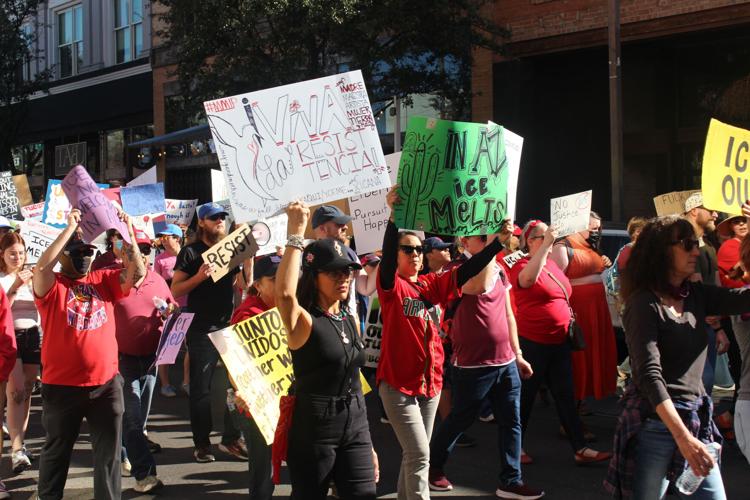
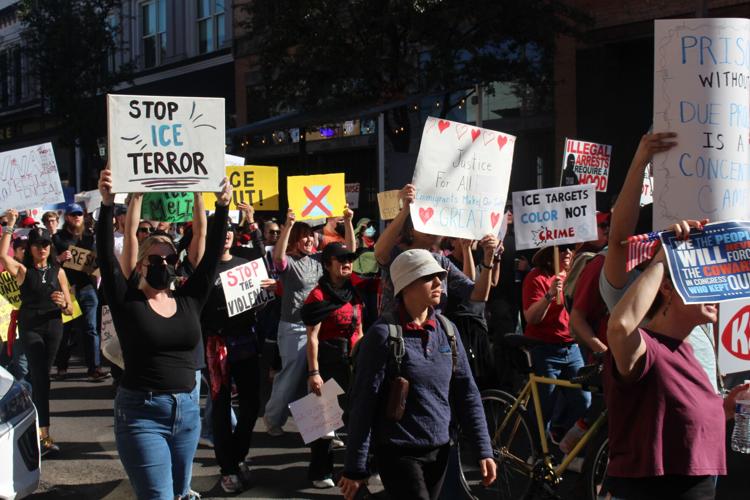
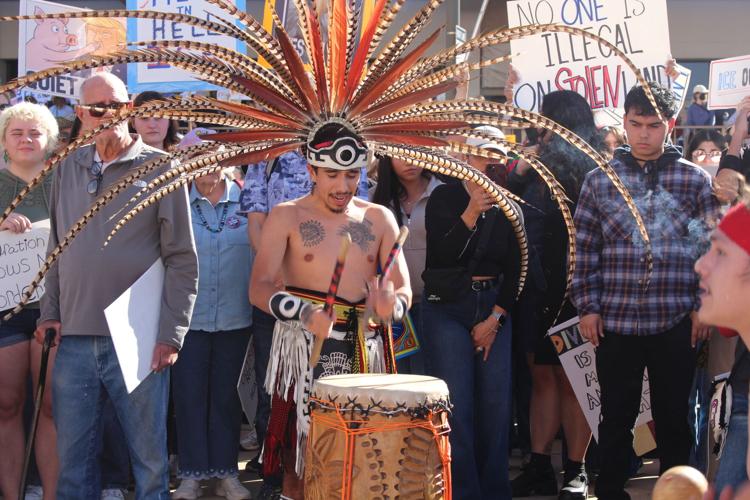
Hundreds of Tucson educators, students and families march in protest on Friday, Jan. 30, 2026, during a nationwide general strike against ICE.
TUCSON – Thousands of Tucsonans took to downtown streets on Friday as part of the nationwide shutdown protesting Immigration and Customs Enforcement (ICE) violence. Among them were hundreds of local teachers, staff and students, many of whom gathered at a community park on Fourth Avenue for a rally before marching toward the Tucson Federal Building to join other protesters.
More than 1,400 Tucson Unified School District (TUSD) employees called out to work or took a sick or personal day to join the protests, said Eliseo Gomez, a teacher at Pueblo High School and one of the organizers of the rally. TUSD announced on Thursday afternoon that it would close 20 schools due to reduced staff.
Around 1 p.m. at Catalina Park, Gomez stood on a concrete park table that served as a stage for the educators' rally and called up speakers — teachers and students alike — to share why they were protesting.
Their demands? Abolish ICE, make Tucson a sanctuary city and for TUSD to create an ICE safety policy for its school, one that does not include more police on campus.
Gomez said some schools have a plan in place after working with administrators, but there is no district-wide safety policy in case ICE agents start showing up at schools.
“Before this rally started, educators gathered as early as 11 a.m. to share school safety plans and talk with each other about how to continue to keep our schools safe,” Gomez told CALÓ News.

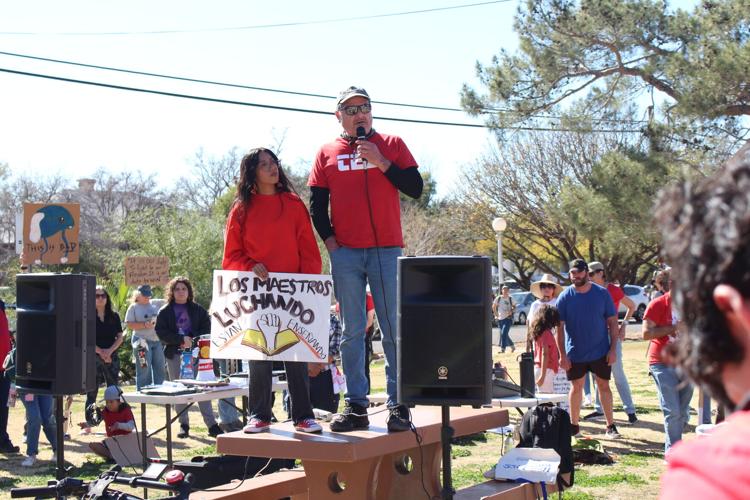
Jessica Ramirez Perea and Julian Barcelo, first-grade teachers at Davis-Romero Bilingual Elementary Magnet School, share their demands to abolish ICE and make Tucson a sanctuary city at an educators' rally on Friday, Jan. 30, 2026, at Catalina Park on Fourth Avenue in Tucson.
TUSD does have immigration enforcement guidelines posted on the district’s website, which outline how administrators should proceed if law enforcement, including ICE, tries to obtain student information or conducts a “sweep” of the school.
Those guidelines say ICE agents need a judicial warrant to gain any access. It also says, “The grounds outside of the school are considered public property so there is not a great deal we can do to prevent ICE agents from setting up shop outside. However, should this scenario arise, please communicate with your Regional and Legal.” The guidelines go on to say that schools can contact families if ICE agents set up outside the school and the principal can approach them and ask them to stop their enforcement outside the school.
Finlay Parsons, a math teacher at Tucson High School, said teachers and staff there began discussing whether they would call out after University of Minnesota student groups issued a call for a nationwide shutdown — no school, no work, no shopping.
By Tuesday, almost 100 staff at Tucson High had requested the day off. It spread across the district like wildfire, he said.
“We keep the world running,” Parsons said. “And when we unite like this, we feel our power.”
Jessica Ramirez Perea and Julian Barcelo, first-grade teachers at Davis-Romero Bilingual Elementary Magnet School, stood side by side on the park table. Ramirez Perea’s big, monarch butterfly earrings dangled as she spoke loudly into the mic.

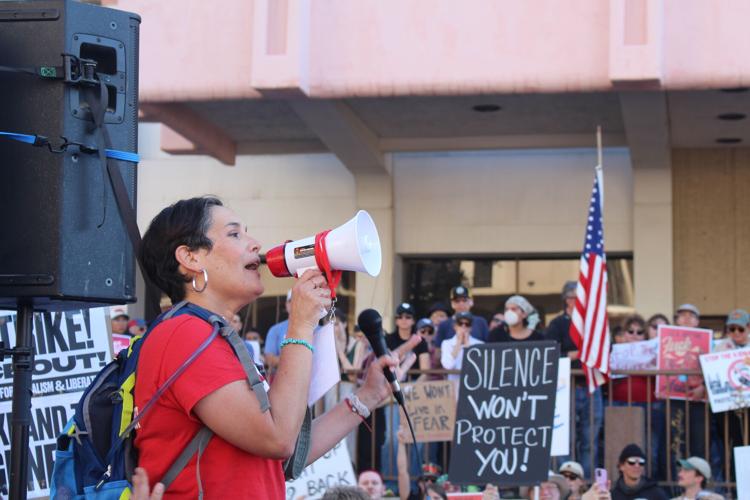
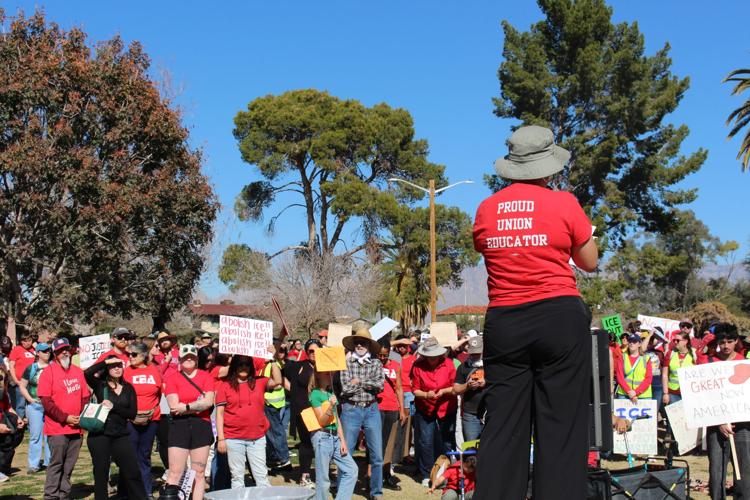
A local teacher speaks before the crowd at an educators' rally on Friday, Jan. 30, 2026, at Catalina Park on Fourth Avenue in Tucson. More than 1,400 Tucson Unified School District employees called out on Friday as part of a national shutdown in protest of ICE violence.
“Nuestras familias tienen miedo”, she said. “Y temen por su seguridad y la separación de sus familias y no vamos a permitirlo. Por eso estamos aquí dando nuestra voz en unión”.
“Our families are afraid. And they fear for their safety and the separation of their families and we won’t allow that. That’s why we are here, giving our voice in unity.”
Educators then made their way onto Fourth Avenue, where they merged with protesters from the University of Arizona on their way to join the larger protest downtown. They chanted as they walked out of the park:
“What do we want?”
“ICE out!”
“When do we want it?”
“Now!”
They covered the block between Church Avenue and Granada Avenue.
The group was so big, chants in one section — “Unite and fight for immigrant rights!” — clashed with those in another — “Say it once, say it twice. We will not put up with ICE!” — as they marched. Speakers stood on a truck and spoke into a mic to one section of protesters, while others watched a tribal dance on the other side of the street.

Hundreds of Tucson educators, students and families march in protest on Friday, Jan. 30, 2026, during a nationwide general strike against ICE.
Having educators at the protest sends a message: they care about their students and they’re willing to sacrifice their own pay and sick time to speak out against the issues affecting them and their families, Ramirez Perea said.
She teaches a dual-language class, where she has had to hold space for students as young as six who are afraid and want to talk about immigration issues.
“They know a lot more than we think,” she told CALÓ News while marching. “They can also critically think more than many adults. Students share things like, ‘What's happening around the world is not right. People should not be kidnapped for not having the right paperwork,’ is what they’ve said.”
Alyssa Barrios, a daughter of immigrants and a history teacher at William J. Pistor Middle School, also teaches in a dual-language program.
“I have a couple of students who have asked me what would happen if ICE came to the school, [whether] ICE could come to the school,” Barrios said. “I do have a student whose dad was picked up after he left work.”
Barrios answers her students’ questions with facts and teaches them the principles of their First Amendment rights.
Gloria Vejar, a paraprofessional at Tucson High Magnet School, showed up in support of the Tucson community with her son, daughter-in-law, grandson and niece.

Hundreds of Tucson educators, students and families march in protest on Friday, Jan. 30, 2026, during a nationwide general strike against ICE.
Her students study, work hard and get ahead, yet they live with fear that ICE agents will take them or their family, she said.
“Me emociona que haya tanto apoyo, especialmente para nuestra educación. Pero al mismo tiempo me da tristeza que nuestras nuevas generaciones, nuestros estudiantes, estén sufriendo toda esa presión de las sociedades, de esta presidencia”, she said.
“I'm thrilled that there's so much support, especially for our education, but at the same time, it saddens me that our new generations, our students, are suffering all this pressure from the societies under this presidency.”
She also had a message for her students.
“Sigan adelante con la lucha”, Vejar said. “Sí se puede. Y prepárense, sigan con su educación adelante, como puedan, para lograr un mundo mejor”.
“Keep fighting. Yes, we can. And prepare yourselves, continue your education however you can to achieve a better world.”
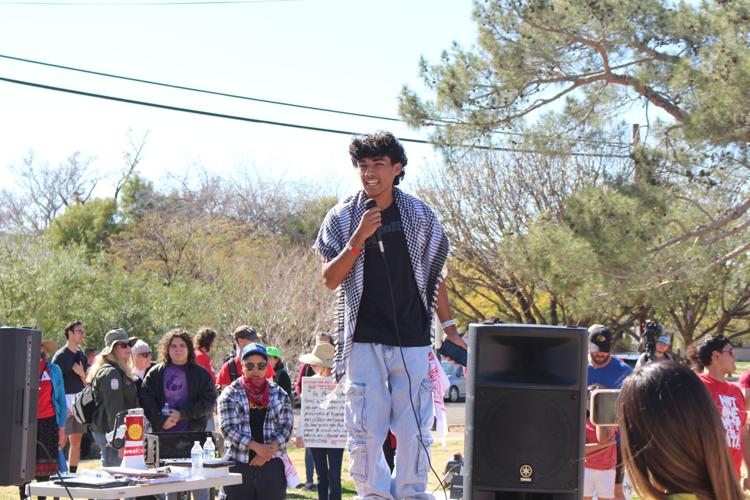
At the educators' rally, a local high school student, Emiliano Caldera, addressed the crowd. He wore a black-and-white keffiyeh around his shoulders.
Caldera said fear shows up in his community every day, as parents leave work, as students check their phones hoping they don’t get a message that might change their lives, as families plan for the worst while trying to live their lives.

Catalina High School student Emiliano Caldera speaks to hundreds of Tucson educators, students and families at Catalina Park on Friday, Jan. 30, 2026, during a nationwide general strike against ICE.
“The fear does not disappear when the school bell rings, it walks into classrooms with us. It sits with us at lunch and it follows us home,” he said. “ICE doesn't just remove people. It removes peace. It removes stability and it removes the sense of safety that every family here deserves."
The people being affected are not just criminals, he continued. They are hardworking families and students who love and contribute to Tucson.
“We are students, but we are also witnesses,” Caldera said. “We see what this does to our friends, we see what this does to our families, and we refuse to accept this as normal.”
The crowd cheered as his words echoed the same chant reverberating across the U.S., demanding that ICE stay away from their communities.
“We want communities built on trust, not terror; on care, not control; on dignity and not fear,” he said. “This movement is peaceful and it is rooted in love and it is driven by the belief that every person deserves to feel safe where they live. “To the students here today, your voice matters more than you've been told to the families watching. You are not alone, and those in power, we are paying attention, and we will keep showing up.”
Stephanie Casanova is an independent, bilingual journalist from Tucson, Arizona, covering community stories for over 10 years. She is passionate about narrative, in-depth storytelling that is inclusive and reflects the diversity of the communities she covers.








(0) comments
Welcome to the discussion.
Log In
Keep it Clean. Please avoid obscene, vulgar, lewd, racist or sexually-oriented language.
PLEASE TURN OFF YOUR CAPS LOCK.
Don't Threaten. Threats of harming another person will not be tolerated.
Be Truthful. Don't knowingly lie about anyone or anything.
Be Nice. No racism, sexism or any sort of -ism that is degrading to another person.
Be Proactive. Use the 'Report' link on each comment to let us know of abusive posts.
Share with Us. We'd love to hear eyewitness accounts, the history behind an article.