
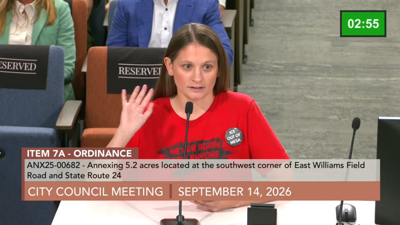


Jillian Ryan, who leads Indivisible Mesa, wears an “ICE Out of Mesa” pin as she speaks against the proposed Legacy Park development during a City Council meeting at City Hall in Mesa, Ariz., on Sept. 14, 2026. (Screenshot from City of Mesa video)
After federal agents made arrests outside a Mesa grocery store on Election Day, Jillian Ryan wondered if more people would show up at City Hall to ask Mesa to end its 287(g) agreement with U.S. Immigration and Customs Enforcement (ICE).
About 10 to 20 people from her group, Indivisible Mesa, arrived with her at the Nov. 16 council meeting, Ryan said. That was about the usual turnout.
But election results have created another possible path forward, she said.
While Mesa voters returned two council incumbents who backed continuing the agreement, voters across Arizona handed Democrats control of both chambers of the Legislature. Ryan sees a chance for state lawmakers to end agreements like Mesa’s even if the City Council never votes on it.
ICE initially reported that federal agents arrested five people outside the Food City near Southern Avenue and Mesa Drive on Nov. 3 as part of an ongoing criminal investigation. The store was within a mile of two voting sites.
On Nov. 8, ICE announced that agents had arrested two men and five other people in an alleged human smuggling case in Mesa. The announcement gave no date or address for those arrests.
LUCHA organizer Karime Rodriguez told KJZZ her group sent people to check a report of arrests at a Mesa shopping plaza on Election Day. She said volunteers stayed at the nearby Mesa Community College voting site with cards explaining people’s rights.
In a statement, the Asian Law Caucus — on behalf of AZ AANHPI Advocates’ This Is Our Mesa campaign — asked why the operation took place on Election Day. They said the timing sent an intimidating message to voters and urged the council to end the city’s ICE agreement.
Casey Blake, Mesa’s communications director, wrote in an email response to CALÓ News that police were notified that federal agents were in the city but did not take part. According to Blake, the city’s 287(g) agreement played no role in the arrest and applies only inside Mesa’s police holding facility. There, trained officers can ask people about their immigration status and issue immigration detainers under ICE supervision.
Seeking an end to Mesa-ICE collaboration
Ryan’s group says it began showing up at council meetings in June 2025, calling for an end to the agreement and attempting to support a council candidate with the same goal. The group knocked on doors for Danny Hart, a council candidate her group recruited. Hart finished third in July. Nick Willis, who had publicly opposed the agreement, won his race. Incumbents Scott Somers and Alicia Goforth, who support keeping it, won reelection.
Blake said Mesa has heard from residents on both sides; either party can end the agreement and withdrawing would not affect grant funding.
Ryan had hoped the idea would also spark interest at the Capitol. In January 2026, state Rep. Seth Blattman, D-Mesa, introduced a bill that would have barred Arizona law enforcement agencies from signing, changing or renewing 287(g) agreements with federal immigration authorities. The bill never made it out of committee.
After the election, state Sen. Lauren Kuby told Ryan she was working with an attorney for Senate Democrats on what a new bill to end 287(g) programs could say. She also planned to talk with the attorney general.
In a Nov. 24 email to Indivisible Mesa, Rep.-elect Lisbeth Arescurenaga said she would “love” to support a new bill to end 287(g) programs in Arizona. On Nov. 17, House Democratic leaders named her vice chair of the House Rules Committee for the session that begins Jan. 11, with Rep. Stacey Travers as chair. Rules was one of two committees where Blattman’s bill stalled.
How much would actually change largely depends on what lawmakers write.
Blattman’s bill contained no requirement to end existing agreements and Mesa’s agreement has no expiration date. If the pact ends, Mesa officers would lose the authority to issue immigration detainers. Federal agents could still send their own requests asking the jail to hold someone for pickup.
Arizona’s Proposition 314 also creates separate state offenses tied to certain border crossings.
Ryan said that even if the state addresses the agreements, she still wants to recruit council candidates for 2028. In the meantime, she’s pressing lawmakers to act.
“We don’t have to just rely on our council now anymore,” she said.
Miguel Torres is a Phoenix-based illustrator and independent journalist who covers courts, crime and the systems around them. He spent five years reporting for The Arizona Republic and USA TODAY Network.










(0) comments
Welcome to the discussion.
Log In
Keep it Clean. Please avoid obscene, vulgar, lewd, racist or sexually-oriented language.
PLEASE TURN OFF YOUR CAPS LOCK.
Don't Threaten. Threats of harming another person will not be tolerated.
Be Truthful. Don't knowingly lie about anyone or anything.
Be Nice. No racism, sexism or any sort of -ism that is degrading to another person.
Be Proactive. Use the 'Report' link on each comment to let us know of abusive posts.
Share with Us. We'd love to hear eyewitness accounts, the history behind an article.