


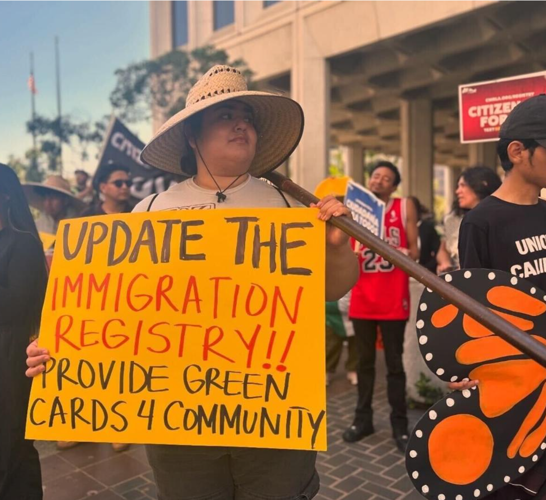




Protest against President Donald Trump's immigration policies. (Photo by Amairani Hernandez.)
Nearly half of Latino parents with young children say their financial situation has worsened over the past year, while immigration reform has risen to the top of the list of issues they want federal policymakers to address, according to the latest National Latino Family Report.
This year’s survey of 1,300 Latino parents and caregivers of children from the prenatal stage through age five included oversamples in California, New Mexico and Texas, providing a deeper analysis into the regional experiences that shape family well-being.
Economic pressure
Economic hardship remains a significant concern among Latino families, with 49% reporting that their financial situation had worsened over the past year, representing the highest level recorded since Abriendo Puertas-Opening Doors (AP-OD) began tracking the experiences of Latino families nationwide. About 54% of Latinos reported having less than $1,000 just in savings.
Despite the ongoing challenges Latino parents are facing, many are taking proactive steps to support their children by creating financial stability. Families reported pursuing higher-paying employment opportunities, seeking promotions, taking on additional jobs and starting businesses.
“For my husband and myself, informing ourselves about financial literacy has been something that we’ve tried to invest more time into. It’s been years in the making to get my husband confident enough to open up his own business… that’s going to be exciting but also financially more geared toward having financial freedom,” shared Joana Perez, a mother of eight children.
Other Latino families have found themselves in need of government support to help them put food on the table. One-third 33% reported having applied for the Supplemental Nutrition Assistance Program (SNAP) in the past two years. Young adults between the ages of 18 and 29 were most likely to have applied for SNAP.
There were also notable differences across states. The share of families reporting that they had applied for food assistance was highest in New Mexico (47%) and Texas (35%), compared with California (29%).
SNAP helps serve 42 million people in the U.S., providing essential food support for families, children, the elderly and those with disabilities. However, last year the budget was cut by $187 billion through 2034, resulting in three million Americans losing SNAP benefits between July 2025 and January 2026.
On average, SNAP participation in California is higher than the national average across its congressional districts. “Certain areas, especially in the Central Valley, show particularly high rates. California’s 22nd District, which includes the Bakersfield area, has about half of households participating in SNAP. California’s 21st District, which includes the Fresno area, has over 50% participation.

Two years ago farmworkers, DACA recipients and immigration reform allies gathered together to march the streets of Los Angeles and urge Congress to pass a pathway to citizenship. (Photo by Amairani Hernandez.)
Immigration fears
At the same time, 42% of families also identified immigration reform and protecting immigrant rights as a top federal priority, nearly doubling concerns from 23% in 2025. The report also highlights how rising living costs and fear tied to immigration enforcement are reshaping daily life for many Latino families.
According to the report 57% of Latinos worry that a family member or childcare provider could be detained or deported, and are avoiding activities like accessing public benefits, reporting crimes and engaging with schools due to immigration fears.
“Latino families are telling us, clearly and urgently, what they need to thrive,” said Javier Martínez, Managing Director of National Policy of AP-OD. “Parents are working harder, taking on extra jobs, starting businesses and doing everything possible to create stability for their children, even as rising costs and immigration fears create extraordinary uncertainty. Families should not have to carry these burdens alone. Their voices must shape the policies that impact their daily lives.”
Healthcare access
As uncertainty surrounding health care coverage eligibility and changes to programs such as Medicaid continues, many families report that the affordability of care and access to quality health services remain important as well. About 53% said their health insurance only covers some of their healthcare needs, while 98% believe Congress and the President should address healthcare costs.
“Every time I needed to see a doctor, I had to pay, medications… it does add up. And that $70… if she’s seeing doctors and medication, that can go towards food or anything else, you know? And, you know, with this economy, every dollar, it’s a dollar.” shared Yamika Hidalgo, mother of one.
As of now, around two million Californians do not have health insurance. The state’s Legislative Analyst Office (LAO) projects that number to roughly double by 2030. Most of the increase in the uninsured population will be due to eligibility requirement changes under H.R. 1, also known as the “One Big Beautiful Bill Act,” which was passed in 2025.

Hundreds in Kern County rally against Medi-Cal's proposed budget cuts. (Photo by Amairani Hernandez.)
Childcare and well being
When individuals were asked which issues the President and Congress should address around child wellbeing, 43% identified access to affordable childcare as a top priority.
Due to the current immigration policy climate that is having on Latino families, 21% of individuals shared that keeping immigration enforcement activities outside of schools was the second highest important issue.
Other top priorities included protecting children from gun violence (20%), reducing the cost of higher education (19%) and expanding access to parenting programs (17%).
"Rising costs, housing instability, child care challenges, health care barriers and immigration fears all connect directly to early childhood education and child well-being. They affect whether young children can attend early learning programs consistently, whether parents feel safe taking them to school or child care, whether families can get the support they need and whether children have the stability to learn and grow,” said Amalia Chamorro, director of the Education Policy Project at UnidosUS. “Now it is the responsibility of decision makers to listen to their constituencies and advance policies that lower costs, protect immigrant families, expand affordable child care and early learning and give every child the strong start they deserve.”







(0) comments
Welcome to the discussion.
Log In
Keep it Clean. Please avoid obscene, vulgar, lewd, racist or sexually-oriented language.
PLEASE TURN OFF YOUR CAPS LOCK.
Don't Threaten. Threats of harming another person will not be tolerated.
Be Truthful. Don't knowingly lie about anyone or anything.
Be Nice. No racism, sexism or any sort of -ism that is degrading to another person.
Be Proactive. Use the 'Report' link on each comment to let us know of abusive posts.
Share with Us. We'd love to hear eyewitness accounts, the history behind an article.