
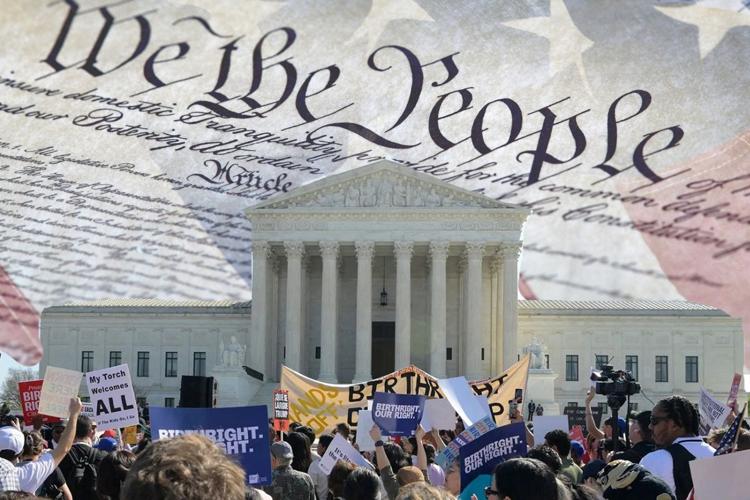
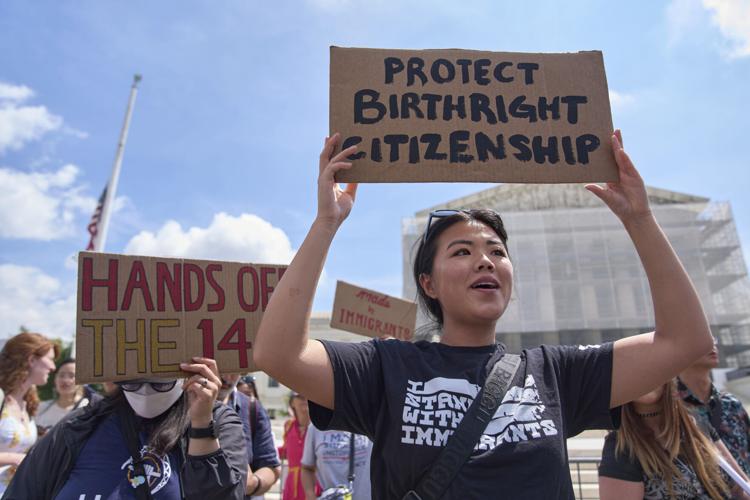


Demonstrators rally outside the U.S. Supreme Court as justices hear oral arguments on whether President Donald Trump can deny citizenship to children born to parents who are in the United States illegally or temporarily, on Capitol Hill in Washington, Wednesday, April 1, 2026. (AP Photo/Tom Brenner)
For the second time since it was enacted, the U.S. Supreme Court has upheld birthright citizenship as the law of the land. The legal team that defended the 14th Amendment as written said that, as far as they are concerned, the case is now closed for good.
In one of its most consequential rulings of this term, the U.S. Supreme Court ruled President Donald Trump’s executive order restricting birthright citizenship is unconstitutional.
On Tuesday, the divided court ruled 6-3 that Trump’s order was in direct conflict with the 14th Amendment, which grants U.S. citizenship to any person born in the country — a right the president sought to revoke from babies born to undocumented parents.
“The Trump administration's assaults on immigrant communities and mixed status families have been relentless, but today we held the line against this cruel and corrosive attempt to alter one of our most cherished constitutional values,” said Cody Wofsy, the deputy director of the ACLU Immigrants’ Rights Project and part of the legal team that defended birthright citizenship before SCOTUS.
Trump signed his order on the first day of his second administration; the following day, California, Arizona and 16 other states sued him.
“The Supreme Court's decision today is a reminder that, no matter what he might wish, Trump is not a king,” California Attorney General Rob Bonta said in a statement.
Arizona Attorney General Kris Mayes said Tuesday’s decision not only upheld the promise of the 14th Amendment, but also “the soul of this nation.”
After being sued by dozens of states, the order was struck down by various low-level courts. The administration first took the case to the Supreme Court in June 2025, with the Court ruling federal district courts cannot issue nationwide decisions.
That is when the ACLU stepped in with Trump v. Barbara, the civil class action lawsuit that SCOTUS based its decision on Tuesday.

On Tuesday morning, the Supreme Court rejected President Donald Trump's executive order attempting to end birthright citizenship, citing the 14th Amendment. Graphic design by Brenda Verano
The case
The ACLU and other national human rights organizations filed the lawsuit on behalf of all the children that would be affected if Trump’s order had gone into effect. Those organizations held a press briefing Tuesday to reflect on the ruling.
In a written testimony shared by Wofsy on Tuesday, one of the case plaintiffs who used the pseudonym Susan wrote, “I've always heard that this country was founded for people who want to be free and who are seeking opportunity … I'm very glad that America is protecting innocent children so they can have a future. This is the version of America I believe in.”
The Supreme Court previously affirmed birthright citizenship in the 1898 United States v. Wong Kim Ark case. Ark was an American citizen born to Chinese parents who was denied reentry to the U.S. after a trip to China in 1895. Immigration officials argued he was not actually a U.S. citizen due to his parents' nationality.
Ark’s lawsuit against the U.S. made it to the Supreme Court, which ruled 6-2 that the 14th Amendment’s Citizenship Clause guarantees citizenship to anyone born in the U.S., regardless of their parents' immigration status – Tuesday’s decision once again reaffirmed this.
“The Supreme Court has settled for the second time in our history that birth in this country makes you a citizen of this country. That question is closed,” said Aarti Kohli, executive director at the Asian Law Caucus, co-counsel in Trump v. Barbara. “So we celebrate every child who will grow up never having to wonder whether their citizenship is conditional.”

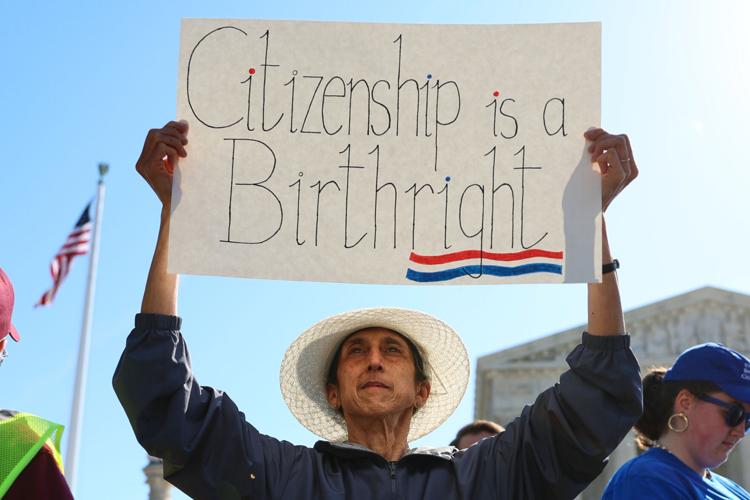
Hannah Liu, 26, of Washington, holds up a sign in support of birthright citizenship, May 15, 2025, outside of the Supreme Court in Washington. (AP Photo/Jacquelyn Martin, File)
In California, 44% of the children born in the state have at least one immigrant parent, according to the Public Policy Institute of California.
Latinos were set to be disproportionately affected by the order. Around four million children in 2022 were born to Latino parents who were not citizens themselves, according to the UCLA Latino Policy and Politics Institute.
“Since January 2025, expected mothers across this country have gone into labor not only with the ordinary fears of childbirth but with the terror that the child in their arms might be denied citizenship in this country,” said Juan Proaño, CEO of the League of United Latin American Citizens on Tuesday. “A mother should be able to hold her newborn and know without question that her baby is home, and today that certainty is restored.”
Despite the definitive win and positive broader implications of the SCOTUS decision, Proaño emphasized that the “work does not end with this ruling.”
What comes next?
Trump immediately took to Truth Social on Tuesday, saying Congress could “easily make it up” by limiting birthright citizenship through its own legislation. Legal experts from the ACLU, Asian Law Caucus and Democracy Defenders Fund have struck down this idea as “not a serious” concern.
The experts said Tuesday they are confident the SCOTUS decision is definitive and leaves no real avenue for Congress to encroach on the right to citizenship.
The only way Congress could legally pursue a change to the scope of birthright citizenship would be through a Constitutional amendment, which requires either a two-thirds vote in Congress or a two-thirds petition from all state legislatures.
“He doesn't understand how the Supreme Court works and how the Constitution works,” Taryn Wilgus Null of the DDF said of Trump’s call to Congress.
More directly, Kohli said any Congressional challenge is “not gonna happen.”
The right to citizenship is a “power that is outside the ordinary political back and forth in the halls of Congress,” Wofsy added, noting that was the exact purpose of how the 14th Amendment was originally written, and what was vindicated by Tuesday’s ruling.
While there was a consensus among the legal experts that the Trump administration will continue to target immigrants in other ways, they are confident this case of birthright citizenship is now firmly closed.
Wofsy said the decision is a “real measure of hope” that shows communities and allies can push back against dangerous rhetoric and policies to “ensure that this country doesn’t lose itself.”






(0) comments
Welcome to the discussion.
Log In
Keep it Clean. Please avoid obscene, vulgar, lewd, racist or sexually-oriented language.
PLEASE TURN OFF YOUR CAPS LOCK.
Don't Threaten. Threats of harming another person will not be tolerated.
Be Truthful. Don't knowingly lie about anyone or anything.
Be Nice. No racism, sexism or any sort of -ism that is degrading to another person.
Be Proactive. Use the 'Report' link on each comment to let us know of abusive posts.
Share with Us. We'd love to hear eyewitness accounts, the history behind an article.