


This story was originally published by EdSource. Sign up for their daily newsletter.
When Fausto Lopez started skipping class in middle school, his grades slipped, but he still managed to pass science class.
He thought about that years later when asked what college courses he might be interested in. Lopez liked biology, but it wasn’t an option because he was attending school from inside a juvenile facility.
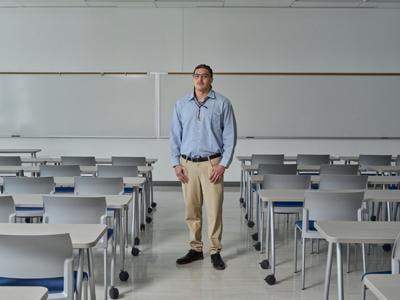
Flash forward to today, and Lopez is a biology major at California State University, San Bernardino, where he just completed his first year of studies. As a student in the court school system, Lopez demonstrated sustained academic prowess and interest, leading a judge to grant him an early release one year ago this month.
In the 2024-25 school year, there were 2,116 students enrolled in juvenile court schools, according to an EdSource analysis. Recent California policy changes have made it possible for some to attend college. Still, the steps Lopez took remain difficult for other incarcerated youth to replicate without significant support from mentors.
While Lopez’s journey in the juvenile justice system ended with an early release based on academic achievement, it began with an honest look at what needed to change in his life.
“It took me losing everything and being isolated from everything to really regain control of my life and then get it together and start doing everything one step at a time,” said Lopez, now 21.
Turning point
Lopez grew up in Indio, in Southern California. He enjoyed school but stopped attending regularly as he entered his teenage years.
“I was trying to pursue a life that I thought was cool and get all the instant gratification from everything I was doing,” he said. “I was fortunate enough to have both parents in my life, and I had a support system, but I was selfish, and I did the things that I wanted to do, hurting the people closest to me.”
In high school, he was barred from one school due to behavior, expelled from another, and was just getting by at a third.
Then, in 2021 at age 16, he was arrested and detained at Indio Juvenile Hall, where he remained for over a year until the verdict came in: seven years for two second-degree murders.
“The story behind all that is it goes back to toxic masculinity,” Lopez said.
He fired a shot out of a vehicle he was in toward a group of men in another vehicle, and when the men fired back, they hit Lopez’s friend, the driver, killing him instantly. The car hit two bystanders, killing one.
Lopez was charged with firing the first shot. Today, Lopez expresses concern for the victims’ families and says that day taught him a lesson: “Every bad thing you do has a consequence.”
Back to school
Lopez attended school while at Indio Juvenile Hall, where he wanted to complete high school as quickly as possible. But he started to take dual enrollment courses, which meant enrolling in college courses while completing high school. They gave him a taste of what college might be like.
“In the back of my head, I’ve always wanted to go to college, and I’ve always wanted to dorm, get that full college experience. Is it too late for me to do all that?” Lopez remembered thinking. “I still want to give it a try.”
He completed high school by the time his case was adjudicated and was transferred to a Secure Youth Treatment Facility, known as SYTF. These units were created after the 2023 closure of the state’s Division of Juvenile Justice to house youth found to have committed serious offenses.
The 2020 bill that overhauled the state’s juvenile justice system also meant that California moved toward offering “less restrictive programs,” which provide gradual access to the community until youths are ultimately released. Universities are considered less restrictive options, though students typically have been granted day passes to attend school in person and must then return to their facility after class.
During fiscal year 2024-25, 333 youths were held in Secure Youth Treatment Facilities, of which 215 were then transferred to a less restrictive program, according to the Office of Youth and Community Restoration.
Despite Lopez’s interest in science, he could not complete lab work in detention. He was advised to pursue psychology since there were classes to “show probation that you can actually do something and it’s going to open doors for you,” he said a counselor told him.
At the SYTF inside the Alan M. Crogan Youth Treatment and Education Center (YTEC) in Riverside, Lopez studied toward his associate’s degree through Riverside City College.
Maintaining focus was often difficult, he said. If a fight broke out during school, class was cut short, and if he didn’t complete an assignment, he couldn’t stay after school.
The longer he was there, Lopez said, the clearer his determination became to correctional officers.
“If fights broke out, sometimes, they would let me stay there. They knew that I was actually putting in the work. So they would accommodate, but not all the time because sometimes they just couldn’t or they just wouldn’t,” Lopez said.
It was in a virtual “Introduction to College Success” course at YTEC that Lopez met Michael Griggs, a program coordinator with Cal State San Bernardino’s Project Rebound. The program supports students who are or have been incarcerated. Of the 15 students who enrolled for the seven-week course, Lopez was one of two who completed it.
Lopez had to give up his recreation time to attend the class. Griggs would see other students walk into the video frame during class, asking Lopez to join their basketball team that evening.
“Nah, I’m good right now,” Griggs remembers Lopez would respond.
Griggs, who also returned to school while incarcerated years prior, later learned just how much Lopez loves the sport. “As soon as he came to Cal State San Bernardino, he wanted to see the basketball court,” Griggs said.
California policy changes
Lopez benefited from recent changes in California law, such as being approved for less restrictive programs and remaining in his home county rather than being sent to a state facility.
He applied to a few universities to pursue a bachelor’s degree and was accepted for fall 2024. He was unsure, however, if he would be allowed to attend while incarcerated. He’d also received approval to transfer to the Pine Grove Youth Conservation Camp, considered a less restrictive program, where incarcerated youths are trained as firefighters in Amador County. At the time, it was the quickest way to get out of the detention facility he was in.
But his counselor reminded him he had only five classes left for his associate’s degree. He could still go to Pine Grove after completing them. So, once again, Lopez put his head down and studied.
As he completed that associate’s degree in 2024, he was slowly reintegrated into the community. His first outings were to equine therapy with armed probation officers. Next came visits to restaurants, an aquarium, a zoo, and a visit to Cal Poly Pomona with classmates.
At his graduation ceremony, he was left unsupervised for the first time in three years so he could walk the stage alongside his peers.
The full college experience
Lopez was at Pine Grove by mid-2024, waking up at 5:40 a.m. to a schedule packed with workouts, fire training and laundry, which he was in charge of at the camp.
But he missed school, so he called Griggs.
“He liked firefighting, but this is not what he was meant to do,” Griggs said. “He wanted to go to school, he wanted to be a medical doctor, but he had ambitions of getting released and going to campus.”
Griggs told him that was unheard of, but they would try.
“Probably in the back of their heads they’re like, ‘What else does he want? We gave him all this, and he still wants more?’” said Lopez. “But I knew there was something more.”
That “something more” required approval from probation officers and a judge. Griggs, who went to court advocating for Lopez’s release, found they were open to the idea.
They asked Griggs to write a reentry plan for Lopez, and by January 2025, they had final approval for release to another less restrictive program: CSU San Bernardino.
On the day Lopez was released, he had hardly slept after a 24-hour shift fighting the Los Angeles fires that burned early in 2025. Within hours of the judge’s final approval, Lopez was standing in his new dorm room. Griggs was there to help him get situated in his new home. It was the first day of the semester, and he needed everything — hygiene essentials, bedding, clothing, groceries, an identification card, a phone.
One year later, Lopez still keeps himself on a strict schedule.
“It’s overwhelming and people don’t perform their best when they’re overwhelmed, but you can’t have idle time. Once you start having idle time, that’s when you start wanting to do things just ’cause you’re bored,” said Lopez, who now also works as a student assistant with Project Rebound. “I need that structure in my life so I can perform at my best.”
Griggs considers Lopez’s academic journey a pathway for others.
“Here these youth are experiencing long periods of incarceration, now at university at the right age group,” he said. “They look as if they just came out of high school or community college and transferred here. What I think is — they’re exactly where they need to be.”





(0) comments
Welcome to the discussion.
Log In
Keep it Clean. Please avoid obscene, vulgar, lewd, racist or sexually-oriented language.
PLEASE TURN OFF YOUR CAPS LOCK.
Don't Threaten. Threats of harming another person will not be tolerated.
Be Truthful. Don't knowingly lie about anyone or anything.
Be Nice. No racism, sexism or any sort of -ism that is degrading to another person.
Be Proactive. Use the 'Report' link on each comment to let us know of abusive posts.
Share with Us. We'd love to hear eyewitness accounts, the history behind an article.