


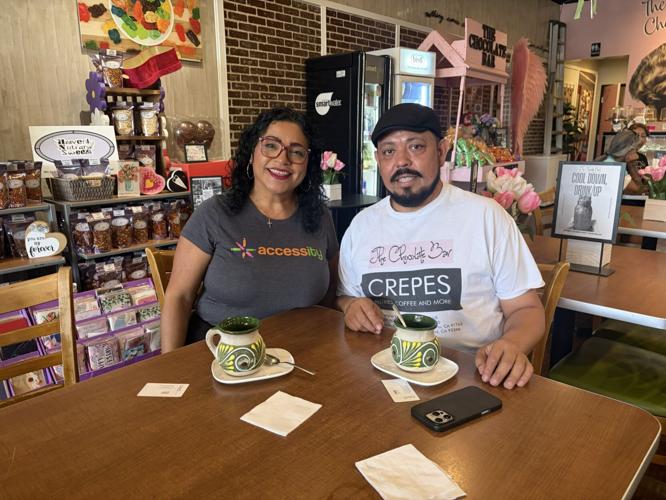




The Chocolate Bar in Ontario, California. (Denise Florez / CALÓ News)
Luis Sanchez and his wife, Beatriz Chavez, opened The Chocolate Bar in Ontario in 2019, just before the pandemic hit.
While many businesses in the same shopping center had to close because of COVID-19 and financial hardship, Sanchez and his wife were able to stay open and they now even have a second location.
They made changes to their menu and added delivery, but they also had financial assistance through the financial nonprofit organization Accessity. The nonprofit helps those who can’t find financial support from traditional lending institutions, such as banks and credit unions.
Regional business development manager Christine Sanchez (no relation) has worked at Accessity for 10 years. The organization itself has operated for 30 years, first in San Diego and expanding to Riverside, San Bernardino, Los Angeles, Orange County, Santa Barbara, Imperial and Ventura County.
“So let's just say they go to the bank, and that might be for different reasons, that might be [denied a loan]because they have a low FICO score, they've never used their credit or they have an ITIN, we provide access to capital,” said Christine Sanchez.
Accessity can help if a person hasn’t been in business for at least two years, which is usually a bank requirement.
The nonprofit organization has its own funds to assist, thanks to grants it receives, donations from past clients and funding from other organizations. “We do our own lending, we don't reach out to anybody else, any other banks. We have our own lending criteria,” she says.
According to their records, in 2025, about 55% of their borrowers were identified as Latino/Hispanic and 48% are immigrants.

Accessity business manager Christine Sanchez, left, and Luis Sanchez, owner of The Chocolate Bar. (Denise Florez / CALÓ News)
“Our mission is to be able to be out in the community and be able to help people know that there's help,” she adds.
Accessity also provides business coaching, help with QuickBooks, creating a business plan and training.
They also have partnerships with other organizations like the Small Business Development Center, Asociación de Emprendedores and the Women's Business Center.
“We're very flexible with our lending,” says Christine Sanchez “We do understand that., I'll give you an example. We have clients that maybe have had a business from home for the past 10 to 20 years, sometimes two years, they're generating income, but they don't have a way to prove it. We take that experience into consideration. We allow them to bring that money into the loan. We allow them to bring co-borrowers. Sometimes, it's a wife starting a business, and she doesn't work, but she has this dream, but her husband works, and might be able to take the responsibility with her of the loan.”
“It doesn't always work out for everyone,” she said. “If it doesn't work out, we give them steps to be able to come back.”
Accessity has a training program called the Academy or La Academia, which teaches entrepreneurs the A through Z of business. It’s a virtual eight-week program, two hours per week.
The business manager said many Latino community members have little experience with the financial industry.
“When they come to us, they've never gotten lending, sometimes no bank account, sometimes no business bank account, so those are things that we require for them to start getting used to,” she said. “Our goal is for them to be able to walk into any financial institution, and for them to get exactly what they need.”

The Chocolate Bar in Ontario, California. (Denise Florez / CALÓ News)
How the Chocolate Bar weathered the pandemic
Luis Sanchez was working for a company that distributed candy and nuts for almost 20 years. His wife was working in the accounting department, while he was part of operations. He then decided to start a nuts and sweets business called Heavenly Nuts. That’s when they decided to use the experience they had in accounting and operations to open their coffee shop.
“It was a big challenge because we were not prepared as far as knowing how to run a business like this, and start getting our menu, the basic stuff, so it was a big challenge,” Luis Sanchez said. “But we were willing to do whatever needed to be done to have this be a successful business, so we started [to sell] crepes and… cafecito de olla.”
He started working with the Chamber of Commerce in Ontario to help guide the process of owning a business.
The coffee shop began by blending Latino flavors with other drinks and treats, like avocado toast and matcha.
Then COVID-19 took over the world.
“Oh my God, what's going to happen now, right? So it was another, another big challenge for us, because all the neighbors had decided to close at that time,” Luis Sanchez said. “I was praying so hard, so we talked as a family, and then my wife was like, if we close, it's because we're closing [for good].”
They decided to stay open to make sure they could pay their lease. They added sandwiches and Mexican tortas to the menu and began to contract with Uber Eats, DoorDash and GrubHub to deliver their food and drinks.

Torta de panela from the Chocolate Bar in Ontario, California. (Denise Florez / CALÓ News)
The Sanchez family worked through the ups and downs of the pandemic years, and customers stayed loyal even though the dining area had to be closed due to state rules and even after they themselves fell sick with COVID-19 and were recovering.
“It was like very, very, very challenging for us as a family, but thanks, God, everything, everything happens, customers were very loyal again,” Luis Sanchez said. “We were like, ‘Oh, wow, we did it.’”
That’s when their five-year lease was about to end, and after seeing other businesses closing down because the lease was being raised, they decided it was time to look for more options.
“I was praying so hard, and that's when I found Accessity, and they were like angels for us,” he remembers.
Accessity was able to provide them with a loan. Christine Sanchez said they had over $11 million in COVID funding to small businesses, many of which didn't qualify for the PPP loan.
“They are very accessible, as far as you know, whenever you explain the [total] situation, and saying this is my true story, this is who we are, and we were very grateful that they were able to give us a loan,” Luis Sanchez said. “We were talking to her about the option of expanding and kind of finding the place where we can put the second location, and they were working with us.”
They opened their second location in Highland in June 2023. It was not without hiccups, of course. They had already started making changes, but they said they had to present plans first before getting the licenses. The city had told them they could work with the existing plan but the health department had other regulations. Luis Sanchez thought he would be able to open in three months, but it actually took a year.
The business is truly a family affair. When they started, their kids were 10 and 12. He initially didn’t want them to be involved, but one of his friends recommended asking them if they wanted to be involved.
“They were helping us to clean the tables, to sometimes take coffee, to charge the customers to do this,” he said. “They know every single aspect of the business. And my son is going to start college this time in August, and he's doing business and hospitality because he wants to expand.”
Their daughter chose a different path by attending UC Berkeley, but still likes to help out in the stores when she’s home.
New challenges have surfaced, like the recent rise in gas prices, but for Luis Sanchez, they have been able to continue their business.
“It's always something, you know, it's like we don't know, I mean, all the things that we say all the time, like we are here day by day, doing the best we can, loving what we do,” he said.
Latinos and their relationship with money
For many Latinos, it’s hard to put money in the bank.
“My mom, I cannot get that lady to put money in the bank; she has a safe at home,” Christine Sanchez said. “I don't know if you know that's the way they did it in Mexico. They kept money at home, they didn't go to the bank, they didn't deposit money. I cannot get her to go and put her money in the bank and I'm helping her slowly. I'm going, putting it in their bank account, and then she's like, ‘oh, but I'm not gonna have any money left.’ I said, ‘Mom, you are.. it's just in the bank.’”
She said one of his clients was so nervous when they were signing loan documents that she asked him if he was okay.
He said he knew he needed the money to take his business to the next level, but in Mexico, the less debt you have, the better it is for you.
“[He said] ‘You're not supposed to owe anybody money, that's just.. you're not supposed to do that, that's not a thing that we do,” she said “So then you come here, and then you have to take care of your credit, and it's okay for you to have a credit card to build your credit and take on debt, he goes, ‘it's so different, and I'm barely starting to get used to it,’ culturally it's kind of a clash from what he was telling me, and I see it with my own family, with my mom, so sometimes what I'm also seeing is they don't like to owe the money. I have clients that tell me, ‘you know, I really need the loan. I don't like to owe anybody. How fast can I pay it back?’”
A lot of it has to do with trust and developing a relationship with money, even other people’s money.
“Sometimes it's okay to use somebody else's money, even if it's for a short period of time. That way you don't empty out your bank accounts,” she continued.
The business manager hopes that with more financial education, Latinos will feel more comfortable with money.
“Sometimes you don't know how to manage a bank account,” Luis Sanchez said. “And you see that they are charging you for not having the funds of all these, so people get scared, you know, like, oh, they're charging me more, because that's what happens with banks, but at the end, you have to learn how to manage your bank account, how to manage your money on in a better way. The administration of a business is another key part.”
Different organizations can help manage a business, start a business or create a business plan. It’s a process that continues throughout the lifespan of any business venture.
“A piece of advice that I could give people that may be hesitant, don't be scared to go talk to your banker, you know. If you're thinking about having a business, don't just walk in the bank and go and deposit your money, especially if you're a business owner. Go sit in with your business banker and build a relationship,” said Christine Sanchez. “Sometimes it's just taking the leap to get out of your comfort zone and ask somebody you know.”
Starting a business can seem daunting at first, but finding assistance could help business owners thrive despite obstacles that surface in the current economic climate.
“Most businesses open and they close, but at the end, when you have the support and the tools to continue growing, it's possible [to succeed],” Christine Sanchez said.








(0) comments
Welcome to the discussion.
Log In
Keep it Clean. Please avoid obscene, vulgar, lewd, racist or sexually-oriented language.
PLEASE TURN OFF YOUR CAPS LOCK.
Don't Threaten. Threats of harming another person will not be tolerated.
Be Truthful. Don't knowingly lie about anyone or anything.
Be Nice. No racism, sexism or any sort of -ism that is degrading to another person.
Be Proactive. Use the 'Report' link on each comment to let us know of abusive posts.
Share with Us. We'd love to hear eyewitness accounts, the history behind an article.