
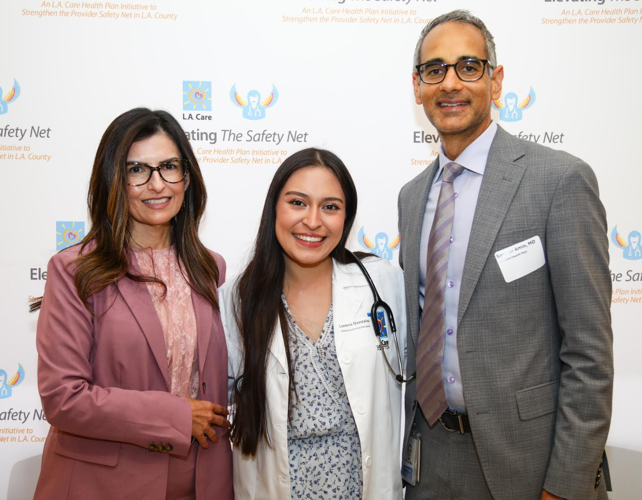
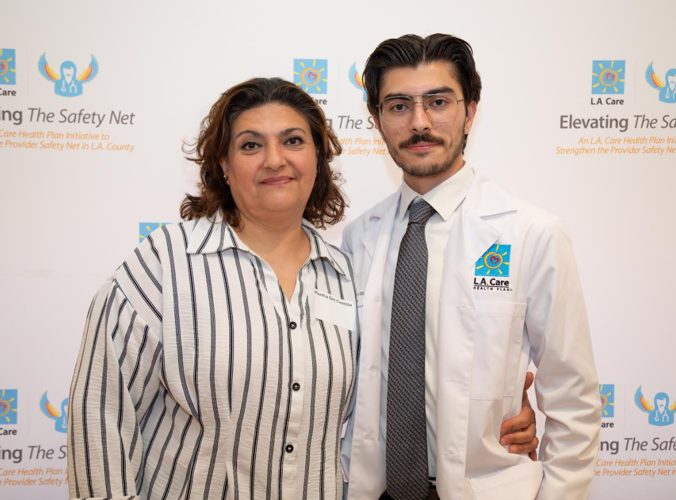


Martha Santana-Chin, L.A. Care CEO, Lorena Gonzalez and Dr. Sameer Amin. (Photo courtesy of L.A. Care.)
With Los Angeles County experiencing a physician shortage that threatens the healthcare of underserved Latino communities, L.A. Care awarded full scholarships to five Latino medical students through its Elevating the Safety Net program (ESN) in order to address this crisis.
In July 2018, L.A. Care launched ESN, now in its ninth year, the program continues to cover the cost of medical school in full, granting almost $500,000 per student. As of now, ESN has given a total of 72 scholarships and all have been awarded to students attending medical school. This year’s 2026 scholarship recipients are Lorena Gonzalez, Vanessa Alvarado, Roberto Del Castillo, Eimar Ixtlilco and Jesus Vasquez.
According to the Association of American Medical Colleges, 75% of medical students leave school with education debt of $196,000. The scholarships that are provided by ESN eliminate the huge debt that can require many physicians to choose higher-paying specialties or to serve in more affluent communities.
Growing up in Los Angeles and as the daughter of a single mother, Lorena Gonzalez’s path to medicine is shaped by her own experiences navigating barriers related to chronic illness, lack of insurance and financial challenges.
“I grew up uninsured, and as a child with asthma and other health needs, I experienced firsthand what it meant when accessing healthcare was not always straightforward. I also watched my mother work while attending school and [she] did everything she could to create opportunities for me,” she said.
For Gonzalez, receiving a full medical grant means having one less financial responsibility during her time attending the David Geffen School of Medicine at UCLA. “The L.A. Care scholarship means I do not have to make decisions about my education based solely on what I can afford,” she said. It gives me the freedom to focus more fully on becoming the physician I hope to be, to learn, serve, conduct research and continue engaging with communities without carrying the same financial burden. There is something especially meaningful about receiving support to become the kind of physician I once needed.”
Gonzalez shared that one of the biggest lessons she has learned is that having healthcare available does not necessarily mean that healthcare is accessible.
As a future doctor, she hopes to be attentive to what a patient needs beyond their diagnosis, while also advocating for healthcare systems that are easier to navigate. “Ultimately, I want patients to feel that they can actually access the care they have been told is available to them,” Gonzalez said.
Highlighting the critical shortage of physicians across the county, she stressed the importance of representation in medicine, pointing out the gap between L.A.’s diverse communities and the demographics of its healthcare workforce.
“LA County is home to nearly 4.8 million Latino residents, who make up about 49% of the county’s population. The Latino community is also a major driver of the region’s economy, with approximately 370,000 Latino-owned businesses across the county. Yet nationally, only about 6.7% of active physicians identify as Hispanic or Latino,” Gonzalez said. “To me, that gap matters. Latinos are not a small or peripheral community in L.A.; they are central to the cultural, social and economic fabric of this region. We should have a healthcare workforce that reflects that reality.”
Martha Santana-Chin, L.A. Care CEO, emphasized that building a healthcare workforce that understands and reflects the communities of L.A. is essential to improving health outcomes. “Students from underserved communities often have firsthand knowledge of the challenges their patients face and are more likely to return to those communities to provide care. At the same time, many aspiring physicians are navigating significant financial barriers, including the rising cost of medical education and new limits on borrowing for medical school,” she said.
By 2030, the state will need more than 8,200 additional physicians to meet basic health needs. As of now, California has a high Latino population, reaching 40%, with further increases projected to 50% by the year 2050 and most of them live in areas without enough primary care physicians.

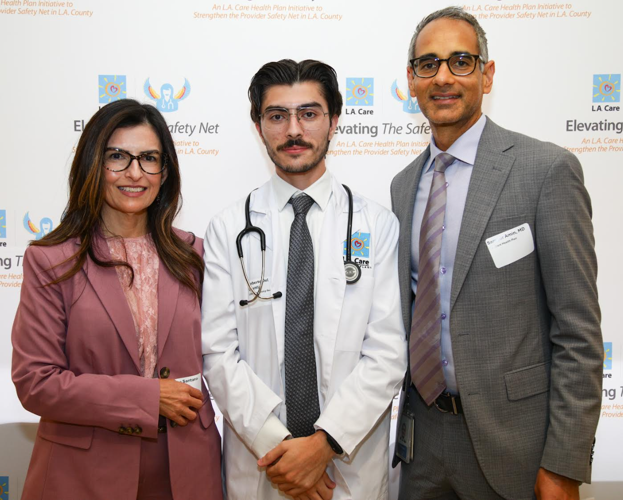
Roberto Del Castillo with Martha Santana-Chin, CEO, and Dr. Sameer Amin, President of Product and Healthcare Delivery, L.A. Care Health Plan. (Photo courtesy of L.A. Care.)
Thanks to the ESN scholarship, first-generation college graduate Roberto Del Castillo will attend the Charles R. Drew University of Medicine and Science to pursue his dream of becoming a physician.
“It was a moment of relief knowing that everything I had done, everything my parents had done, was not in vain. It meant that I could focus completely on becoming a doctor and not having to worry about the debt that came with the degree. My younger brother was a first-year at UC Berkeley at the time, so money was extremely tight. But seeing that email was nothing short of having changed our lives,” he said.
Growing up, Del Castillo experienced financial hardships and family transitions that strengthened his determination to pursue a career focused on helping others. He shared that while becoming a pediatric scribe, the conversations he often heard between the physician and the patient and their parents felt all too familiar.
He said that most of those conversations involved worrying about losing medical insurance, immigration raids, the cost of treatment or not being able to read the messages the physician sent because it was not in their native language.
“It is those experiences that left a mark on me, some where I left feeling hopeful, others powerless. That tenacious and compassionate attitude that I've learned along the way is something I hope every patient gets to experience when they meet me,” Del Castillo said.
He also noted that a lot of physicians are slowly moving away from the one-dimensional model of curing the patient and nothing more. “We as doctors may not be able to solve every problem that a patient comes with, but being able to share some experiences and have patients feel like they’re being heard can make a great difference,” he said.

Roberto with his mom, Martha Del Castillo. (Photo courtesy of L.A. Care.)
After graduating medical school, he hopes to stay in L.A. and complete his residency. “From the moment that I stepped into the long halls of the hospital as a volunteer, I knew that I was right where I wanted to be, right with the population that raised me,” Del Castillo said. “It is evidence of all the support from family, friends, peers, mentors and everyone else that played a role in my life, no matter how small. It is proof that someone like me, born and raised by two Mexican immigrants, could accomplish their dreams despite the hardships that the world kept throwing at them.”






(0) comments
Welcome to the discussion.
Log In
Keep it Clean. Please avoid obscene, vulgar, lewd, racist or sexually-oriented language.
PLEASE TURN OFF YOUR CAPS LOCK.
Don't Threaten. Threats of harming another person will not be tolerated.
Be Truthful. Don't knowingly lie about anyone or anything.
Be Nice. No racism, sexism or any sort of -ism that is degrading to another person.
Be Proactive. Use the 'Report' link on each comment to let us know of abusive posts.
Share with Us. We'd love to hear eyewitness accounts, the history behind an article.