
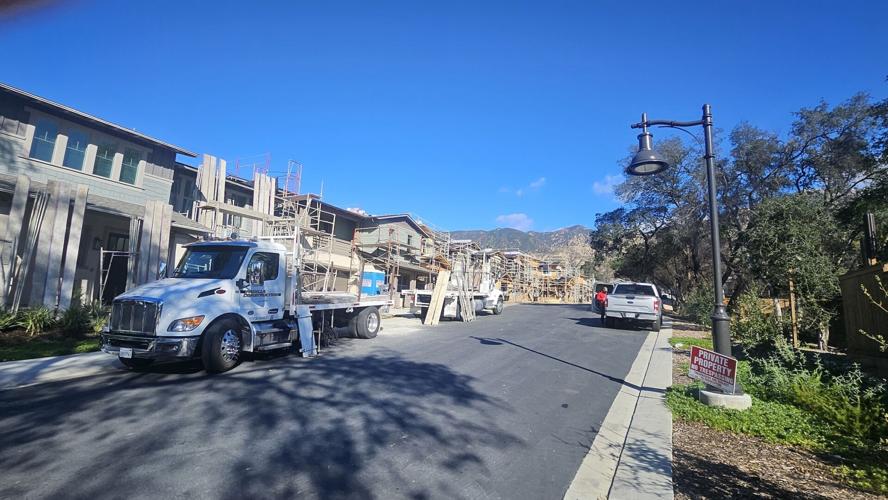



A construction site in Jan. 2026. (By Jacqueline García)
A new report shows that many day laborers who worked in debris cleanup and recovery after the January 2025 wildfire in Altadena often worked through informal contracts that provided inconsistent safety protections and lacked proper oversight.
The study is based on a limited qualitative sample intended to document workers’ experiences rather than represent all workers involved in recovery, the authors indicate.
“The population that we looked at were workers, and specifically day laborers,” said Michael Mendez, environmental policy and planning professor at UC Irvine. “Because in majority, these temporary workers tend to be undocumented, they don't have the same type of worker rights as a legal resident or a U.S. citizen.”
Some of the key findings included workers facing hazardous conditions at work and home. Nearly half of participants lived in or near fire-affected neighborhoods, exposing some workers to environmental hazards both while working and where they lived.
Once at the job, workers indicated their safety training and protective equipment were inconsistent. Only those who were connected with local community organizations like NDLON, CARECEN and IDEPSCA were more likely to report receiving safety training and adequate protective equipment versus those hired through informal or subcontracted arrangements.

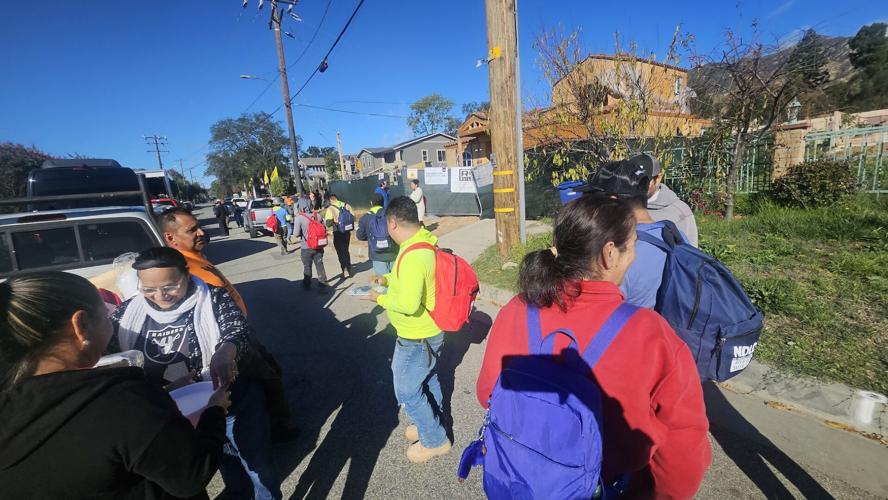
Organizers and volunteers gave tamales and safety equipment to construction workers during the one year anniversary of Altadena Eaton fire in Jan. 2026. (By Jacqueline García)
“A lot of them felt like they were completely over-scrutinized with the types of enforcement that was around them,” said Carlo Chunga Pizarro, co-author of the report. “They often went to the Pasadena Day Labor Center as a form of agency that helped them out when it came to understanding where enforcement was happening, but also as a form of trust and some type of peace when they came to just being safe.”
Workers said on average their self-income loss exceeded $4,300 since the start of the fire. This income loss was driven by disaster-related disruption and immigration enforcement. The effects of recovery extended to workers’ mental health. The report indicated workers rated their mental health as fair, poor, or very poor. The stress was linked to unstable employment, unsafe conditions, and immigration enforcement.
The expected outcome
Mendez said this study will help us understand that extreme events like wildfires, droughts and even El Niño that is coming, with a substantial amount of rain, mudslides and flooding, will need recovery efforts. But this is the time to start preparing and have a plan should those events arise with little to no notice.
They also hope workers who are on the frontlines have access to more appropriate physical, mental and emotional healthcare.
Pizarro said during his interview he often saw workers revealing they were coping with heavy trauma and didn't know where to turn for services.
“For those reasons, one of our policy recommendations that we made was implementing a type of behavioral health protection into the disaster workers policy because a lot of these workers not only are they living with various health hazards, but also at the same time mental health hazards that a lot of community-based partnerships or governmental agencies are not thinking about right now,” he said.
The report recommends that there be an implementation of culturally and linguistically appropriate trauma-informed help for the workers.
Another recommendation is that state and local governments work together to have a better preparedness plan and create more equitable policies around disaster recovery.
With the discoveries found through interviews and visitations, there is new information provided that will help to start thinking proactively and not reactively during and after the fire.
“This report is very timely in terms of having empirical data, policy-relevant data, because unfortunately, these extreme wildfire events that we saw in January 2005 are going to continue to happen with greater frequency and severity,” said Mendez.







(0) comments
Welcome to the discussion.
Log In
Keep it Clean. Please avoid obscene, vulgar, lewd, racist or sexually-oriented language.
PLEASE TURN OFF YOUR CAPS LOCK.
Don't Threaten. Threats of harming another person will not be tolerated.
Be Truthful. Don't knowingly lie about anyone or anything.
Be Nice. No racism, sexism or any sort of -ism that is degrading to another person.
Be Proactive. Use the 'Report' link on each comment to let us know of abusive posts.
Share with Us. We'd love to hear eyewitness accounts, the history behind an article.