
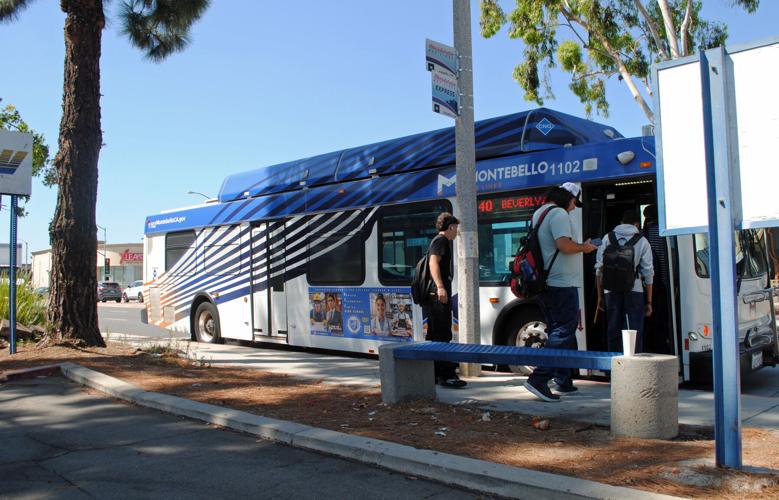
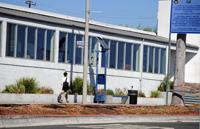
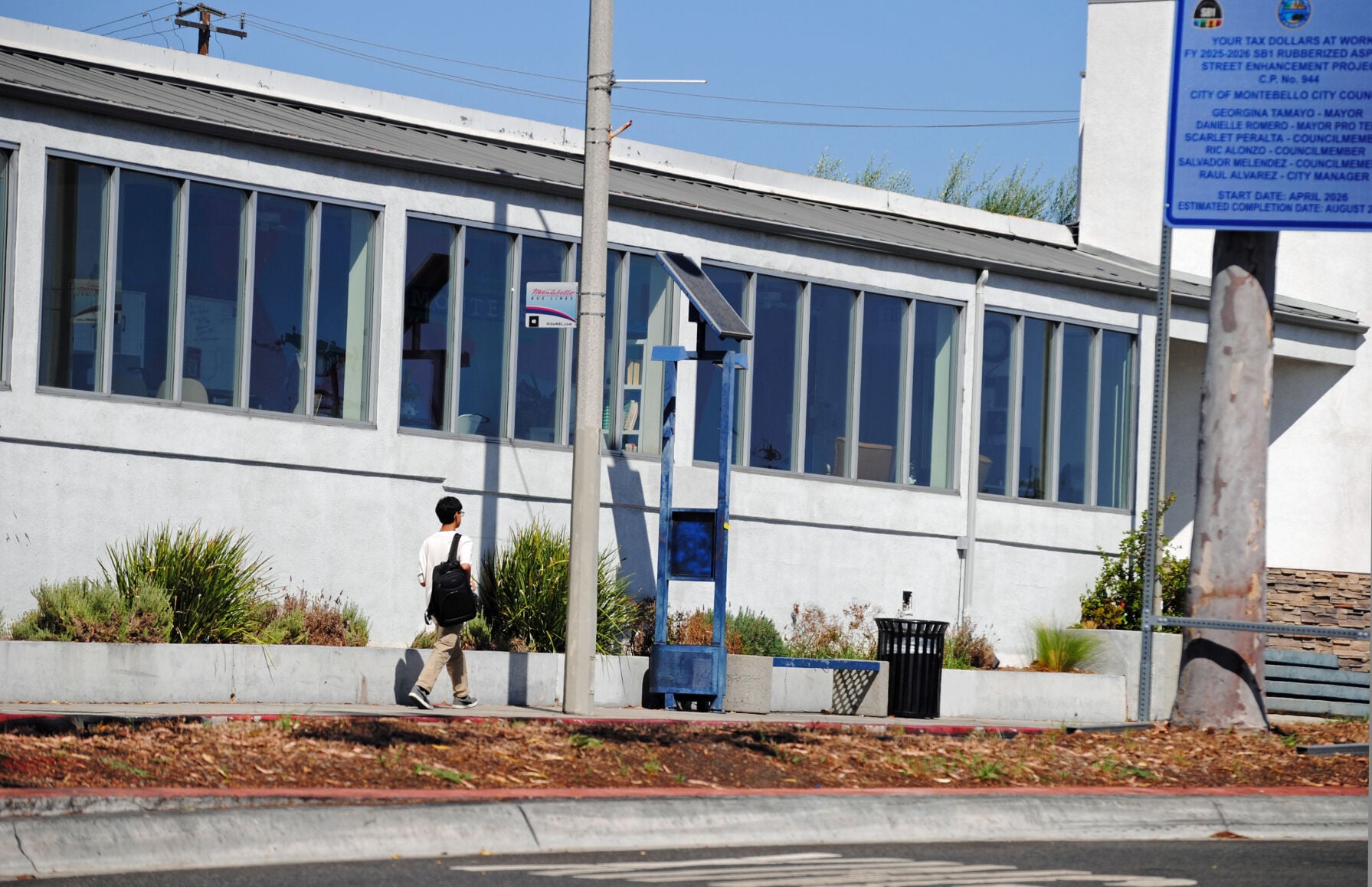
A student approaches a bus stop without shelter in Montebello near Beverly Boulevard and 20 Street on Aug. 31. On Aug. 26, the City Council voted 5-0 to cancel a plan to upgrade bus stops and add features to comply with disability laws. (Credit: Alfredo Santana/ CALÓ News)
The City of Montebello nixed a program that would have approved the construction of shelters and accommodations required by the Americans with Disabilities Act (ADA) to hundreds of bus stops used along eight Montebello Bus Lines (MBL), mostly located within the city.
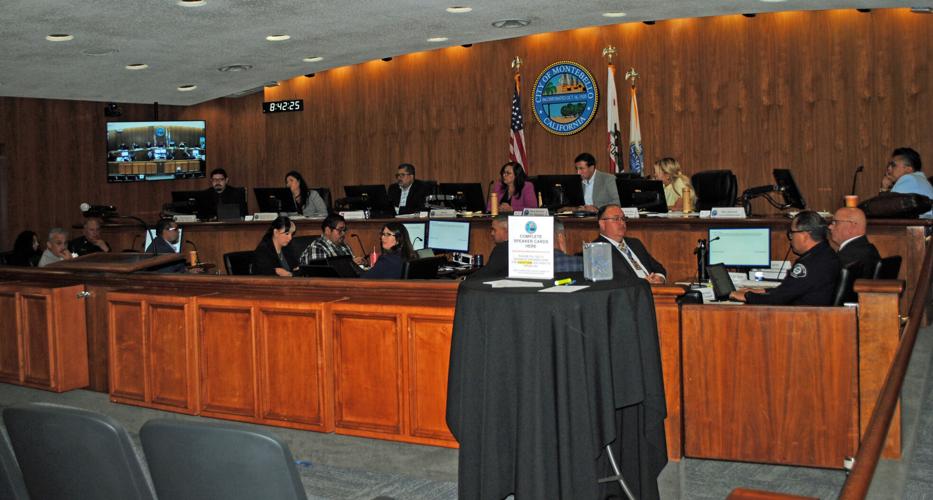
The 5-0 vote was cast by the City Council during the Aug. 26 public meeting. City officials cited lack of funds to support upgrades estimated at between $8 million and $12.3 million.
Currently, Montebello has $2.7 million for the program obtained through federal, state and local sources, meaning there is a $5.3 million to $9.6 million financial gap.
A report prepared by Kimley-Horn and Associates, the consulting firm Montebello hired to run a bus stops inventory, improvements advice and cost estimates, concluded that 152 stops in Montebello are in poor or moderate shape and need work to comply with ADA rules.
Outside Montebello, there are 545 bus stops that lack shelters or require ADA modifications, the report, finished in March 2026, said. MBL has a total of 823 bus stops.
Overall, Kimley-Horn flagged 115 MBL bus stops for “immediate improvements,” due to their “poor conditions and above average ridership.” The report averages 374 riders a month per stop in the city, and 273 outside the city.
John Soria, Montebello’s director of transportation, said the plan’s cancellation allows the city to restart and continue searching for additional money sources to fund the project.

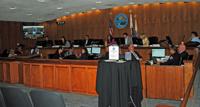
The Montebello City Council discusses an agenda item to shelve a plan to install canopies and build features to make bus stops compliant with disability laws on Aug. 26. The City Council voted 5-0 to cancel the plan, citing lack of funds. (Credit: Alfredo Santana/ CALÓ News)
“We are not looking to entirely do away with the information that we do have, but this gives us an opportunity to reset and also look at what the opportunities are to have, like a second opinion,” Soria said at the meeting. “So we’d go out and consider a peer review from a second engineering firm to confirm these numbers are adequate.”
In February 2024, the City Council agreed to pay Kimley-Horn $170,000 to conduct the “planning and design” analysis. Soria said the ADA infrastructure changes are specific to Montebello’s bus stops.
Soria said the Buy-American Act of 1933 requires cities to procure domestic materials and products when they use federal money, making it harder to control costs associated with imported materials subject to tariffs to build bus shelters or buses.
Councilmember Scarlet Peralta, who questioned the ballooned project cost, said Soria should provide feedback on items like bus stop canopies and accessibility to control expenses and ensure vendors’ estimates remain within budget.
“At the end of the day, those are resources that are lost, time that is lost. That is a project our community has to essentially wait [for] who knows how much longer,” Peralta said from the dais. “We are talking about bus stops, which are critical, critical spaces within our community our residents rely on.”
What do disability laws say about bus stops?
Attorney Michelle Uzeta, executive director of the Disability Rights Education and Defense Fund in Berkeley, said cities have a legal obligation to make bus stops built or “significantly altered” after 1992 accessible to people with disabilities.
“If [Montebello] did not do that, the city needs to go back and do that now, because the ADA and Section 504 of the Rehabilitation Act [of 1973] apply to the city,” Uzeta said. “The city gets federal money for transportation and their infrastructure.”

Montebello students board a Route 40 bus driving on Beverly Boulevard near the intersection with Wilcox Ave. in Montebello on Aug. 31. By unanimous vote, the City Council nixed a program to upgrade bus stops along Montebello Bus Lines (MLB) routes. (Credit: Alfredo Santana/ CALÓ News)
On bus stops built before 1992, Montebello has a “general obligation” to ensure that its network allows people with disabilities get “to key places in the city without an issue,” like going to work or visiting a doctor, Uzeta said.
She underscored that not every bus stop needs to be accessible if it was built before 1992. Similarly, installing canopies or shelters to shield passengers from inclement weather are amenities not required by federal disability laws, Uzeta said.
However, Montebello has a duty to maintain and preserve its current lineup of accessible bus stops within its boundaries, but is not responsible for transportation stops outside the city, like those in East LA, Pico Rivera and other neighboring cities, Uzeta said.
The city has a webpage for riders with disabilities to file complaints related to MBL services and to request a “reasonable modification,” or a physical change if a bus stop is not accessible at montebelloca.gov/departments/transit/civil_rights/ada. They can schedule an appointment by calling (323) 558-1625.
If they do not get a response, MBL riders with disabilities may decide to file a lawsuit, a claim with the Department of Transportation, or the California Department of Civil Rights, Uzeta said.
Alex Gillman, Montebello’s public affairs director, did not return messages requesting comment on potential liability the city may face if bus stops fail to meet disability laws.
Features of ADA-compliant stops include a clear five foot by eight foot area to deploy ramps for boarding and exiting buses, flat boarding surfaces of cement and removing obstructing items.
Lorena Sol, a high school teacher at Montebello Unified School District and an MBL transit rider, said the city should invest in public infrastructure to protect its passengers and to encourage more commuters to take buses.
She called the city’s decision to shelve the bus stops improvement plan “a bad idea.”
During the interview, Sol sat at a metal bench waiting for a Route 40 bus Aug. 31 headed to Whittier. Shaded by a tree canopy, the bus stop is located near a Department of Motor Vehicles office near the corner of Beverly Boulevard and Wilcox Avenue in Montebello.
“The people don’t use public transportation because they are under the sun [at the stops],” Sol said. “Folks with disabilities are going to ride much less.”
The bus stop attracts riders who shun others that lack canopies to shield them from scorching weather, she said. Sol underscored that many elderly passengers are boarding the local buses because they cannot drive anymore. “Many [riders] take the buses on wheelchairs,” Sol said.
MBL has routes that serve the communities of Alhambra, Bell Gardens, Boyle Heights, Commerce, downtown Los Angeles, East Los Angeles, La Mirada, Montebello, Monterey Park, Pico Rivera, Rosemead, South Gate and Whittier.







(0) comments
Welcome to the discussion.
Log In
Keep it Clean. Please avoid obscene, vulgar, lewd, racist or sexually-oriented language.
PLEASE TURN OFF YOUR CAPS LOCK.
Don't Threaten. Threats of harming another person will not be tolerated.
Be Truthful. Don't knowingly lie about anyone or anything.
Be Nice. No racism, sexism or any sort of -ism that is degrading to another person.
Be Proactive. Use the 'Report' link on each comment to let us know of abusive posts.
Share with Us. We'd love to hear eyewitness accounts, the history behind an article.