
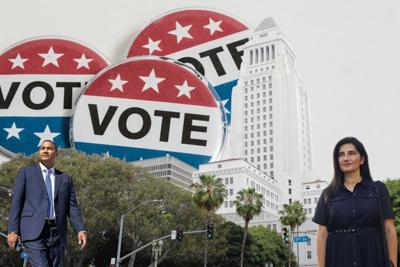


Marissa Roy and John McKinney are running for L.A. City Attorney. Graphic by Brenda Verano
Voters will choose the next official legal advisor and general counsel for the City of Los Angeles in the Nov. 3 general election. The Los Angeles City Attorney is one of the most impactful and important, yet misunderstood, positions in a city of 3.87 million residents, most of whom are Latinos.
On L.A. residents' ballots, right below the mayoral candidates, is the section for city attorney, where the names of Marissa Roy and John McKinney appear. Voters will have to choose between these two candidates, but what would be their role and how much power and influence does this office have for Latinos and other residents of the city?
For starters, as stated on the L.A. City Attorney's website, the office's primary mission is to serve the city and its residents by providing the highest caliber of legal services and promoting public safety, as well as pursuing justice in the city's criminal justice system.
In other words, the city attorney will counsel the city in legal matters, write and draft city laws and ordinances requested by the council and defend and represent the city in lawsuits and prosecute misdemeanor crimes, such as minor offenses.
As the city attorney, the office takes on a unique position, working for the people of L.A. and also the city government, including the mayor and council members, as well as other departments.
The office must maintain close, collaborative relationships with the mayor, city council members and various municipal departments while operating as an independent legal advisor. The office works directly with the mayor’s administration and non-proprietary departments; for example, the city’s housing department. The office works directly with the mayor’s administration and non-proprietary departments to ensure that any drafts, ordinances and contracts are reviewed and implemented with legality.
History
The office of the Los Angeles City Attorney has existed since at least 1822. As stated in “The History of Los Angeles As Seen From the City Attorney's Office,” by author Leon Thomas David, the city role under both Spanish and later Mexican rule was known as the sindico-procurador.
At that time, the sindico-procurador was in charge of municipal legal counsel and was the defender of public rights for the Pueblo de Los Angeles. Soon after California secured independence from Mexico in 1846 and joined the California constitution, the city attorney seat was officially codified under U.S. and California state law in 1850.
Since then, L.A.'s city attorney has been an elected, nonpartisan official, chosen directly by city voters for a four-year term.
Historical race
This will be the first time in years that a city attorney incumbent failed to advance past a primary.
In the June primary, current city attorney Hydee Feldstein Soto became the first city attorney to lose a primary reelection race in nearly 100 years.
Feldstein Soto finished third with about 18% of the vote, opening the opportunity for voters to choose her successor in the upcoming election.
On the ballot
McKinney, a police union candidate focused on public safety and neighborhood protection, advanced to the general election and is on this year's ballot.
Today, McKinney works as a deputy L.A. County District Attorney and holds a senior role as the director of the specialized prosecutions for the L.A. County District Attorney's Office. He oversees juveniles, family violence, sex crimes, narcotics and major crime and gang homicides.
McKinney, who was born in New Jersey, earned a bachelor's degree from Rutgers University in 1994 and a law degree from the UCLA School of Law in 1997.
“I came of age during the crack epidemic of the 1980s. Almost overnight, neighborhoods changed. Hard-working people fell into addiction. Friends who were strong students or talented athletes began chasing fast money in the drug trade. Violence, incarceration and aggressive policing became part of everyday life. That environment forged my character,” McKinney stated on his campaign website.
According to McKinney, if elected, he plans to implement a program in which every neighborhood has an identified prosecutor or team responsible for those community concerns. He also looked to create an office where prosecutors will coordinate with LAPD, city council offices, city departments and communities in order to build stronger partnerships.
“For more than two decades as a prosecutor, I have worked to protect victims and hold offenders accountable. As city attorney, I will bring that same commitment to enforcing the laws that keep our communities safe. That means focusing on repeat offenders who drive quality-of-life crime, addressing retail theft and organized shoplifting, prosecuting illegal firearms possession and working closely with law enforcement to address dangerous activity like street racing and open-air drug markets,” he states on his website.
McKinney is best known for his role as lead prosecutor in the high-profile 2022 trial against Eric Holder Jr. for the 2019 first-degree murder of rapper Nipsey Hussle. Under McKinney’s leadership, Holder Jr. was sentenced to 60 years to life, detailing how the March 31, 2019, shooting outside Hussle's South Los Angeles clothing store was premeditated.
His campaign is being endorsed by a wide range of elected officials, law enforcement groups and civic organizations and political leaders, including L.A. County District Attorney Nathan Hochman, former L.A. Mayor Antonio Villaraigosa, as well as L.A. City Council members, including Traci Park, Monica Rodriguez, John Lee and Tim McOsker.
His opponent, Roy, a deputy attorney general in the California Department of Justice under Rob Bonta, launched her campaign in early 2025 to be “the people's lawyer,” as she has previously stated.
As a deputy attorney general in the state Department of Justice’s consumer protection section, she focuses mainly on tenants’ rights.
If elected, the 34-year-old would become the city’s 44th city attorney and the second woman in the history of L.A. to hold such a position.
In an interview last month, Roy told CALÓ News that one of the most important roles that she looks to carry throughout her term, if elected, is “fighting for the people, not the powerful.”
“People don't realize they have an attorney; any of these abuses that they might be shouldering right now, they should not have to do that alone. They have an attorney who should be fighting for them,” she said. “What people are electing in this position is something frankly at times much more powerful than a single council member or even a mayor.”
Roy grew up in Monrovia, a city in the San Gabriel Valley of L.A. County and about 30 minutes away from Downtown L.A. While working under the L.A. City Attorney’s Office, Roy helped in the securing of a more than $1 million settlement for immigrant employees who had been victims of wage theft in Silver Lake Car Wash Inc. and Catalina Car Wash Inc. Roy said that the case was especially complex because many of the workers had been underpaid and had received no overtime pay or breaks. Many feared retaliation because of their immigration status.
“Wage theft disproportionately impacts Latino immigrant women in particular in Los Angeles. We need to make sure then that that is the population we are working extra hard for,” she said.
She said that as a city attorney, she will tackle her role in enforcing laws involving homelessness, encampments and public spaces through a preventative, care-first approach.
Roy, who has been endorsed by U.S. Senators Alex Padilla and Bernie Sanders, L.A. County Supervisors Hilda Solis and L.A. City Controller Kenneth Mejia, as well as the L.A. County Democratic Party, California Working Families Party and the Democratic Socialists of America—Los Angeles, said she hopes to transform the L.A. City Attorney's Office into the city's largest public interest law firm.
Both McKinney and Roy have publicly said one of their priorities will be to defend the City of L.A. and its residents against U.S. Immigration and Customs Enforcement (ICE) and the federal government’s compliance with the racial profiling of thousands of Latinos in L.A., which has amounted to more than 65,700 people being held in detention centers and the detention of more than 610,000 people.
________________________________________________________________
Elections are scheduled for Nov. 3, 2026.
To locate an early voting location near you, visit CAEarlyVoting.sos.ca.gov or contact your county elections office. You may deliver your ballot in person to any polling or ballot drop-off location in California by 8:00 p.m. on Election Day.

















(0) comments
Welcome to the discussion.
Log In
Keep it Clean. Please avoid obscene, vulgar, lewd, racist or sexually-oriented language.
PLEASE TURN OFF YOUR CAPS LOCK.
Don't Threaten. Threats of harming another person will not be tolerated.
Be Truthful. Don't knowingly lie about anyone or anything.
Be Nice. No racism, sexism or any sort of -ism that is degrading to another person.
Be Proactive. Use the 'Report' link on each comment to let us know of abusive posts.
Share with Us. We'd love to hear eyewitness accounts, the history behind an article.