
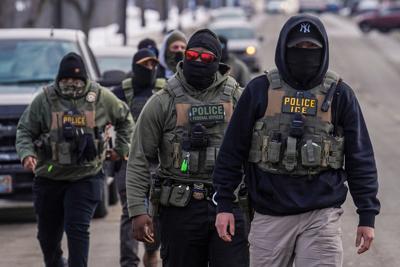

Federal agents walk down a street while conducting immigration enforcement operations in Minneapolis, Feb. 5, 2026. (AP Photo/Ryan Murphy, File)
The presence of law enforcement officers at polling locations can be intimidating to many voters–particularly voters of color–and deter them from exercising their constitutionally protected right to vote.
While many election laws and rules are state-specific, this document from the National Police Accountability Project (NPAP) offers general guidance on your rights when interacting with police and federal law enforcement agents while voting.
1. Is it legal for local police officers to be at my voting site?
It depends. Because local police officers are often responsible for keeping the peace at polling locations and enforcing election-related laws, they are permitted to enter voting sites when election officials or members of the public call for assistance. However, there are other circumstances where sustained law enforcement presence at a polling location could constitute voter intimidation or interference under state criminal law. Certain types of law enforcement presence could also violate federal voting rights protections. Whether an officer’s presence at a polling site is permissible depends on the facts, including whether the officer has a legitimate reason to be at or near the polling location, how long they remain at or near the polling location, and whether they are engaging in conduct that might deter a person from voting. For example, it would not be illegal for an officer to briefly dispatch to a polling location to respond to a report of illegal electioneering. However, an officer stationed at a polling location for an hour checking voters’ driver’s licenses is likely illegal.
2. Is it legal for ICE agents or National Guardsmen to be at my voting site?
No. Federal law prohibits the deployment of federal troops to polling locations. Federal law also restricts the presence of ICE and other federal law enforcement agents at the polls by making it a crime for any employee of the federal government to interfere with an election. Because these are federal criminal statutes, the Department of Justice or local U.S. Attorneys’ offices have sole discretion about whether to enforce these protections. For the 2026 Midterm Elections, civil rights groups have also sued to get a court order preventing federal presence at voting sites. Check to see if there are any court-ordered restrictions in your state. P.O. Box 508 | Redmond, WA 98073 www.nlg-npap.org
3. What should I do if officers are at my polling location?
You may consider reporting their presence to a poll worker or an election judge. In many states, poll workers are trained on working with law enforcement agents. You can also report law enforcement presence to election protection hotlines. 1-866-OUR-VOTE (866- 687-8683) is a nonpartisan election protection hotline that can provide real-time support to voters experiencing problems at the polls. The hotline also provides Spanish-language assistance at 1-888-VE-YE-VOTA (888-839-8682).
4. What should I do if I think there are ICE agents at my polling location?
You should report ICE presence to election protection hotlines, including 1-866-OURVOTE, or your local ICE watch group. Voting rights groups are discouraging voters from posting about possible ICE presence on social media or other public forums to reduce misinformation and avoid escalating disruption at the polls. Instead of posting about ICE presence online, call an election protection hotline immediately.
5. What if an officer or agent approaches me while I’m trying to vote?
You have the same rights when interacting with a law enforcement officer in a polling location as you do in any public space. You have the right to ask if you are free to go. If the answer is yes, consider walking away. If the officer says you are not under arrest, but are not free to go, you are being detained. Officers can pat down the outside of your clothing if they have reason to suspect you might be armed and dangerous. If they search more than this, say clearly, “I do not consent to a search.” They may keep searching anyway. If this happens, do not resist—you can be charged with assault or resisting arrest. You do not have to answer any questions. You do not have to open bags or any closed container. Tell the officer you do not consent to a search of your bags or other property. You also have a right to ask the officer for their information. Try to find witnesses who were at the scene and get their names and phone numbers. If you are injured, seek medical attention and take pictures of the injuries as soon as you can. Call a lawyer as soon as possible. While you have the same rights when interacting with a police officer, you should be aware that state election laws may place restrictions on your First Amendment rights while in or around a polling location, including your right to express support for a candidate and speak loudly. P.O. Box 508 | Redmond, WA 98073 www.nlg-npap.org
6. What can I do to limit law enforcement presence at my polling location in the future?
States and local election officials have discretion to regulate their elections and can enact legislation and regulations that limit law enforcement presence at polling locations. For example, New Jersey has enacted legislation prohibiting law enforcement presence within 100 feet of a polling place on election day unless they are responding to a request for assistance. Bills have been introduced in other states limiting police presence at the polls. You may consider supporting these types of measures to strengthen protections against law enforcement intimidation and harassment at polling locations in your state.

















(0) comments
Welcome to the discussion.
Log In
Keep it Clean. Please avoid obscene, vulgar, lewd, racist or sexually-oriented language.
PLEASE TURN OFF YOUR CAPS LOCK.
Don't Threaten. Threats of harming another person will not be tolerated.
Be Truthful. Don't knowingly lie about anyone or anything.
Be Nice. No racism, sexism or any sort of -ism that is degrading to another person.
Be Proactive. Use the 'Report' link on each comment to let us know of abusive posts.
Share with Us. We'd love to hear eyewitness accounts, the history behind an article.