
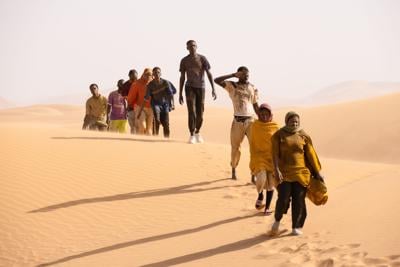


A still from Matteo Garrone’s "Io Capitano." Courtesy Cohen Media Group.
This article was produced by Capital & Main. It is published here with permission.
This Thanksgiving, a lot of American families will set the table one place short: a father picked up in an immigration raid, a mother put on a deportation flight, a child in federal custody.
The irony comes baked in: The holiday itself celebrates an immigrant story. The Pilgrims were religious refugees twice over — out of England for Holland, and then 11 years later to what is now Massachusetts. The 1621 harvest feast they shared with the Wampanoag leader Massasoit and his people is the scene American history kept in the final cut. The sequel was less kind to the hosts. Fifty-five years later, the colonists killed Massasoit’s son Metacom, displayed his head on a pike at Plymouth for 25 years and sold his wife and son into slavery in the West Indies. Try telling that story while you’re carving the turkey.
Immigrant journeys have been a part of film since the beginning. In 1903, the Edison company filmed a boat full of passengers docking at Ellis Island: two and a half minutes, no story, two cuts. A decade later, Traffic in Souls turned the island into a hunting ground, following a ring of traffickers who prey on newly arrived immigrant women. Four years later, in The Immigrant in 1917, Charlie Chaplin’s Tramp gazes up at the Statue of Liberty from a steamer deck seconds before officers rope the passengers off like cattle.
Seven years after Chaplin’s film, Congress slammed the door. The Immigration Act of 1924 capped each nationality at 2% of its numbers in the 1890 census — a formula drawn from a eugenics committee report (and completely excluded immigrants from Asia). The quotas held for four decades.
In Hold Back the Dawn in 1941, Charles Boyer plays a Romanian gigolo stranded in a Mexican border town who romances an American schoolteacher (Olivia de Havilland) seeking marriage and a quicker way in. A year later, Casablanca turned Rick’s Café into the world’s most glamorous departure lounge, packed with Europeans desperate for exit visas to Lisbon, and many of the actors playing them had fled the Nazis themselves; when the room drowns out the Germans with “La Marseillaise,” some of the tears on set were real.
Elia Kazan, who immigrated to the U.S. in 1913, turned his uncle’s escape from Ottoman Anatolia into the film America America in 1963, a couple of years before the quotas fell. In The Godfather Part II (1974), Francis Ford Coppola sent a 9-year-old Vito Andolini through Ellis Island, where a clerk renames him after his village and quarantines him alone in a cell. Barry Levinson’s underrated Avalon (1990) brought the story home to the dinner table, where a family of Baltimore immigrants fights over the most American offense imaginable: carving the turkey before everyone arrives.
As of September, Human Rights Watch had tallied more than 540,000 deportations since the start of President Donald Trump’s second term in January 2025. The number of detained parents nearly doubled between 2024 and 2026, the Migration Policy Institute reports, and many get a choice: Leave the country with their children, or fight their case and watch the kids go to a federal shelter.
The country whose founding holiday celebrates a refugee crossing has nearly stopped taking in refugees: The administration suspended admissions on its first day, then set last year’s cap at 7,500 — mostly white South Africans — the lowest in the program’s history. Worldwide, the U.N. refugee agency counts more than 117 million people forced from their homes.
Policy debates about immigration and refugees often center on statistics — caseloads, surges and caps — and the people inside them disappear. Movies work the other way, one face at a time. Half-a-million deportations is a statistic. One father missing from one table is a story.
Over the past decade, filmmakers have found new ways into the crossing: passionate features, animation, cell-phone footage, a documentary that stayed with one family for 10 years.
And the cameras continue to roll. Oscar winner Laura Poitras and Rachel Lauren Mueller’s short documentary They’re Here follows Minneapolis volunteers tracking ICE agents during last winter’s Operation Metro Surge is awaiting release. Frontline and ProPublica’s Caught in the Crackdown aired in April. And on Dec. 2 comes A Fox Under a Pink Moon, in which a 16-year-old Afghan artist and refugee films her own repeated escape attempts from Iran on her phone.
Here are 13 films, served in two courses, that dish out the reality of migration and the families on the other side of the statistics.
Features
"Persepolis" (2007) Marjane Satrapi was a punk rock-loving 9-year-old in Tehran when the revolution came, and a mouthy teenager in danger by the time the war with Iraq did. So her parents put her on a plane to Vienna, alone, at 14. Drawn from her own graphic memoir in stark black and white, the animated film tracks a girl who becomes a foreigner twice: too Iranian for Austria, too Western when she goes home. Her grandmother keeps telling her to stay true to herself. That’s hard advice when you don’t feel like you belong anywhere. Satrapi became the first woman nominated for the Oscar for Best Animated Feature. Rent on Amazon and Apple TV.
"Sin Nombre" (2009) Cary Joji Fukunaga’s stellar debut puts a Honduran teenager and a gang member on the run from MS-13 on the roof of the same freight train headed north to the States. It won two prizes at the Sundance Film Festival and launched Fukunaga’s career (Beasts of No Nation, HBO’s True Detective). Rent on Amazon and Apple TV.
"Le Havre" (2011) “Le havre” means “the harbor” or “the haven,” and Aki Kaurismäki takes the title literally. In his fable, an aging shoeshiner in the French port city of Le Havre hides a young African refugee from the officials hunting him for deportation — and an entire working-class neighborhood quietly conspires to help. It’s set in present-day France but shot like a hand-tinted postcard from a 1950s Douglas Sirk melodrama, a reminder that this story is perennial. And its fairy-tale ending makes you wonder whether it was all a colorful burst of wishful thinking. Rent on Amazon and Apple TV.
"Limbo" (2020) Omar is a young Syrian musician carrying his grandfather’s oud around a remote Scottish island while he waits for an asylum decision. Writer-director Ben Sharrock creates a whimsical yet melancholy cross between Napoleon Dynamite, Casablanca and Local Hero. Peacock.
"Green Border" (2023) Agnieszka Holland’s black-and-white drama is set in the forest on the Poland-Belarus border, where refugees are pushed back and forth between the two countries’ guards. The master filmmaker makes the Kafkaesque endeavor all at once beautiful, tragic and spellbinding. It won the Special Jury Prize at Venice, but Poland’s nationalist government denounced it as anti-Polish before its release, which mostly proved her point. The government even made a propaganda spot to run before screenings. The country’s arthouse cinemas refused to show the propaganda. Kanopy, Hoopla, Roku; rent from Apple.
"Io Capitano" (2023) Director Matteo Garrone’s Oscar-nominated film follows two Senegalese cousins from Dakar across the Sahara, through Libyan detention and into the Mediterranean Sea, where one of them, still a teenager, ends up steering the boat. The title, which translates to “I’m the captain,” isn’t a boast. It’s a job no kid should have. The harrowing film was screened for the late Pope Francis, and Mamadou Kouassi, the Ivorian migrant whose journey inspired it, has since toured it through schools and villages in Senegal. Rent on Amazon.
"To a Land Unknown" (2024) Two Palestinian cousins (Mahmood Bakri and Aram Sabbah) are stranded in Greece. Think Midnight Cowboy set in Athens: While Ratso and Joe hustled New York to try and get to Florida, these two work the streets dreaming of a café in Germany. In Mahdi Fleifel’s first narrative feature, the city becomes a holding cell, days blur into scams that fail and promises that dissolve, and you feel the weight of waiting. Few films capture immigration purgatory this well. Nothing is resolved. And that’s the point. Rent on Amazon.
Documentaries
"Human Flow" (2017) Artist Ai Weiwei, himself the son of an exiled poet, filmed the refugee crisis across 23 countries, from Greek beaches to Gaza to the U.S.-Mexico border. What stands out isn’t the art, but the scale: one global crisis that’s everyone’s problem but nobody’s priority. Prime, Kanopy.
"For Sama" (2019) Waad al-Kateab was a university student when the protests began in Aleppo in 2011. She picked up a camera and never put it down. For five years she filmed the doctors, nurses and families holding a besieged city together, then shaped it all into an Oscar-nominated letter to Sama, the daughter she gave birth to under siege. The bombing is relentless, and the bodies of children, and the parents who come to collect them, are hard to watch. What stays with you, though, is the light: a newborn pulled lifeless from her mother by emergency C-section who suddenly cries, Sama giggling in the hospital basement while the bombs fall, and a couple finding joy in a single persimmon. PBS.
"Flee" (2021) Animating the plight of his friend who fled Afghanistan as a boy and spent years in smugglers’ hands allows filmmaker Jonas Poher Rasmussen to protect the identity of his subject, but it also lets him draw what no camera could have caught: memory, fear and a childhood erased. The result became the first film ever nominated for the Oscars for Best Documentary Feature, Best Animated Feature, and Best International Feature at once. Tubi.
"One in a Million" (2026) In the first minutes of this stirring epic, young Syrian girl Israa says, “War is not the hardest thing a person can go through. It’s not as hard as what comes after.” Filmmakers Itab Azzam and Jack MacInnes follow the charismatic young girl and her family for a decade, covering their winding, wrenching journey from Aleppo, Syria to Germany. Watching two worlds collide and land differently on each family member is a revelation. Coming to PBS.







(0) comments
Welcome to the discussion.
Log In
Keep it Clean. Please avoid obscene, vulgar, lewd, racist or sexually-oriented language.
PLEASE TURN OFF YOUR CAPS LOCK.
Don't Threaten. Threats of harming another person will not be tolerated.
Be Truthful. Don't knowingly lie about anyone or anything.
Be Nice. No racism, sexism or any sort of -ism that is degrading to another person.
Be Proactive. Use the 'Report' link on each comment to let us know of abusive posts.
Share with Us. We'd love to hear eyewitness accounts, the history behind an article.