
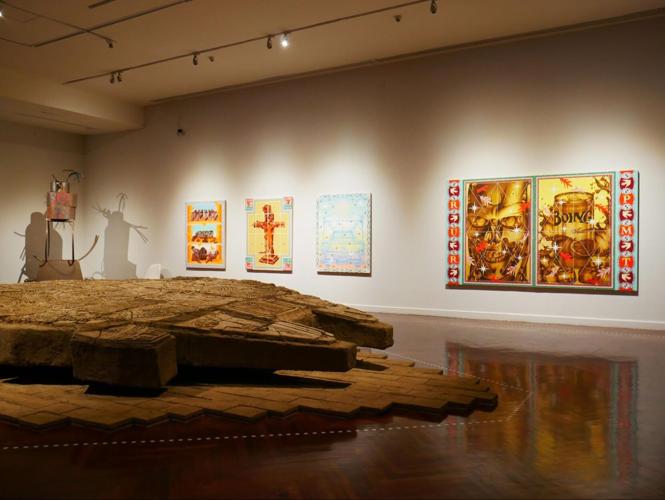

The section “Transtemporalidades: Lowriding con los dioses” features artists like Rafa Esparza and Jaime Muñoz. Their work merges Mesoamerican imagery with elements of science fiction, pop culture and low rider culture to reimagine different ways of experiencing time.
For performance artist Rafa Esparza, creating art with adobe is a way to connect with land as a first-generation Mexican American. His father once worked with the ancient building material as a brickmaker in Durango before he migrated to the United States.
Esparza’s installation “Mexica Falcon” is an adobe spacecraft that blends pop culture imagery, such as the Millennium Falcon from “Star Wars” with the Aztec Sun Stone, an ancient symbol of time for the Indigenous Mexicas. It is part of a landmark Chicano art exhibition in Mexico City that tackles themes of migration, identity and memory.
Esparza is one of more than 30 artists and collectives of Mexican and Latino descent, mainly from Los Angeles, whose work is on display at Mexico City’s Palacio de Bellas Artes. The exhibition, titled “AztLÁn: Tunnel of Time,” marks the first time one of Mexico’s most prestigious cultural institutions has had a show dedicated to Chicano art.
The exhibition takes its name from Aztlán, the ancestral homeland of the Mexica people, who are said to have migrated from there to settle in Tenochtitlan, now Mexico City. Centuries later, during the Chicano Movement of the 1960s and 1970s, Aztlán became a powerful political and cultural symbol for Mexican Americans in the U.S. Southwest, helping them reclaim a sense of belonging and connection to the land.
Through historical and contemporary works, the exhibition explores the relationship between Mexico and the U.S., with a particular focus on L.A.

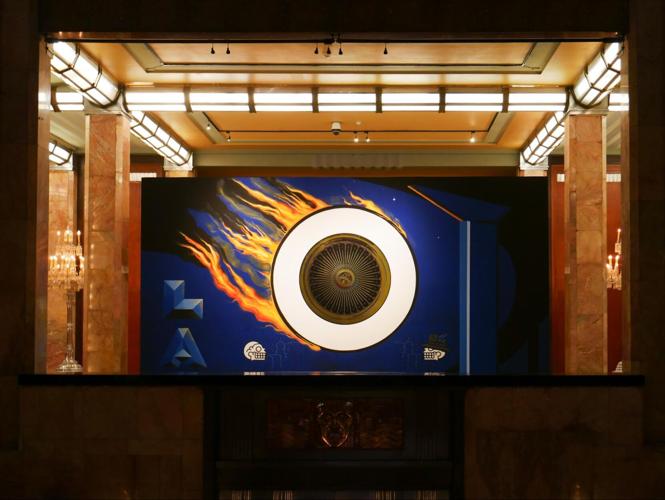
The 3B Collective, a Los Angeles-based group of indigenous, Mexican and Chicano artists, created the site-specific mural titled “El Más Allá” in El Museo del Palacio de Bellas Artes. It reconnects traditional Chicano mural painting with earlier famous Mexican muralists.
While Chicano artists are now gaining visibility in U.S. art spaces, curator Rubén Ortiz Torres said they remain underrepresented and underrecognized both here and internationally. He and co-curator Jesse Lerner curated the exhibition specifically for Bellas Artes and a Mexican audience, whereas previous shows, they said, have originated in the U.S. before traveling to Mexico.
The exhibition comes at a moment when the American identity is being actively contested and pushback against inclusion and diversity is intensifying, Ortiz Torres noted.
“Right now, Americanness is being redefined in a way that excludes people of color, excludes immigrants,” Ortiz Torres said. “So maybe now is the time to respond to that. We have to learn to resist.”
The shared history between the U.S. and Mexico informs Esparza’s use of adobe in his work. Inside the museum, he sculpted and painted sun stone motifs onto the material, tracing how images, people and resources move across borders through extractive processes.

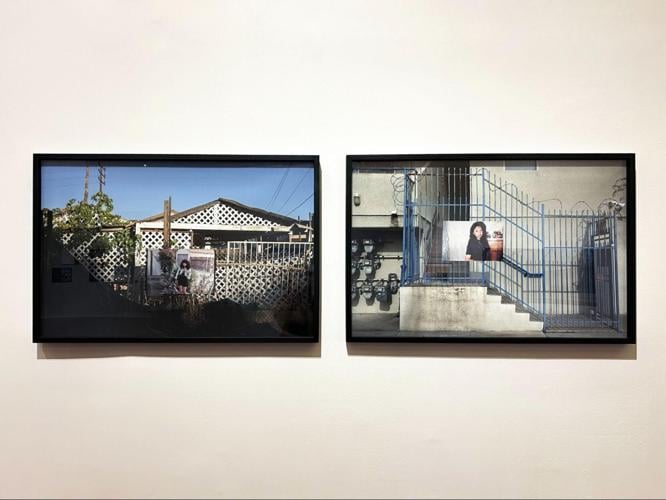
From left, Lens-based artist Arlene Mejorado’s photographs “Anna’s Apartment” and “My Mother Madonna” are featured in the exhibition’s section, “Varrio.” Her work touches on themes of displacement, memory, and belonging in the San Fernando Valley.
“This museum was built during the Porfiriato, when [General Porfirio Diaz,] the dictator governing Mexico was selling much of the country’s natural resources to wealthy American families,” Esparza said. “Before the entire Southwest was taken by the U.S., this economic expansion of the country was possible because of these ties that the U.S. had with Mexico. So we can’t understand the U.S. without understanding Mexico.”
Like Esparza, lens-based artist Arlene Mejorado uses her work to reflect on displacement, memory and belonging. Her photographs “My Mother Madonna” and “Anna’s Apartment,” featured in the exhibition, are part of an ongoing series titled Breathing Exteriors, which began in 2020.
The series centers on urban landscapes in California’s San Fernando Valley, where Mejorado was born and raised. Originally drawn to portraiture, Mejorado became increasingly interested in the layers of memory embedded in those spaces. During the COVID-19 pandemic, however, limited contact with subjects pushed her practice in a new direction.
Mejorado began carrying her portable scanner as she drove through the Valley, visiting family members, sifting through old photographs and digitizing them in their backyards. Using this growing archive of family portraits, she printed the images on vinyl banners and installed them at their original sites.
As a first-generation Mexican American and Chicana, Mejorado’s work examines the layers of identity within herself, her family and the broader diasporic community of Mexican and Central Americans in the Valley.

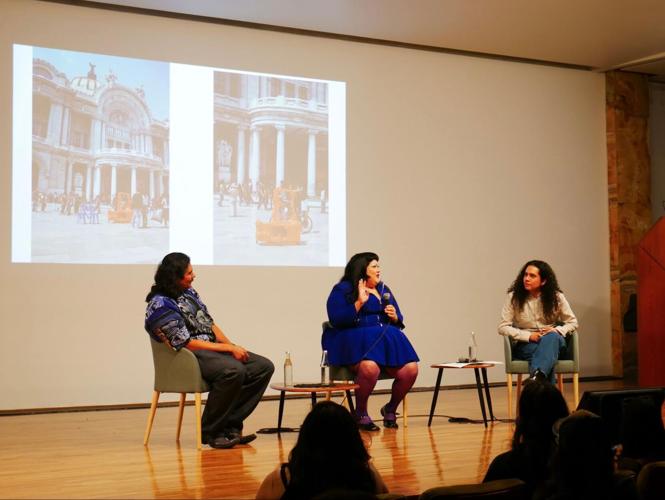
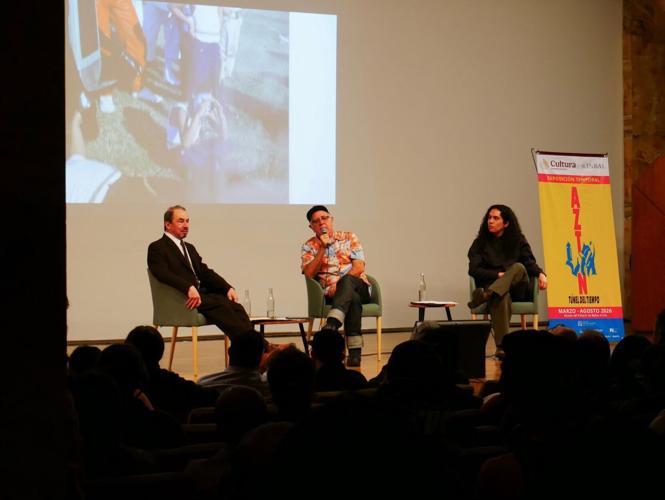
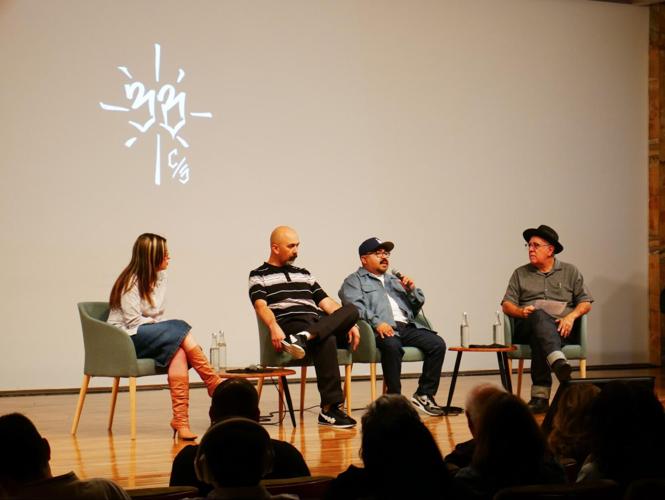
From left, artists Rafa Esparza and Gabriela Ruiz discuss performance art during an artist talk with Joshua Sánchez, lead curator of El Museo del Palacio de Bellas Artes.
“It feels like we were displaced and somehow we're trying to grapple with that, and we're trying to make this new landscape at home,” Mejorado said. “And so all of my work, I feel, deals with that unbelonging and that constant perpetual strive to make a place a home that will always kind of reject you.”
Some Mexican citizens visiting Bellas Artes said an exhibition of this kind has been long overdue.
Samantha Menchaca, a Mexico City resident, said that while Bellas Artes has hosted international shows in the past, it has taken far too long for Chicano artists to gain that same recognition. To her, this points to a larger issue: Chicano and Mexican art has not been regarded as fine art on its own, but has only been validated in art spaces once it is recognized within a more Eurocentric context.
“In Mexico, I think that they’re stuck on classical art, paintings and painters, and murals, and it's like they’re not turning to look at new artists or old artists that break away from the more conventional, classical art narrative,” Menchaca said.
As Angélica Ballesteros, who is from Sonora, looks through the exhibition, she recognizes imagery that resonates with her as someone who grew up in Mexico. However, they often carry a different, typically nostalgic, meaning for Chicanos, she said, and although Chicanos and Mexicans share the same roots, there are still cultural differences.
“Many things seem ordinary for those of us who were born in Mexico, and seeing it from that point of view is also important,” Ballesteros said. “There’s a sense of nostalgia from them [Chicanos’] towards here. They long for all these elements, but I feel that there are some elements that no longer matter to us in Mexico.”
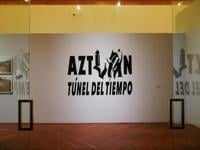
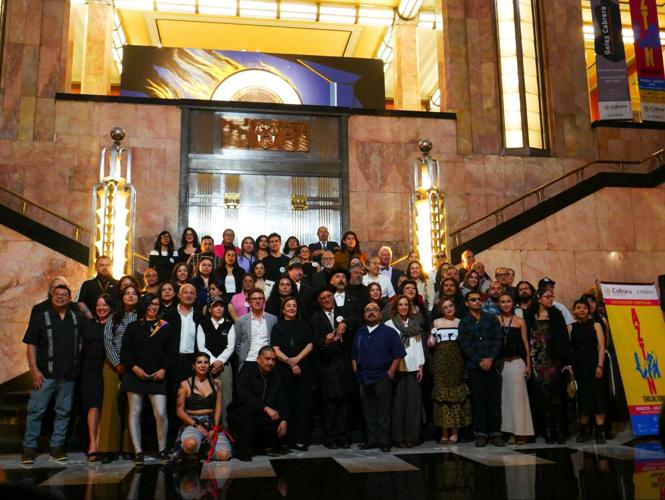

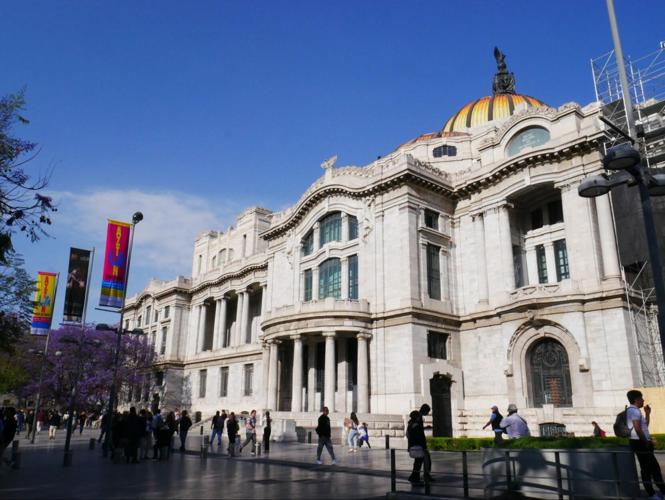
The first Chicano exhibit in Bellas Artes
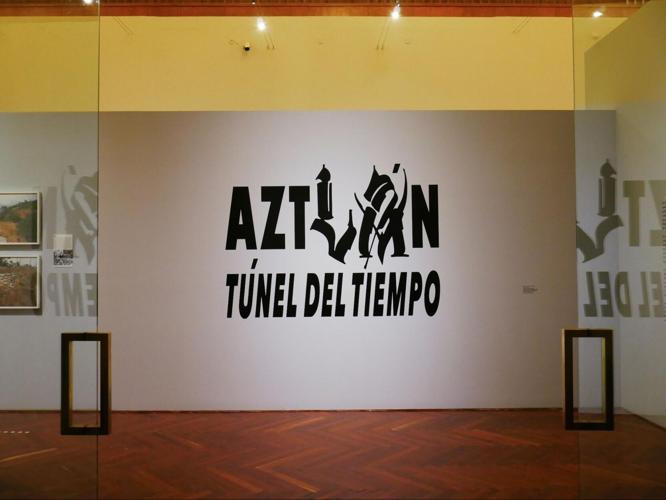
“AztLÁn: Túnel Del Tiempo” is the first exhibition dedicated to Chicano art at El Museo del Palacio de Bellas Artes in Mexico City.
The exhibition also caught the attention of Juan Rodríguez, who is from Mexico City and visited L.A. over thirty years ago. He finds Chicano culture especially interesting because, in his view, it emerged when people of Mexican descent in the U.S. were pushed to assimilate, leading many to fight for their distinct identity as Chicanos. Rodríguez added that they had to distance themselves from Mexican traditions, forming a culture that differs significantly from that of the people in Mexico.
While Rodríguez said that the local community rarely discusses the social issues Chicanos face, he sees this exhibition as a meaningful step toward those conversations.
“It's an opportunity for many of us to learn about the development of Chicanos, how they suffered when all the conflicts first started,” Rodríguez said. “There's still so much to learn about the struggles between the Chicano groups, the art, the culture, the music, the bicycles, the cars, all of that which didn't happen in Mexico.”
From creating art in L.A. to having it shown in Bellas Artes, Mejorado sees the exhibition as a breakthrough for her and other Chicano artists.
“I think as Chicanos, Chicanes, we're constantly grappling with this feeling of rejection, both in the U.S. and in Mexico,” Mejorado said. “And I feel like standing in that in-betweenness right now is actually being studied and embraced, and people are trying to understand it and celebrate it.”








(0) comments
Welcome to the discussion.
Log In
Keep it Clean. Please avoid obscene, vulgar, lewd, racist or sexually-oriented language.
PLEASE TURN OFF YOUR CAPS LOCK.
Don't Threaten. Threats of harming another person will not be tolerated.
Be Truthful. Don't knowingly lie about anyone or anything.
Be Nice. No racism, sexism or any sort of -ism that is degrading to another person.
Be Proactive. Use the 'Report' link on each comment to let us know of abusive posts.
Share with Us. We'd love to hear eyewitness accounts, the history behind an article.