

This story was originally published by EdSource. Sign up for their daily newsletter.
Top Takeaways
- About two-thirds of California’s children ages 3 to 5 are considered to be “on track” to enter kindergarten.
- Some experts question whether “readiness” is an appropriate measure for young children.
- Students’ race, gender and socioeconomic status play significant roles in widely varying levels of readiness.
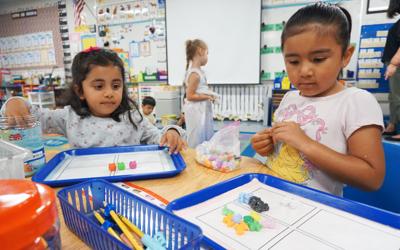
A child’s ability to use their words, identify several numbers and letters and even count all the way to 10.
These are some of the factors that go into the idea of a child’s “readiness” for school — a concept that is often not a concrete set of milestones but a measure that may be influenced by other factors such as a family’s income or a child’s gender and ethnicity.
“As educators, we need to address children’s needs wherever they are,” said Deborah Stipek, emeritus professor at the Stanford University Graduate School of Education.
According to new federal data, about two-thirds of California’s children ages 3 to 5 are considered to be “on track” to enter kindergarten. The data is based on answers from parents and guardians in the National Survey of Children’s Health about their children across five areas: early learning, motor skills, social-emotional development, self-regulation and health.
Among researchers, readiness is a measure of a young child’s social and emotional skills, executive function capabilities, and some basic literacy and numeracy skills. These skills could range widely.
“Readiness when they enter school is not destiny,” said Megan Kuhfeld, director of growth modeling and data analytics for the education research company NWEA. More importantly, she added, “readiness is a multidimensional measure.”
Some experts question whether measuring readiness for kindergarten is the appropriate approach in early childhood education, as it places the responsibility for being “ready” on children.
“There are definitely long-standing, historic differences in children’s skill levels and developmental levels, and they happen to be associated with both race and ethnicity and with poverty and family income,” said Stipek. “But I would get rid of the concept of readiness and say some kids are starting kindergarten with some significant advantages that other kids lack.”
While it’s critical to adapt instruction to students’ needs, “it’s extremely demanding and challenging” for teachers to address children’s needs across a wide spectrum of areas, she said.
Students’ race, gender, socioeconomic status play significant roles in readiness
The national survey data, released in December, found significant differences among children’s readiness when accounting for several factors, including poverty level, race and ethnicity, and sex.
For example, more than 70% of white and Asian parents reported that their children were ready for school, while only 61% of Hispanic parents reported the same. A rate for Black children is unavailable as not enough families were surveyed.
Additionally, the higher a family’s income, the more likely the child is to be deemed ready, according to the survey, which used the federal poverty rate.
About 16% of California respondents living at or below the federal poverty level, which is an annual income of $31,200 for a family of four, reported that their children need support to prepare for kindergarten. That rate dropped to about 5% for families 400% above the federal poverty level, about $124,800 for a family of four.
“We know that when children don’t have access to enough food, when they don’t have access to stable housing, when they don’t have access to quality health care, that impacts their ability to learn. It impacts their growth and development, thus directly tied to kindergarten readiness at a high level,” said Laura Pryor, who uses the supplemental poverty measure in her work at the California Budget & Policy Center.
Given California’s high cost of living, some researchers rely on this supplemental poverty measure, which is released annually by the U.S. Census Bureau and accounts for additional necessary expenses that the federal poverty rate does not.
Pryor’s colleagues have found that California’s child poverty rates more than doubled between 2021 and 2024, from 7.5% to nearly 19%. According to their research, rates were lower during pandemic-era temporary expansions of public programs, including the federal child tax credit and earned income tax credit and the state’s unemployment benefits. Rates sharply increased once those programs ended.
“When we’re thinking about poverty as a policy choice in light of kindergarten readiness and educational outcomes for young children, it’s really striking to me that when we let these important policies expire and then don’t create new policies or expand policies to address what’s happening federally, it’s really our children 0-3 that are hit the hardest, which is very concerning,” said Pryor.
The National Survey of Children’s Health results published Thursday were collected before California made transitional kindergarten, or TK, available to all 4-year-olds.
“TK was designed in part to make sure that all 4-year-olds had equal access to a strong learning environment, and we hope, as Californians, that it does what we hope it will do,” said Stipek, the Stanford University professor.
The problem of children entering school with varying levels of advantages and disadvantages, however, “won’t go away,” Stipek added, saying it’s more likely that “it may be diminished.”
Readiness is ‘not destiny’
The national survey also asked respondents about readiness based on the child’s sex. Close to 75% of girls in the state are on track to enter kindergarten, while just under 60% of boys are.
Kuhfeld, from NWEA, said that when analyzing the rates between boys and girls, it is significant that the National Survey of Children’s Health is self-reported by parents or guardians.
There could be differences in results from surveys where a parent self-reports regarding their child’s readiness versus a researcher observing readiness using potentially more objective measures.
“They are picking up different things. One is picking up an actual, more objective measure of skills. The other is picking up perception,” Kuhfeld said.
They’re both important, she added, but regarding perception: “I think in the most recent years there has been this more kind of overwhelming narrative, especially about young boys in terms of boys falling behind.”
She listed a few factors contributing to that narrative, including news media coverage of educational leaders who have argued that all young boys should begin kindergarten a year later than girls, in part due to lower maturity levels among boys.
“If this theory held true, we would expect boys to fall further behind girls over the course of the school year as instruction accumulates,” Kuhfeld wrote in a recent article.
However, her research, published this week, found that boys tend to pull ahead in math during kindergarten and continue the pattern through fifth grade.
“I think to me the most important thing to convey is, we don’t see boys are struggling across the board. We don’t see girls are struggling across the board,” said Kuhfeld. “When we talk about the boy crisis or boys falling behind or girls falling behind, we have to be really careful to talk about which domain we’re talking about because it’s not as kind of monolithic as people often pan it out to be.”
The Associated Press contributed to this report. Read the AP’s national story here.







(0) comments
Welcome to the discussion.
Log In
Keep it Clean. Please avoid obscene, vulgar, lewd, racist or sexually-oriented language.
PLEASE TURN OFF YOUR CAPS LOCK.
Don't Threaten. Threats of harming another person will not be tolerated.
Be Truthful. Don't knowingly lie about anyone or anything.
Be Nice. No racism, sexism or any sort of -ism that is degrading to another person.
Be Proactive. Use the 'Report' link on each comment to let us know of abusive posts.
Share with Us. We'd love to hear eyewitness accounts, the history behind an article.