
This story was originally published by EdSource. Sign up for their daily newsletter.
When a patient at Los Angeles General Medical Center experienced a medical emergency, Brandon Maldonado grabbed an intercom and called a “code blue” to bring immediate help from emergency hospital staff.
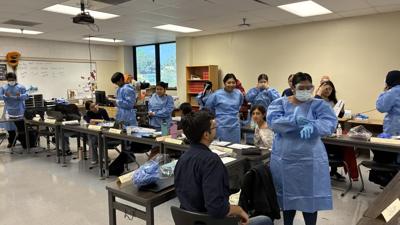
The Bravo Medical Magnet High School senior had trained for such emergencies through Los Angeles Unified’s patient care pathway — one of several career education programs a new study found improves students’ college readiness.
“That experience stuck with me because it taught me how to stay calm under pressure, and I didn’t panic,” Brandon said. “I knew what to do.”
A new report from research institute SRI International found promising results for students in Los Angeles Unified who completed career and technical education pathways — especially those that combine academics with workplace experience. These students not only graduated at higher rates, but were also more likely to complete college preparatory curriculum and enroll in college than their peers.
PODCAST
How Los Angeles Unified fire academies build leadership skills for any career
May 14, 2026EdSource · How Los Angeles Unified fire academies build leadership skills for any career
California has significantly expanded career and technical education in recent years, with a combined $400 million in funding each year and an additional $300 million approved for new CTE school facilities in 2025.
Miya Warner, lead author of the report, said the findings puncture the longstanding perception that career and technical education is mostly geared toward students who have no plans to go to college.
“The findings combat some of those lingering stereotypes around CTE and who it’s for,” Warner said.
In the state’s largest school district, with more than 165,000 LAUSD high school students as of the 2021-2022 school year, the investments in career tech programs appear to provide students a leg up after they graduate from high school. These programs include 265 traditional CTE pathways and 72 Linked Learning pathways — which combine technical training with college preparatory coursework — across 15 industry sectors.
Nearly two-thirds of students took at least one CTE course, but the report found higher positive outcomes among about a fifth of all students who completed a full CTE or Linked Learning pathway.
“The more the word can get out about the value of completion versus just a one-off course, the more that all the staff at the school can support students in meeting that goal,” Warner said. “I visited schools where counselors are putting seniors into the first year of a CTE sequence, and they can’t complete it.”
At Bravo Medical Magnet High, students begin taking medical prerequisite courses as sophomores before choosing a pathway in sports medicine or patient care. Brandon, now a senior, has gained hands-on experience in the ophthalmology department, the volunteer center and the infusion clinic at Los Angeles General Medical Center, which partners with the magnet school.
“I wanted to get real-world experience and get an overview of different departments; that way I can know which field I want to go into,” Brandon said. “’The value of getting the early exposure stage is you’re not just thrown out there. The (program) gives you the basic skill of how to respond.”
Ben Gertner, director of Linked Learning at LAUSD, said the district has raised CTE pathway completion rates from about 18% to nearly 25% between 2022 and 2025 and increased the number of Linked Learning pathways from 43 to 100.
“We want to ensure that we focus on developing school-site capacity,” Gertner said. “We also help schools to balance competing priorities, increase graduation rate and college and career readiness.”
Access is a key hurdle for students trying to start and complete CTE pathways. The report found that students with the highest and lowest academic performance took fewer CTE courses than students in the middle, suggesting that AP classes or credit recovery can create scheduling conflicts. Although incoming freshmen had access to an average of nine pathways, many did not learn about them early enough to enroll.
Warner emphasized that starting a CTE program early helps students build transferable skills, professional networks and gain hands-on experience.
One theater pathway student interested in becoming a lawyer, she said, gained confidence in communication and collaboration skills. Another student in patient care realized a healthcare career was not the right fit for him.
“How much better to figure that out in high school than wait, going into debt in a program that turns out is not actually a good fit for you,” Warner said. “It’s better to have those experiences early.”
Linked Learning shows better outcomes
Going Deeper
Linked Learning integrates academics, career-based instruction and real-world work experience to prepare students for both college and careers.
Traditional CTE teaches technical and occupational skills for trades, jobs and careers through standalone courses.
The report found stronger outcomes for students in Linked Learning pathways, which combine work-based training and academic instruction, than in traditional CTE pathways, which offer standalone technical skills courses.
High school graduates who completed a certified Linked Learning pathway were about 16% more likely to finish college preparatory courses and 24% more likely to enroll in college than those who did not take any CTE courses.
“In the Linked Learning pathways, we saw a little bit more integration of those work-based learning experiences into the curriculum,” Warner said, adding that students are also more engaged with experiences in real workplaces.
Karen Benavides, a senior in the patient care pathway at Bravo Medical Magnet High, recalled stepping in to help in the surgical intensive care unit during a hospital staff shortage.
“I got to help a patient, help the nurses. I took phone calls, and it was just a very immersive experience,” Karen said. “I didn’t stop for a second, and I really liked the rush.”
Karen, who plans to become a physician assistant, said she has become more confident communicating with peers, teachers and patients, especially with those who may be uncooperative.
“I also feel like it’s helped improve my teamwork and being able to think critically, go through situations and see what the best course of action is,” Karen said.
About half of the students in certified Linked Learning pathways completed their programs, while about a quarter completed traditional CTE pathways, according to the report. Students at a “higher-need” middle school also had greater access to Linked Learning pathways but fewer traditional CTE options than students at “lower-need” schools.
Suzanne Bogue, a teacher in the patient care pathway at Bravo Medical Magnet High, said strong teacher collaboration distinguishes Linked Learning from traditional CTE.
“The junior year teachers and the senior year teachers, we all work together and help each other target the students that might need a little more support,” Bogue said.
Schools can opt into Linked Learning with a 75% faculty vote in favor of onboarding at LAUSD, which has “led to more of a sense of commitment to the Linked Learning approach,” Gertner said.
Brandon said he plans to attend UC Riverside to study biology and hopes to become an anesthesiologist after shadowing one through the program.
“One of the valuable skills I’ve learned is teamwork,” Brandon said. “It just gives you that exposure to being able to talk to people you’ve never really talked to before.”








(0) comments
Welcome to the discussion.
Log In
Keep it Clean. Please avoid obscene, vulgar, lewd, racist or sexually-oriented language.
PLEASE TURN OFF YOUR CAPS LOCK.
Don't Threaten. Threats of harming another person will not be tolerated.
Be Truthful. Don't knowingly lie about anyone or anything.
Be Nice. No racism, sexism or any sort of -ism that is degrading to another person.
Be Proactive. Use the 'Report' link on each comment to let us know of abusive posts.
Share with Us. We'd love to hear eyewitness accounts, the history behind an article.