
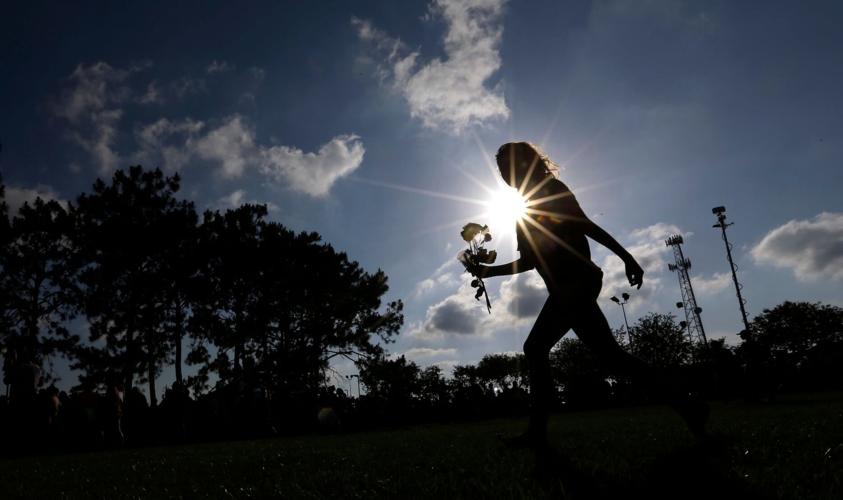


A mourner carries a rose during a prayer vigil for victims of the 2018 mass shooting at Santa Fe High School. David J. Phillip/AP Photo
On May 18, 2018, a teenager at Santa Fe High School in Texas walked into the school armed with his father’s guns and opened fire, killing eight students and two teachers. Evidence later showed the teen had been experiencing a severe and spiraling mental health crisis leading up to the attack.
But Texas had no mechanism that would have allowed law enforcement or anyone else to petition a court to temporarily remove firearms from the home. Last year, the state made sure it never would: Lawmakers banned extreme risk protection orders, which allow police and families to ask judges to temporarily remove guns from dangerous people.
Christina Delgado, a Santa Fe resident who became a gun reform advocate after the shooting, told state lawmakers the attack might have been prevented with the kind of legal remedy the bill sought to ban. “Had timely and appropriate intervention and support been provided to that family, a different outcome may have been achieved,” she told a Texas Senate committee considering the bill.
They still passed the measure. And Texas is not alone. A growing number of states are outlawing the orders meant to quickly — and temporarily — take guns from people at imminent risk of hurting themselves or others.
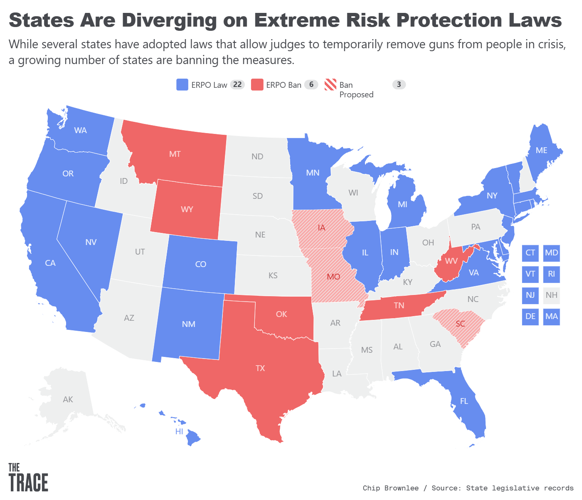
ERPO laws, also known as red flag laws, once enjoyed support from across the political spectrum, including from President Donald Trump and the National Rifle Association, which in 2018 advocated federal funding to help states implement the measures. Now, six states have prohibited enforcing the orders — and in some cases, prescribed fines or criminal charges for officials who try. Three other states are considering similar bans in 2026.

Researchers and advocates warn the trend could leave courts, police, and families navigating a patchwork of conflicting rules. It could also undermine a tool widely credited with preventing suicides, which make up the majority of U.S. gun deaths.
“We’re very concerned about the trajectory of anti-ERPO laws, both in the rise in the number of states passing these laws and the escalations within the laws themselves,” said Emily Walsh, a law and policy adviser at the Johns Hopkins Center for Gun Violence Solutions.
From symbolic to punitive
ERPOs grew in popularity after the 2018 Parkland school shooting, and 22 states now allow courts to issue them. Oklahoma became the first state to ban the orders in 2020. The measure prohibits cities and counties from enacting ERPOs or accepting funding to carry them out. West Virginia and Tennessee followed. These bans lacked significant penalties for violations and were largely symbolic, as no localities in these states had ever enacted ERPOs.
But a newer wave of legislation takes a more aggressive approach. Bans passed by Montana and Texas in 2025 and by Wyoming in 2026 impose consequences on officials who enforce ERPOs, including those issued by other states. In Montana, the state can fine local governments up to $10,000 per violation. In Wyoming, running afoul of the ban can earn someone as much as a year in prison, a $2,000 fine, or both. Texas’ ban goes furthest: It makes enforcing or serving an ERPO a felony punishable by up to two years in prison.
Nicole Golden, a Texas gun reform advocate, said the bans mirror other policy fights she has watched unfold. She fears Texas’ ban is inspiring other states to adopt similar proposals. “This is just the way this goes,” she said. “Sometimes Texas is the petri dish for these really extreme tactics.”
The proposed ERPO bans pending in at least three other statehouses suggest the trend is accelerating. Proposals in Iowa and Missouri prescribe $50,000 fines for violations. South Carolina’s bill, dubbed the Ban Against Red Flag Gun Confiscation Act, would make enforcement a felony. The sponsors of those measures did not respond to requests for comment.
Due process protections
While ERPOs once enjoyed bipartisan support as a way to keep guns from people in crisis without broadly restricting gun access, over time, positions have polarized. Today, gun rights advocates and Republicans argue that banning ERPOs protects gun owners from firearm confiscation without due process.
But ERPO laws do include protections. Orders require approval by a judge, sworn evidence, and a prompt court hearing. People subject to an order receive notice, can contest the allegations, and can typically ask a judge to end the order early. Most laws also guarantee the return of firearms when an order expires. To prevent abuse, many states punish people who lie in their petition or misuse the process.
Still, opponents say those safeguards fall short. “This is a situation where a law-abiding Texan, based on a random report or complaint, can be deprived of their constitutional rights without due process,” Texas State Senator Bryan Hughes, a Republican who sponsored the state’s ban, told colleagues during a committee hearing last year.
At the same hearing, Kyle Rittenhouse, a representative of a group called Texas Gun Rights, also testified in support of the ban. Rittenhouse — wearing a pin in the shape of an assault-style rifle on his lapel — portrayed ERPOs as a means to “weaponize” false accusations. In 2020, during racial justice protests in Kenosha, Wisconsin, he shot three people, killing two. A jury acquitted him of homicide, but he still faces lawsuits for negligence and wrongful death brought by the man he wounded and the family of 26-year-old Anthony Huber, one of the two men Rittenhouse killed.
Cross-border disputes
Five of the six states that ban ERPOs border at least one state that allows them, increasing the chances of cross-border disputes over how those orders are enforced.
For example, if a New Mexico court issues an ERPO against a person who lives in or moves next door to Texas, the police there could face felony charges for attempting to enforce it. “Maybe now they’re here in Texas accessing firearms. Maybe they’re going to take that gun back and hurt someone. Maybe they’re going to try to take their own life,” said Golden, the Texas Gun Sense director. “Police can’t help them; no one can help them.”
The order would prevent the person from buying a gun if they underwent a background check. But Texas, like the other anti-ERPO states, does not require background checks on all gun sales.
In most states with ERPOs, there are two main types: emergency and final orders. Judges can issue emergency orders without both parties being present, but they last just days or weeks before a hearing on a final order is required. Final orders usually last a year.
Walsh, the Johns Hopkins expert, said people in states that allow ERPOs may be unable to obtain a final order against someone in a state that bans them because authorities cannot serve the subject with the legally required notice.
Suicides
ERPOs are often passed in response to mass shootings, as a way to prevent future tragedies. Some small studies and case reviews suggest the orders have thwarted mass violence. But a growing body of research shows the orders are most effective at reducing gun suicide.
Every state that bans ERPOs had a gun suicide rate higher than the national average in 2024, according to the latest available data from the Centers for Disease Control and Prevention. Wyoming had the highest rate in the country.
In Texas, Ayaan Moledina, a 15-year-old student advocate, called on lawmakers to block the ban and to consider enacting an ERPO law instead. He told the committee he had attempted to take his own life on multiple occasions.
“I am alive today because I did not have access to a firearm,” Moledina said. “I firmly believe that if I had been able to use a gun, I would not be sitting here before you today.”



(0) comments
Welcome to the discussion.
Log In
Keep it Clean. Please avoid obscene, vulgar, lewd, racist or sexually-oriented language.
PLEASE TURN OFF YOUR CAPS LOCK.
Don't Threaten. Threats of harming another person will not be tolerated.
Be Truthful. Don't knowingly lie about anyone or anything.
Be Nice. No racism, sexism or any sort of -ism that is degrading to another person.
Be Proactive. Use the 'Report' link on each comment to let us know of abusive posts.
Share with Us. We'd love to hear eyewitness accounts, the history behind an article.