
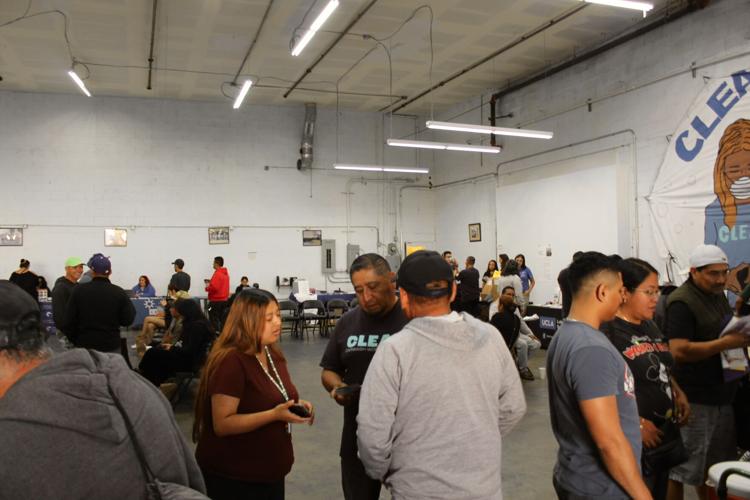
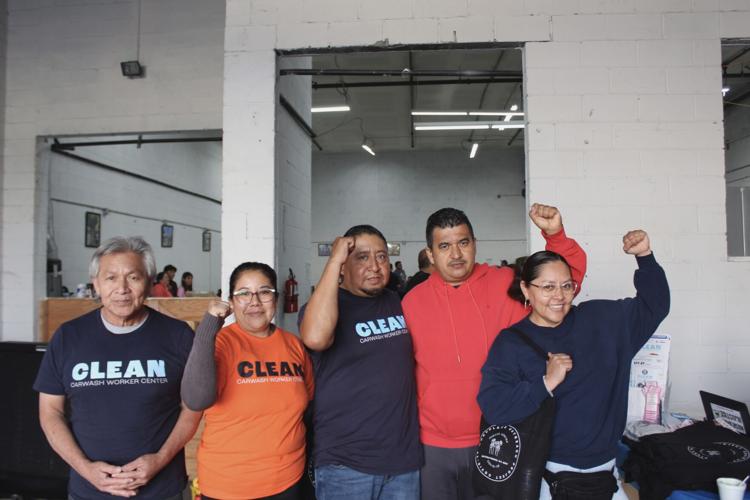
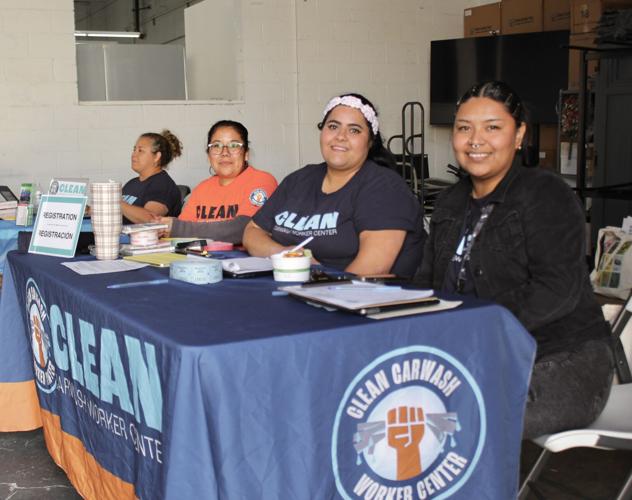


Last week, the CLEAN Carwash Worker Center hosted a “Día de Bienestar,” or wellness day, in South Central L.A. Photo by Brenda Verano
In Los Angeles County, one of the most car-dependent places in the world, there are about 10,000 car wash workers, many of whom are undocumented Latinos or part of mixed-status households.
Despite the hundreds of car wash locations throughout the county, the industry continues to be part of the underground economy, making it prone to wage theft and violations of basic labor, health and safety laws.
In documented incidents, car wash workers have reported unpaid overtime, denial of meal and rest breaks and failure to provide essential safety gear for chemical-heavy work from employers.
Last week, the CLEAN Carwash Worker Center, the nation's first worker center, founded in 2007 and dedicated to improving the rights of immigrant and low-wage workers, hosted a “Día de Bienestar,” or wellness day, in South Central L.A.
The event was organized to bring health, economic, immigration and social services to not only car wash workers but also Angelenos working in garmentry, gardening, construction or other physically intensive jobs.
The event featured free immigration consultations, worker rights workshops, STI testing, respiratory testing and vaccines.

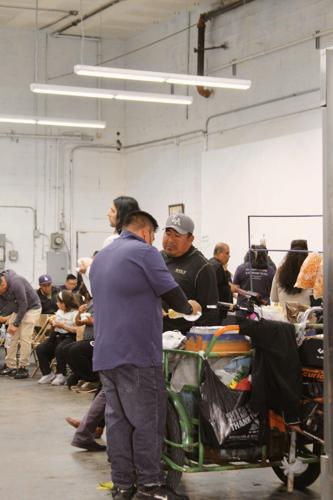
Inside the CLEAN Carwash Worker Center wellness day, in South Central L.A. Photo by Brenda Verano
Carmen Gutiérrez, an organizer with the CLEAN Car Wash Worker Center, said the purpose behind the event was to focus on the holistic health of workers.
“There are so many aspects of health, physical and mental health, but also the well-being and safety within their jobs are important,” she said. “We invited organizations to focus on the different aspects of wellness and invited workers to come in and connect workers with resources that they would not otherwise be able to access because of time or proximity.”
Some of the partners tabling at the event included the Los Angeles Public Library, which distributed library cards, showing workers the free amenities and resources they can have access to with their card. The L.A. Public Health Department administered free STI and HIV testing, as well as COVID-19, flu and hepatitis vaccines. Also present were representatives from Carecen, Mujeres en Accion and the L.A. County Office of Immigrant Affairs, offering immigrant rights consultation and resources.
Organizers with Mujeres en Acción said that with the increasing ICE raids, there have been more cases of employers violating workers' rights. Jocelyn, an outreach coordinator with Mujeres en Acción, said many workers are unaware they are being victims of labor rights violations in real time.
“Today we are here to offer resources for workers to know their labor rights in case they have any questions on any labor violations they have been through,” she said. “Workers are welcome to do a consultation with us so that we can give them more information about their choices because they all have rights, regardless of their immigration status.”

Participants of the CLEAN Carwash Worker Center wellness day, in South Central L.A. Photo by Brenda Verano
Gutiérrez said that more than a space to obtain resources, La Bodega, the name of where the event was held, is also a space to foster community within car wash workers, especially in a time when they have been one of the most targeted groups by the recent ICE raids, which began almost a year ago in L.A.
“It's really just a space for car washers to be able to come and bond with each other, many of whom are going through the same issues or that are a part of the same industry,” she said. “This last year was a very impactful year for the car wash industry and so we wanted to really make sure that this year our members were able to take advantage of free resources.”
The CLEAN Car Wash Worker Center has pivoted its organizing effort to protecting many of its members. In the last few months, as hundreds of car washes have been raided by federal agents, the organization has created community patrols to warn workers of ICE activity.
And although ICE raids have decreased in number, Gutiérrez said they have left behind alarming effects in the community.
“It was important to host a couple of workshops that focus on mental health and show our communities that we come with tools and a culture of resilience. Carwashers are stronger than yesterday and although this was a really rough year for the car wash industry, look at us. We are here in the community, holding space for each other,” Gutiérrez said.
In 2022, the Labor Commissioner’s Office cited Shine N Brite Car Wash $908,998 for wage theft violations affecting 15 workers.
At that time, the Los Angeles-based employer was cited for minimum wage, overtime and rest break violations. As stated by the commissioner’s office, an investigation found that workers, who worked 8- to 10-hour days, were paid a flat daily rate as low as $70.
Workers who complained to the employer regarding wage theft and safety issues faced retaliation, including dismissal or reduced hours.
The investigation was brought forward after a referral from the CLEAN Car Wash Worker Center. Like this, there are many unreported cases of employers using different schemes to avoid paying legal wages, such as paying flat daily rates and paying workers in cash.

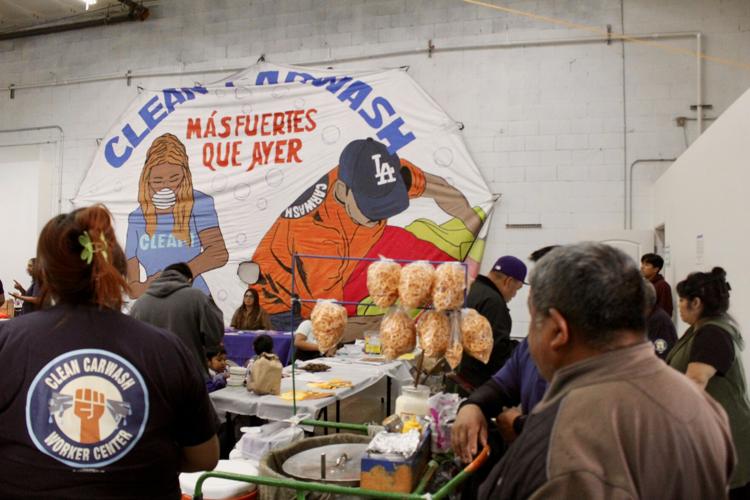
Food was provided at the event. Photo by Brenda Verano
Alejandro Gámez, a worker who has been part of the organization for more than three years, said he attended the wellness event because he heard they were going to offer free mental health workshops, immigration screenings and vision exams, things he said he needed but would be too expensive to get outside of today’s event.
“As a worker, it is important to stay informed of our rights, because one never knows. There could be a list of things that we are not aware of,” he said.
Another worker, Mateo, who was accompanied by his wife and two children, said he saw a flyer of the event in the streets and decided to come after work.
He told CALÓ News the event reminded him of the way food is incorporated in familial and community spaces in Mexico and South America.
“When an event offers food, of course, it incentivizes you. I always jokingly tell my wife, ‘you will find me where there is food,’ but it's not only about eating; there is so much information here that if we do not go out, we would not know about it and it's very important,” he said.
He said spending time with his family in community events like the one hosted last week is what brings him joy and a sense of safety. “To all the workers in the U.S., especially Latinos, hay que echarle ganas,” he said. “I know times are hard right now and that many people still can't come out to work or they have lost their job, and maybe they are going through a very hard time with their families economically. We have to persevere and get ahead and succeed.”
As previously reported by CALÓ News, over the past five years, Latinos have had the biggest rise in new human immunodeficiency virus (HIV) cases and are72% more likely than the overall U.S. population to be diagnosed with HIV.

Carmen Gutiérrez, an organizer with the CLEAN Car Wash Worker Center (center) with colleagues. Photo by Brenad Verano
The Latino community is already disproportionately impacted by HIV, accounting for 32% of new HIV diagnoses in the U.S., despite only making up19% of the population. In L.A. County, the rise in HIV testing has also been an alarming problem.
“That’s why we are here today at this event,” said Michelle Jaramillo, with the L.A. County Public Health Department. “We go all over L.A. in our van, offering HIV and STI testing for free. We let people know of their result in five days, and if there is a need for follow-up, we give people free medications and connect them with health professionals who will be in charge of their treatment,” she said.
Walter, also with the L.A. County Public Health Department, said their targeted audience is Latino men. “We're predominantly seeing a rise in HIV cases in L.A. County among Latino men between like 25 and 40 years old. That's why we're here. We're hoping to test more Latino men who probably have more than one sexual partner and try to identify positive cases or just lead people to resources if they need them.”
Walter said that STI testing is still stigmatized among the Latino community and in physically demanding workforces, this is no different. “Among our Latino community, there's a lot of stigma still around HIV, STDs and sex. We're here hoping to destigmatize and also make sexual health education a little more accessible and easier to talk about,” he said.
Wednesday's event hosted more than 50 car wash workers and their families. Today the CLEAN Carwash Worker Center members led the creation of the first car wash worker co-op, CleanWash Mobile, LLC. Although COVID-19 significantly delayed the opening of CleanWash Mobile LLC, the co-op remains active and its development is supported through the incubation of the CLEAN Carwash Worker Center.
Organizers said that although the ICE raids have impeded a lot of their work, they continue to protect the car wash workers in L.A. by responding to their immediate needs, whether that is through a wage theft workshop or on-the-ground immigration protection.





(0) comments
Welcome to the discussion.
Log In
Keep it Clean. Please avoid obscene, vulgar, lewd, racist or sexually-oriented language.
PLEASE TURN OFF YOUR CAPS LOCK.
Don't Threaten. Threats of harming another person will not be tolerated.
Be Truthful. Don't knowingly lie about anyone or anything.
Be Nice. No racism, sexism or any sort of -ism that is degrading to another person.
Be Proactive. Use the 'Report' link on each comment to let us know of abusive posts.
Share with Us. We'd love to hear eyewitness accounts, the history behind an article.